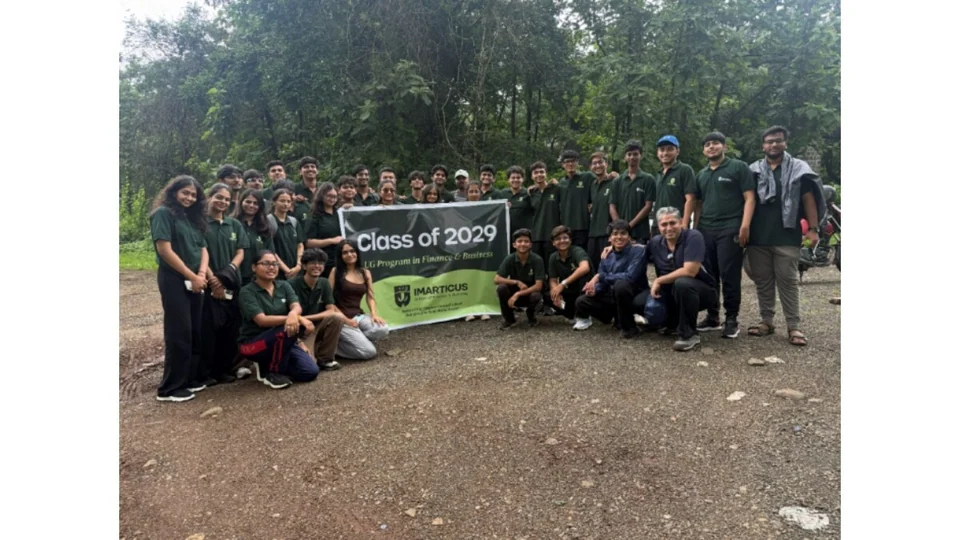
The Imarticus School of Finance & Business (ISFB) has introduced its first undergraduate cohort to college life through a two-week orientation programme designed to connect academic learning with real-world business and finance experiences. The initiative, called ISFB Ignite, combined industry interactions, financial markets education, team challenges, sports, cultural activities and outdoor experiences to help students begin developing professional skills from the start of their undergraduate journey.
The programme reflects ISFB’s approach to undergraduate education, which encourages students to engage with industry professionals and practical business challenges well before their internships or final year. Following the fortnight-long campus experience, students continued their industry exposure at the Global Fintech Fest 2026, where they encountered financial technology companies, investors, regulators and other industry participants.
For the institution’s founding batch, the programme also provided an opportunity to build friendships, develop a shared student culture and begin exploring the professional opportunities available in finance and business.
ISFB Ignite Brings Industry Exposure Into the First Weeks of College
Traditional college orientation programmes typically focus on campus familiarisation, introductions to faculty and academic procedures. ISFB Ignite took a broader approach, bringing together professional conversations, finance and business learning, collaborative challenges and extracurricular activities over 14 days.
The programme began with an interaction with Ajay Srinivasan, Co-Chair of the ISFB Advisory Council, whose career includes leadership roles at Prudential ICICI AMC, Prudential Fund Management Asia and Aditya Birla Capital.
During the session, Srinivasan discussed the power of compounding and its relevance to both financial decisions and career development. He also highlighted resilience, health, relationships, emotional intelligence, continuous learning and the importance of asking better questions.
He emphasised that habits and relationships developed early in a career can have a lasting influence on professional growth.
“The habits students build, the relationships they develop and the questions they learn to ask early in their careers can compound significantly over time,” said Ajay Srinivasan, Co-Chair of the ISFB Advisory Council.
Students also interacted with Joy Parekh, CEO of ISFB, and Nikhil Barshikar, Chairman of the ISFB Advisory Council. These discussions introduced the founding cohort to the people guiding the institution and its approach to finance and business education.
The early sessions were followed by Cipher, a campus-wide team mystery challenge that required students to interpret clues, coordinate with teammates and solve problems. The activity encouraged collaboration and communication among students who had only recently met.
Finance and Business Leaders Explain Real-World Decision-Making
ISFB Ignite combined introductory professional experiences with sessions led by industry practitioners. The aim was to help students understand how concepts discussed in classrooms apply to financial markets, investment decisions and business strategy.
Rajat Mathur, former Managing Director at Morgan Stanley, conducted a workshop focused on decision-making, risk, uncertainty and ethics. These subjects are particularly relevant to finance professionals, who often need to evaluate incomplete information, assess potential outcomes and make decisions with significant financial implications.
Vikas Khattar, Managing Director and Head of Equity Capital Markets and Financial Sponsors Coverage at Ambit Private Limited, introduced students to the evolution of India’s equity capital markets. His session covered the development of the country’s stockbroking industry, the emergence of the Bombay Stock Exchange and the National Stock Exchange, and the growth of modern financial products and market infrastructure.
The session provided students with a broader understanding of how India’s financial markets have developed and how their institutions support companies, investors and the wider economy.
Students also met Amit Ratanpal, Founder and Managing Director of BLinC Investment Management. The interaction introduced them to the ISFB venture fund of Rs 25 crore and practical questions surrounding startup investing and entrepreneurship.
By engaging with professionals from different parts of the financial ecosystem, students gained early exposure to areas including investment management, equity capital markets, risk assessment and venture investing.
Learning Beyond the Classroom Through Sports and Team Challenges
Alongside industry sessions, the programme included activities designed to encourage teamwork, communication and relationship-building. Students participated in bowling, pickleball, cricket and football, took part in a treasure hunt across Powai, watched movies together and went on a monsoon trek.
These activities were intended to complement formal learning by giving students opportunities to develop interpersonal skills in different settings. Team sports can encourage communication and coordination, while group challenges require participants to share information, divide responsibilities and make decisions under time pressure.
The treasure hunt, for example, required students to work together to interpret clues and reach solutions. Sports activities created opportunities to build trust and respond to setbacks, while the trek encouraged participants to cooperate and look out for one another.
The combination of academic sessions and informal activities also gave students opportunities to apply similar skills in different environments. Discussions about risk, uncertainty and decision-making could be followed by collaborative sporting activities that required quick thinking and teamwork.
The programme also included student club induction, an Onam Sadya, a Freshers’ Party and an interaction with Angel Xpress Foundation focused on education and mentorship. These experiences introduced students to the social, cultural and community-oriented aspects of college life.
ISFB Focuses on Experience-Based Undergraduate Education
According to ISFB, the intention behind Ignite was to give students an experience of the institution rather than simply provide an introduction to its campus and academic structure.
“We wanted the students to experience ISFB, not just be introduced to it. The idea was to bring together people, conversations and experiences that would give them a sense of what their three years here could look like,” said Joy Parekh, CEO of ISFB.
The programme forms part of the school’s broader approach to undergraduate education, which combines classroom teaching with practical exposure, industry conversations and experiential learning.
The institution’s approach is based on the belief that professional readiness develops through a combination of academic knowledge, practical application, collaboration and reflection. Rather than postponing industry engagement until students approach graduation, ISFB aims to introduce these experiences from the beginning of their academic journey.
Global Fintech Fest 2026 Extends Industry Exposure
The founding cohort’s exposure to the finance industry continued beyond the campus through participation in the Global Fintech Fest 2026, held from September 9 to 11. The event brought students into contact with fintech companies, founders, investors, regulators and financial institutions involved in shaping the future of finance and technology.
Just weeks into their undergraduate studies, students explored the exhibition floor, interacted with professionals and learned about emerging developments across the financial technology sector. They also asked questions and identified potential internship opportunities.
The event provided access to discussions involving prominent industry and policy figures, including Union Finance Minister Nirmala Sitharaman and Reserve Bank of India Governor Sanjay Malhotra, alongside founders and chief executives from financial services and fintech businesses.
For students at the beginning of their undergraduate education, the experience offered a practical view of the people, companies and technologies that influence the financial services industry. It also created opportunities to connect classroom concepts with real businesses, products and industry challenges.
Nikhil Barshikar, Chairman of the ISFB Advisory Council, said early industry exposure could help students develop a clearer understanding of the professional environment and ask more informed questions.
“We cannot expect students to understand the industry simply by reading about it. Early exposure gives them context. It makes them curious, helps them ask better questions and gives classroom learning a reference point,” Barshikar said.
R.E.A.L. Pedagogy Connects Reflection With Practical Learning
ISFB Ignite is part of the institution’s broader R.E.A.L. pedagogy, which stands for Reflect, Experience, Apply and Learn. The approach is designed to complement classroom teaching with experiences that encourage students to connect theoretical knowledge with practical situations.
Under this model, students are encouraged to reflect on what they encounter, gain experience through activities and industry interactions, apply their learning to relevant situations and use the outcomes to strengthen their understanding.
The programme does not suggest that a two-week orientation or a three-day industry event can make students fully industry-ready. Instead, the objective is to begin building professional awareness, curiosity and practical skills early in their academic careers.
Students can meet experienced investment professionals before completing their first semester, discuss startup investing with practitioners, learn about the evolution of India’s capital markets and observe fintech companies in action. At the same time, they can develop friendships, participate in sports and become involved in campus communities.
This combination of professional exposure and student life is intended to create a more integrated undergraduate experience, where learning extends beyond formal lectures without replacing the importance of academic foundations.
Founding Students Help Shape ISFB’s Campus Culture
As the institution’s inaugural undergraduate cohort, ISFB students have an additional responsibility: helping establish the traditions, relationships and student culture that future batches may inherit.
The activities during Ignite provided opportunities for students to connect with one another while learning about the institution’s expectations and approach to education. The mix of industry interactions, team challenges, cultural celebrations and community engagement helped introduce students to different dimensions of campus life.
For the founding cohort, these early experiences may also influence how student communities, clubs and collaborative activities develop as the institution grows.
Reflecting on the experience, Shikha Runwal, a student from ISFB’s founding batch, said the programme exceeded her expectations and increased her interest in finance.
“I thought Ignite would be just another college orientation with a catchy name, but it lived up to its name in every sense. Meeting and learning from preeminent visionaries and understanding current finance and fintech trends through GFF and guest lectures sparked a genuine passion for finance. It made me even more enthusiastic and curious to learn,” Runwal said.
About the Imarticus School of Finance & Business
The Imarticus School of Finance & Business (ISFB) is a finance-focused educational institution established to help bridge the gap between academic learning and industry readiness. Built on the legacy of Imarticus Learning, the institution says its parent organisation has trained more than 10 lakh learners and placed over 50,000 professionals in Fortune 500 companies.
ISFB offers bachelor’s and postgraduate programmes that combine academic learning with industry exposure, practitioner-led mentorship and applied experiences. Its areas of specialisation include investment banking, fintech, digital finance and global accounting, with programmes integrating CFA and ACCA pathways.
The school’s R.E.A.L. pedagogy Reflect, Experience, Apply and Learn is designed to encourage students to connect finance concepts with practical situations. ISFB also identifies partnerships with organisations including Ambit, Motilal Oswal and Cognizant as part of its industry engagement approach.
Through its academic programmes, industry interactions and experiential learning initiatives, ISFB aims to prepare students for careers in finance and business by introducing professional contexts and practical learning opportunities during their undergraduate education.
For breaking news and live news updates, like us on Facebook or follow us on Twitter and Instagram. Read more on Latest Business on thefoxdaily.com.





COMMENTS 0