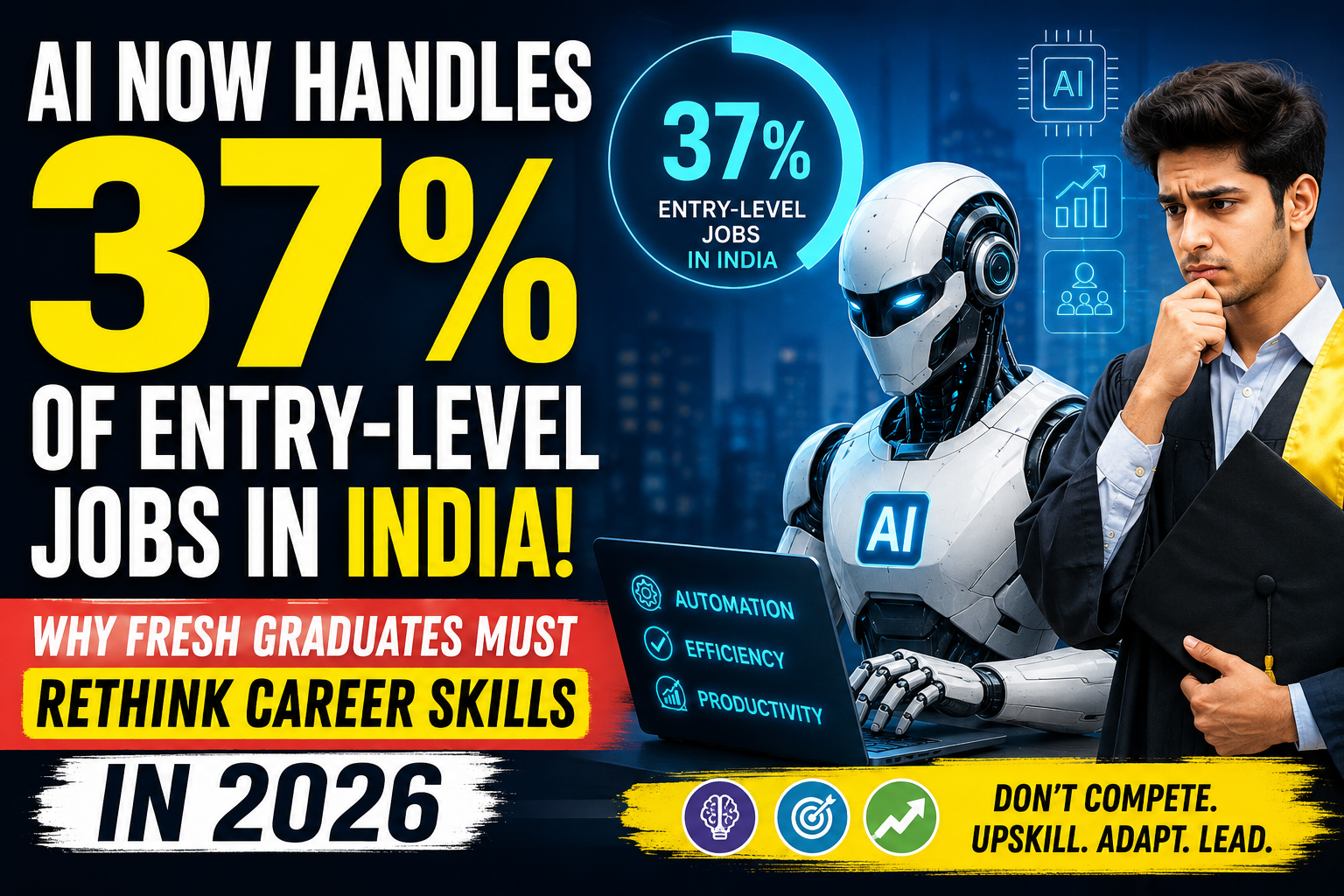
Artificial Intelligence is no longer a future disruption—it is already reshaping India’s job market at an unprecedented pace.
According to the latest “AI Workforce Pulse” report by cognizant and Pearson, 37% of entry-level work in India is now being handled by AI systems, surpassing the global average of 33%.
The findings underscore a major shift in how businesses operate, recruit, and train talent. For students, fresh graduates, and educational institutions, the message is clear: traditional Career pathways are evolving rapidly, and adaptability has become a critical professional skill.
Based on responses from 750 HR leaders across India, the United States, and the United Kingdom, the report highlights how AI is transforming entry-level roles from task execution to oversight, decision-making, and human-centered problem-solving.
What Does It Mean That AI Handles 37% of Entry-Level Work?
The statistic does not necessarily mean that 37% of jobs have disappeared. Instead, it indicates that AI tools are increasingly automating routine, repetitive, and time-consuming tasks that were traditionally assigned to entry-level employees.
These tasks include data entry, scheduling, report generation, customer support responses, content summarisation, document analysis, and basic research.
As automation takes over these functions, entry-level professionals are expected to focus on higher-value responsibilities such as critical thinking, relationship building, creative problem-solving, and strategic decision-making.
This transition represents a fundamental redesign of entry-level work rather than a simple reduction in employment opportunities.
India Is Leading the Global Shift Toward AI Adoption
India’s 37% AI integration rate in entry-level work exceeds the global average of 33%, reflecting the country’s rapid digital transformation and expanding technology ecosystem.
Several factors are driving this accelerated adoption:
- A large and digitally connected workforce
- Strong investment in AI infrastructure and innovation
- Growing demand for productivity and operational efficiency
- Widespread availability of cloud-based AI tools
- A competitive business environment focused on cost optimisation
For employers, AI offers opportunities to streamline workflows and improve efficiency. For employees, however, it raises an important question: what skills will remain valuable in an AI-powered workplace?
Key Findings from the AI Workforce Pulse Report
| Metric | Key Finding |
|---|---|
| Entry-level work handled by AI in India | 37% |
| Global average of AI-handled entry-level work | 33% |
| HR leaders who believe AI handles half or more of fresher tasks | 18% |
| Companies that say AI reduces repetitive work | 80% |
| HR leaders expecting entry-level roles to transform within five years | 96% |
| HR professionals who consider AI literacy essential | 98% |
| Experts expecting new AI-driven roles to emerge | 94% |
| Employers prioritising soft skills | 97% |
| Employees requesting AI training | 91% |
| Companies facing AI talent shortages | 61% |
Entry-Level Roles Are Being Redefined, Not Eliminated
For decades, entry-level jobs served as a training ground where graduates learned foundational skills through routine tasks. AI is now taking over many of these responsibilities.
As a result, the next generation of professionals will need to supervise AI systems rather than compete with them.
Future entry-level employees will increasingly be expected to:
- Evaluate and validate AI-generated outputs
- Identify biases or inaccuracies in automated systems
- Interpret data-driven insights
- Collaborate effectively with AI tools
- Apply ethical and human judgment to business decisions
The workplace of the future will reward professionals who know how to ask the right questions, assess AI recommendations, and make informed decisions.
AI Literacy Is Becoming a Universal Workplace Skill
One of the report’s most significant findings is that AI fluency is no longer limited to technical careers.
Nearly 98% of HR leaders believe AI literacy will become essential across non-technical fields, including:
- Marketing
- Sales
- Human resources
- Legal services
- Operations
- Finance
- Customer support
Professionals who understand how to use AI tools effectively—regardless of their industry—will likely enjoy a competitive advantage in the job market.
Just as digital skills became mandatory over the past two decades, AI literacy is quickly becoming a baseline expectation.
Human Skills Are Becoming More Valuable, Not Less
Paradoxically, as AI capabilities expand, uniquely human skills are becoming even more important.
The report found that 97% of employers now place increasing value on soft skills such as:
- Critical thinking
- Problem-solving
- Communication
- Collaboration
- Creativity
- Empathy
- Adaptability
These capabilities remain difficult for AI systems to replicate and will play a crucial role in helping professionals succeed alongside technology.
Technical knowledge alone is no longer enough. The future workforce will need a balanced combination of AI expertise and human-centered skills.
Why Liberal Arts and Multidisciplinary Education Are Gaining Importance
The report challenges the assumption that only engineering and computer science graduates will benefit from the AI revolution.
Nearly 67% of HR leaders said they are increasingly valuing candidates with liberal arts and humanities backgrounds.
Additionally, 65% believe multidisciplinary education offers a stronger foundation than deep specialization in a single field.
Professionals who can combine technical understanding with communication, ethics, business knowledge, and creativity are expected to thrive in AI-driven workplaces.
This marks a significant shift in hiring priorities, encouraging educational institutions to rethink traditional curricula.
The Growing AI Skills Gap
Despite rapid AI adoption, organizations are struggling to prepare their workforce for change.
While 91% of employees have requested AI training, 63% of corporate learning and development programs are failing to keep pace with evolving demands.
The result is a widening skills gap.
More than six in ten companies report difficulties finding candidates with the right combination of AI knowledge and workplace skills.
This disconnect presents both a challenge and an opportunity: professionals who proactively upskill can position themselves ahead of the curve.
How Students and Fresh Graduates Can Prepare for an AI-Driven Future
Students entering the workforce in 2026 and beyond should focus on building adaptable skill sets rather than preparing for a single job description.
- Develop practical AI literacy through hands-on experience.
- Learn prompt engineering and AI-assisted workflows.
- Strengthen communication and collaboration skills.
- Build expertise in data analysis and digital tools.
- Stay updated on emerging technologies and industry trends.
- Create a portfolio showcasing real-world projects.
- Embrace continuous learning and reskilling.
The professionals most likely to succeed will not be those who avoid AI, but those who learn how to work effectively alongside it.
Conclusion
The finding that AI now handles 37% of entry-level work in India signals a pivotal moment for the country’s workforce.
While concerns about job displacement remain valid, the bigger story is one of transformation rather than replacement.
AI is changing the nature of entry-level roles, creating demand for new skills, new responsibilities, and entirely new career paths.
For students, educators, employers, and policymakers, the challenge is no longer whether AI will impact jobs—it already has.
The real question is how quickly individuals and institutions can adapt.
In the age of artificial intelligence, the most valuable career skill may no longer be technical expertise alone, but the ability to learn, evolve, and combine human judgment with machine intelligence.
For breaking news and live news updates, like us on Facebook or follow us on Twitter and Instagram. Read more on Latest Careers on thefoxdaily.com.






COMMENTS 0