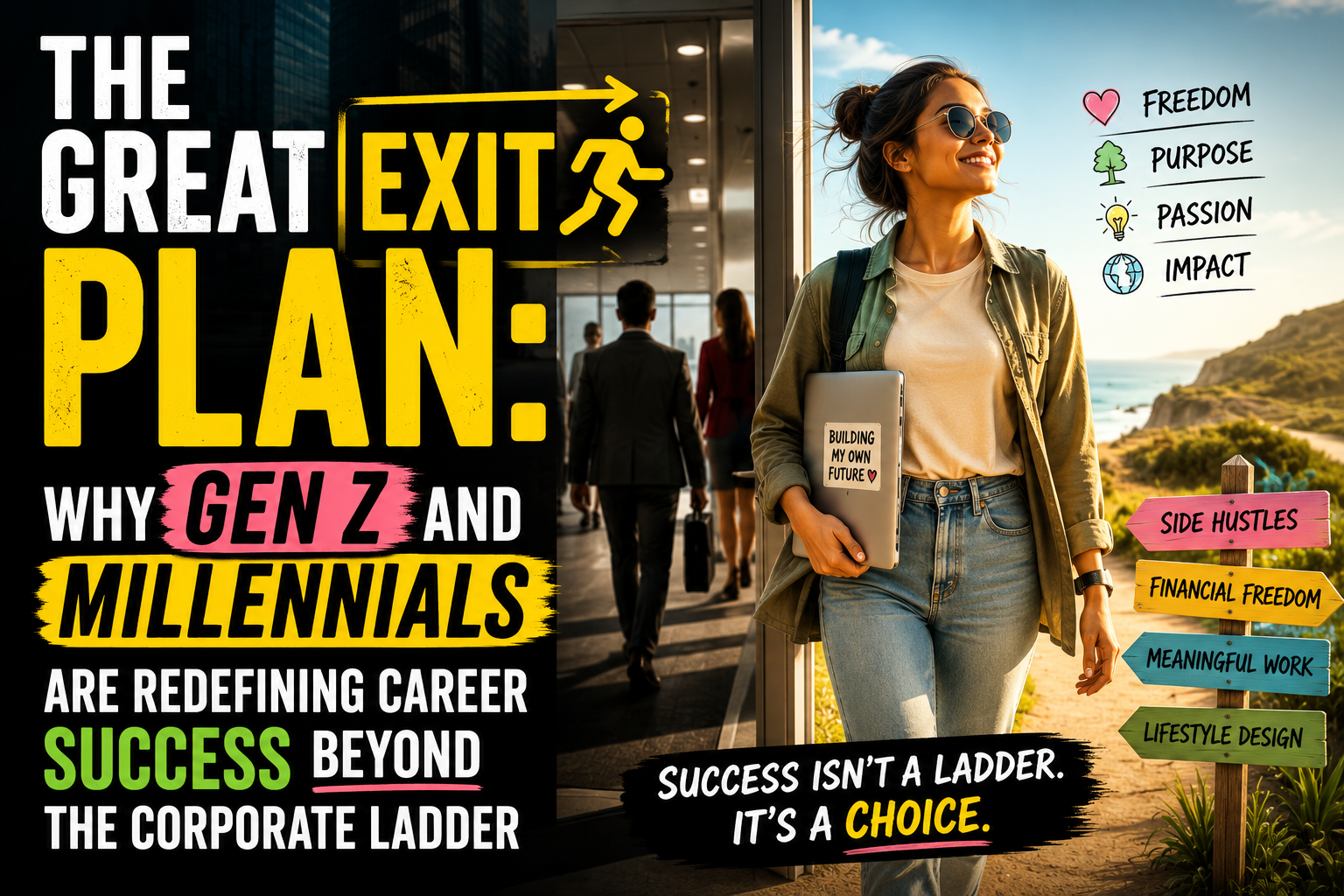
For decades, career success followed a familiar script: earn a degree, secure a stable job, climb the corporate ladder, and eventually reach a leadership position.
For many Gen Z and Millennial professionals, that script no longer feels relevant.
Instead of focusing exclusively on promotions, titles, and long-term loyalty to a single employer, younger workers are creating what many call a “great exit plan”—a deliberate strategy designed to provide greater flexibility, financial security, and personal fulfilment beyond traditional employment.
This shift does not necessarily mean employees want to quit their jobs tomorrow. Rather, it reflects a growing desire to gain more control over how they work, where they work, and ultimately, why they work.
As economic uncertainty, burnout, layoffs, and rapid technological change reshape the modern workplace, career ambition is evolving. Success is no longer defined solely by reaching the corner office; increasingly, it is measured by autonomy, balance, and the freedom to choose what comes next.
What Is the Great Exit Plan?
The great exit plan refers to a growing movement among Gen Z and Millennials to build alternatives to traditional full-time employment.
These alternatives can include:
- Developing side hustles and freelance businesses.
- Building multiple income streams.
- Investing for long-term financial independence.
- Creating portfolio careers across different industries.
- Learning future-ready skills to remain adaptable.
- Planning lifestyle changes that prioritise well-being.
For some, the goal is to leave corporate life entirely. For others, it is about creating enough financial security to have options when career priorities change.
At its core, the great exit plan is not about escaping work. It is about escaping dependence on a single source of income.
Today’s professionals are not rejecting ambition; they are redefining it.
Why Gen Z and Millennials No Longer See Corporate Careers the Same Way
Younger generations entered the workforce during periods of extraordinary disruption.
They experienced the aftermath of economic slowdowns, witnessed widespread layoffs during and after the pandemic, and have seen industries transformed by automation and artificial intelligence.
These experiences have fundamentally altered their relationship with work.
Many professionals no longer believe that one employer, one degree, or one career path can guarantee long-term stability.
Instead, adaptability has become the new form of job security.
| Traditional Career Model | Modern Career Mindset |
|---|---|
| Stay with one employer long term | Build transferable skills and networks |
| Prioritise promotions and titles | Prioritise flexibility and purpose |
| Rely on a single income source | Create multiple income streams |
| Measure success through status | Measure success through freedom |
| Climb the corporate ladder | Design a personalised career path |
The result is a generation that values optionality as much as opportunity.
Burnout Is Reshaping Career Priorities
Burnout has emerged as one of the most significant factors driving the shift away from traditional career ambitions.
Long working hours, always-on digital communication, and the pressure to constantly perform have blurred the boundaries between professional and personal life.
Many younger workers watched previous generations sacrifice health, relationships, and personal goals in pursuit of career advancement—often without the promised rewards of stability or satisfaction.
As a result, they are asking different questions.
Instead of asking, “How quickly can I get promoted?” they are increasingly asking:
- Will this role support my mental well-being?
- Can I maintain a healthy work-life balance?
- Does this job align with my values?
- Will this career give me more freedom in the future?
These questions are reshaping how organisations attract and retain talent.
Why Side Hustles Are Becoming Essential
One of the clearest signs of the great exit plan is the rise of side hustles.
Freelancing, content creation, consulting, tutoring, e-commerce, and digital businesses are no longer viewed as hobbies or extra income sources. For many professionals, they represent strategic investments in future independence.
Multiple income streams offer several advantages:
- Reduced dependence on a single employer.
- Greater financial resilience during economic uncertainty.
- Opportunities to explore personal interests.
- Additional skill development.
- Potential pathways to entrepreneurship.
The digital economy has made launching a side business easier than ever. Professionals can now monetise expertise, build audiences, and create products with minimal upfront investment.
For many Gen Z and Millennial workers, side hustles are not temporary solutions—they are long-term career strategies.
The Rise of Portfolio Careers
The traditional concept of having one job, one title, and one career path is giving way to portfolio careers.
A portfolio career involves combining multiple professional roles simultaneously, often across different industries or disciplines.
A marketing professional may also teach online courses. A software engineer might consult for startups while creating digital content. A designer could balance freelance work with a part-time corporate role.
This approach offers greater flexibility and allows professionals to diversify their income while reducing career risk.
Portfolio careers also reflect a broader shift in how people define professional identity.
Rather than being known by a single job title, individuals increasingly see themselves as collections of skills, experiences, and interests.
Financial Independence Is the New Career Goal
Conversations among younger professionals are increasingly centred around investing, budgeting, passive income, and long-term wealth building.
The goal is not necessarily early retirement. Instead, it is achieving enough financial independence to make choices without being constrained by immediate income needs.
Financial freedom creates options:
- Taking a career break without financial stress.
- Starting a business.
- Pursuing creative projects.
- Relocating to a different city or lifestyle.
- Choosing meaningful work over higher salaries.
This mindset has fuelled growing interest in personal finance education, investment strategies, and income diversification.
For many professionals, wealth is no longer viewed as a symbol of status but as a tool for creating flexibility.
How Artificial Intelligence Is Accelerating the Shift
The rapid advancement of artificial intelligence has intensified concerns about job security across industries.
While AI is expected to create new opportunities, it is also changing the nature of work faster than many professionals anticipated.
As routine tasks become increasingly automated, workers recognise the importance of continuously updating their skills.
Learning agility, digital literacy, and adaptability are emerging as critical career assets.
The great exit plan is partly a response to this uncertainty. By building multiple skills and income sources, professionals reduce their dependence on any single role or industry.
What Employers Need to Understand
The shift in employee priorities does not mean younger workers lack ambition.
It means their definition of ambition has changed.
Organisations that continue to rely solely on promotions, compensation, and traditional career paths may struggle to retain top talent.
Today’s workforce increasingly values:
- Flexible work arrangements.
- Meaningful career development opportunities.
- Support for mental well-being.
- Transparent communication.
- Purpose-driven work.
- Respect for personal time.
Companies that adapt to these expectations will be better positioned to attract and retain future talent.
The Future of Work Is About Choice
The great exit plan is not a rejection of work itself. It is a rejection of outdated assumptions about what work should look like.
Gen Z and Millennials are building careers that prioritise freedom, flexibility, and personal fulfilment alongside financial security.
They are not abandoning ambition—they are expanding its definition.
The next generation of successful professionals may not be those with the most impressive titles but those who have the greatest ability to design lives aligned with their values.
Conclusion
As burnout, economic uncertainty, and technological disruption continue to reshape the workplace, Gen Z and Millennials are rethinking what career success truly means.
Instead of chasing promotions at any cost, they are building side hustles, developing new skills, diversifying income streams, and investing in financial independence.
The great exit plan reflects a simple but powerful idea: work should support life, not consume it.
For employers, this shift offers both a challenge and an opportunity. The organisations that recognise evolving employee expectations and embrace flexibility will be best equipped for the future of work.
For individuals, the message is equally clear: the most valuable career asset in 2026 is not a job title—it is the ability to create choices.
For breaking news and live news updates, like us on Facebook or follow us on Twitter and Instagram. Read more on Latest Careers on thefoxdaily.com.


COMMENTS 0