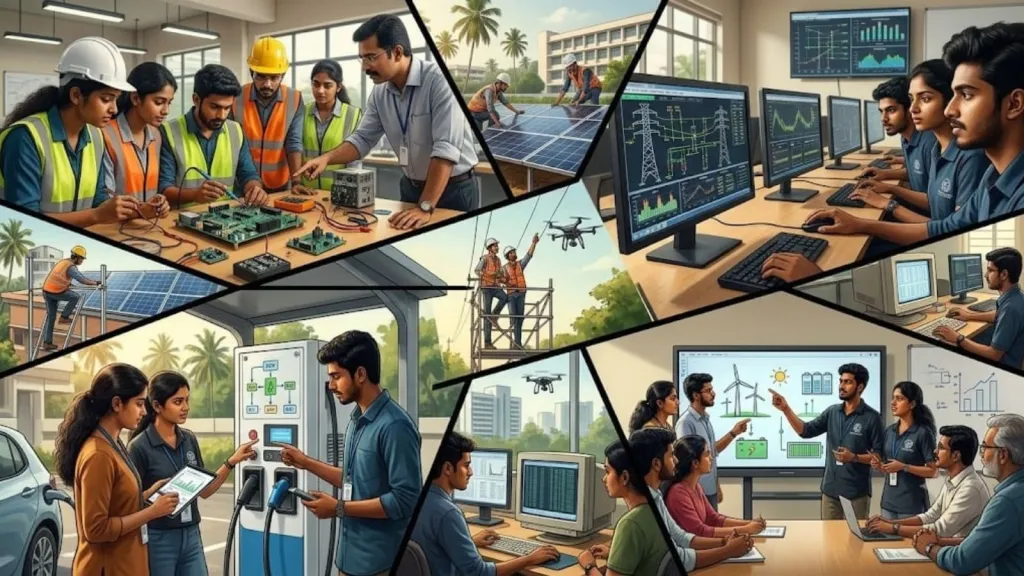
The Keralam State Electricity Regulatory Commission has invited expressions of interest from engineering colleges across the state to establish research partnerships aimed at addressing challenges in the power sector. The initiative seeks to draw on the expertise of faculty members and researchers at higher education institutions to support the commission’s work and encourage innovation in electricity-related fields.
The proposed partnerships will cover a broad range of subjects, including Renewable Energy, electricity transmission and storage, artificial intelligence, data analytics, electricity markets, electric vehicles and consumer protection. Institutions will also be able to suggest innovative research topics beyond the areas specifically identified by the commission.
According to an official statement, the selection process will take place in two stages. Colleges will first be assessed on their research infrastructure and experience before being empanelled. Those selected will then be invited to submit detailed proposals for specific projects identified by the commission or developed from ideas put forward by the institutions themselves.
Two-Stage Selection Process for Engineering Colleges
The commission has designed a two-stage process to identify institutions capable of undertaking research relevant to the electricity sector.
In the first stage, engineering colleges will be evaluated on the strength of their research infrastructure and their previous experience. Institutions that meet the requirements will be empanelled for potential research partnerships.
Colleges will not need to submit detailed project proposals during this initial assessment. Instead, the first stage will focus on determining their research capabilities and suitability for collaboration with the commission.
In the second stage, empanelled institutions will be invited to submit detailed proposals for individual research projects. These projects may originate from the commission’s identified requirements or from innovative ideas proposed by the colleges themselves.
The approach allows the commission to assess institutional capabilities before considering specific research plans. It also creates an opportunity for colleges to contribute their own ideas to address challenges in the power sector.
Research Proposals to Be Evaluated on Technical Merit and Relevance
Proposals submitted during the second stage will be evaluated against several criteria, including technical merit, relevance to the commission’s requirements, expected outcomes and project timelines.
Technical merit will be one consideration in determining the suitability of a proposed project, while its relevance to the commission’s needs will help establish its practical value. The expected outcomes and proposed timelines will also form part of the evaluation.
The criteria indicate that the commission intends to assess both the quality of the research and its potential contribution to the electricity sector. However, the official statement provided does not specify a scoring system, application deadlines, the number of institutions to be empanelled or the number of projects expected to receive approval.
Renewable Energy, AI and Energy Storage Among Priority Areas
The commission has identified several areas of interest for potential research partnerships, reflecting the range of technical, economic and regulatory issues within the power sector.
- Renewable energy: Research related to renewable energy technologies and their role in the electricity sector.
- Energy transmission and storage: Studies addressing electricity transmission systems and energy storage.
- Artificial intelligence and data analytics: Research exploring the use of AI and data-driven methods in power-sector applications.
- Electricity markets and energy economics: Work examining electricity markets and the economic dimensions of energy systems.
- Power system planning and operation: Research concerning the planning and operation of electricity systems.
- Consumer protection: Studies focused on issues affecting electricity consumers.
- Electric vehicles: Research addressing electric vehicles and their relationship with the power sector.
- Demand-side management: Work related to managing electricity demand.
The range of topics allows for research across technical disciplines as well as economic, operational and consumer-related questions. Engineering colleges may be able to contribute through specialised laboratories, faculty expertise and research teams working in relevant fields.
The commission has also left room for institutions to propose other innovative topics connected to the power sector. This provision means that the research programme will not be restricted to the areas listed in the initial invitation.
Colleges Can Propose Their Own Research Ideas
An important feature of the initiative is the opportunity for empanelled colleges to put forward research ideas of their own. Alongside projects suggested by the commission, institutions will be able to submit proposals addressing other relevant challenges in electricity and energy.
This arrangement creates two possible routes for research collaboration: projects shaped by the commission’s identified requirements and projects originating from the expertise or ideas available within the colleges.
The opportunity to suggest additional topics could allow institutions to present solutions based on their existing research capabilities. Whether a proposal is taken forward will depend on the evaluation process, including its technical merit, relevance, expected outcomes and proposed timeline.
The statement does not identify specific projects that have already been approved or indicate which institutions are likely to participate. Those details would depend on the empanelment and subsequent project-selection stages.
Project Funding and Intellectual Property Rights to Be Decided Separately
The commission has clarified that funding, data availability, intellectual property rights and publication rights will be decided separately for each project.
This means the arrangements governing research support and the use of research outputs will be determined at the individual project level rather than through a single set of terms outlined in the initial invitation.
Funding arrangements will be an important consideration for institutions assessing whether they can undertake a proposed project. Access to relevant data may also influence the scope and feasibility of research, particularly for studies involving electricity markets, power-system operations or data analytics.
Intellectual property and publication rights are also relevant to research partnerships between public bodies and academic institutions. The commission’s statement indicates that these matters will be settled separately for each project, but it does not provide further details about the terms that may apply.
Research Partnerships Aim to Support the Power Sector
The initiative is intended to promote research in the electricity sector by bringing the expertise of faculty members and researchers at higher education institutions into the commission’s activities and the wider development of the sector.
Engineering colleges may offer specialised research infrastructure and technical knowledge relevant to subjects such as renewable energy, energy storage, artificial intelligence and power-system planning. The proposed partnership framework provides a route through which that expertise can be considered for projects identified by the commission or proposed by the institutions themselves.
The initiative also covers areas beyond engineering technology, including energy economics, electricity markets and consumer protection. This broad scope reflects the range of subjects included in the commission’s invitation, although the statement does not specify the expected deliverables for individual research areas.
What Engineering Colleges Need to Know
Engineering colleges in Keralam interested in the initiative will first be assessed on their research infrastructure and experience. Detailed proposals are not required at this initial stage, according to the official statement.
Institutions that are empanelled will subsequently be invited to submit project-specific proposals. These may address research priorities identified by the commission or present additional ideas from the colleges.
The proposals will be evaluated on technical merit, relevance to the commission’s requirements, expected outcomes and timelines. Funding, data access, intellectual property rights and publication rights will be determined separately for each project.
The supplied announcement does not provide an application deadline, a list of required documents, a designated application portal or contact details for submissions. Colleges will need to refer to the commission’s official notice for any further procedural requirements.
A Framework for Academic Collaboration on Electricity Challenges
The Keralam State Electricity Regulatory Commission’s invitation establishes a framework for involving engineering colleges in research related to the state’s power sector. By separating institutional empanelment from project-level proposals, the process allows research capabilities to be assessed before individual projects are considered.
The proposed areas range from renewable energy and storage to AI, electricity markets, consumer protection and demand-side management. Colleges will also have the opportunity to suggest other relevant topics, while project-specific arrangements will determine funding, data availability and rights relating to research outputs.
The initiative’s next steps will depend on the selection of institutions and the evaluation of detailed proposals. The announcement establishes the proposed collaboration process, but it does not yet identify approved projects, participating colleges or their expected research outcomes.
For breaking news and live news updates, like us on Facebook or follow us on Twitter and Instagram. Read more on Latest Education on thefoxdaily.com.






COMMENTS 0