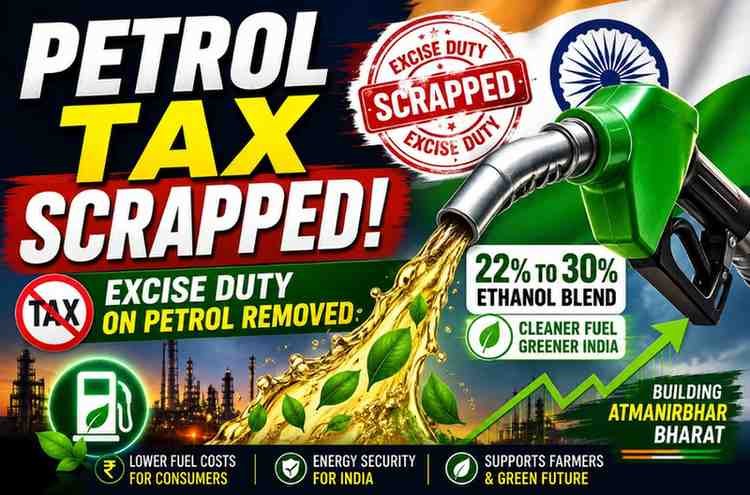
India‘s push toward energy independence received a major boost after the government announced an excise duty exemption for petrol blended with 22% to 30% ethanol. While the move may appear technical at first glance, it has significant implications for India’s fuel economy, oil import bill, environmental goals, and millions of farmers who supply feedstock for ethanol production.
As the world’s third-largest consumer and importer of crude oil, India spends billions of dollars annually on energy imports. With fuel demand expected to rise steadily over the coming decades, policymakers have been searching for ways to diversify energy sources while reducing vulnerability to global Oil Market volatility.
The latest excise duty exemption is not merely a tax adjustment. It represents another milestone in India’s long-term strategy to transform its transportation fuel ecosystem through higher ethanol blending and greater reliance on domestically produced biofuels.
The decision also signals that India is preparing for the next phase of its ethanol blending programme, moving beyond current targets and encouraging wider adoption of fuels containing significantly higher proportions of renewable ethanol.
What Is Ethanol-Blended Petrol?
Ethanol-blended petrol is conventional gasoline mixed with ethanol, an alcohol-based renewable fuel typically produced from agricultural feedstocks such as sugarcane, maize, damaged food grains, and other biomass sources.
The blend ratio indicates the percentage of ethanol present in the fuel.
| Fuel Type | Ethanol Content |
|---|---|
| E10 | 10% Ethanol, 90% Petrol |
| E20 | 20% Ethanol, 80% Petrol |
| E22–E30 | 22% to 30% Ethanol, 70% to 78% Petrol |
| E85 | 85% Ethanol, 15% Petrol |
| E100 | 100% Ethanol Fuel |
The newly announced excise duty exemption specifically applies to petrol containing between 22% and 30% ethanol, a category that goes beyond the current E20 blending target being rolled out across India.
What Does the Excise Duty Exemption Mean?
Excise duty is a tax imposed by the central government on the manufacture and production of specific goods, including petroleum products.
By eliminating excise duty on higher ethanol-blended petrol, the government is effectively reducing the tax burden associated with these fuels.
This creates several advantages:
- Improves the economic viability of producing higher ethanol blends.
- Encourages oil marketing companies to invest in expanded ethanol infrastructure.
- Supports the development of alternative fuel markets.
- Increases demand for domestically produced ethanol.
- Reduces dependence on imported crude oil.
Although the exemption does not immediately guarantee lower fuel prices at retail outlets, it provides a strong financial incentive for fuel suppliers to accelerate the transition toward higher ethanol content fuels.
Why India Is Aggressively Promoting Ethanol Blending
India’s ethanol programme is driven by a combination of economic, strategic, environmental, and agricultural considerations.
1. Reducing Crude Oil Imports
India imports the majority of its crude oil requirements from international markets. This dependence exposes the economy to:
- Global oil price shocks.
- Geopolitical conflicts.
- Supply disruptions.
- Currency fluctuations.
Every percentage increase in ethanol blending reduces the amount of petrol that must be produced from imported crude oil.
In a country where fuel demand continues to grow rapidly, even small reductions in oil imports can translate into billions of dollars in savings.
2. Strengthening Energy Security
Energy security has become increasingly important as geopolitical tensions affect global Energy Markets.
Recent disruptions in international Shipping routes, conflicts in major oil-producing regions, and fluctuations in crude prices have reinforced the importance of developing domestic energy alternatives.
Ethanol offers India a renewable fuel source that can be produced within the country rather than imported from abroad.
3. Supporting Farmers and Rural Economies
One of the less discussed but highly significant benefits of ethanol production is its impact on agriculture.
Ethanol manufacturing creates a stable market for agricultural commodities.
Major feedstocks include:
- Sugarcane.
- Maize (corn).
- Damaged food grains.
- Rice stocks approved for ethanol production.
- Agricultural residues.
The expansion of ethanol production generates additional income opportunities for farmers while reducing dependence on traditional commodity markets.
It also supports rural employment through investments in distilleries, logistics networks, and biofuel processing facilities.
India’s Ethanol Blending Journey: A Decade of Rapid Progress
India’s ethanol blending programme has evolved dramatically over the past decade.
What began as a modest initiative has become one of the world’s fastest-growing biofuel programmes.
| Year | Approximate Ethanol Blending Level |
|---|---|
| 2013-14 | Below 2% |
| 2018-19 | Around 5% |
| 2021-22 | Approximately 10% |
| 2024-25 | Near 20% in many regions |
| Future Goal | Expansion beyond E20 |
The latest excise exemption indicates that policymakers are already looking beyond E20 and preparing the groundwork for broader adoption of higher ethanol blends.
How High Ethanol Blends Could Affect Fuel Consumers
For ordinary motorists, the immediate impact may not be dramatic.
Most vehicles currently on Indian roads continue to use conventional petrol or lower ethanol blends. However, the policy creates conditions that could influence fuel markets over time.
Potential consumer benefits include:
- Greater fuel diversification.
- Reduced exposure to international oil price spikes.
- Potential long-term fuel cost stability.
- Lower carbon emissions.
- Improved domestic energy resilience.
At the same time, higher ethanol blends require compatible vehicle technologies.
Automobile manufacturers have already begun developing engines capable of efficiently operating on E20 fuel, and future vehicle designs may accommodate even higher ethanol concentrations.
Environmental Benefits of Higher Ethanol Use
The ethanol blending programme is also linked to India’s climate and sustainability objectives.
Compared with conventional petrol, ethanol can contribute to lower lifecycle greenhouse gas emissions when produced sustainably.
Key environmental advantages include:
- Reduced fossil fuel consumption.
- Lower carbon intensity of transportation fuels.
- Better utilization of agricultural by-products.
- Support for renewable energy development.
- Potential reduction in certain vehicular emissions.
While ethanol is not a complete substitute for broader decarbonization efforts, it serves as an important transitional fuel in sectors where electrification may take longer to achieve widespread adoption.
Challenges India Must Address
Despite its benefits, scaling up ethanol production and blending presents several challenges.
Feedstock Availability
Expanding ethanol production requires a consistent supply of agricultural raw materials. Policymakers must balance fuel production needs with food security considerations.
Water Usage Concerns
Certain feedstocks, particularly sugarcane, require significant water resources. Sustainable production practices will be critical as ethanol demand increases.
Infrastructure Development
Higher blending targets require investments in:
- Storage facilities.
- Transportation systems.
- Distribution networks.
- Blending infrastructure.
- Quality control systems.
Vehicle Compatibility
Not all vehicles are currently designed for higher ethanol concentrations. Expanding E22-E30 fuel availability will require coordination between fuel suppliers and automobile manufacturers.
How India Compares with Global Biofuel Leaders
India is not alone in pursuing ethanol as a transportation fuel.
Several countries have successfully integrated high ethanol blends into their fuel systems.
| Country | Biofuel Strategy |
|---|---|
| Brazil | Global leader in ethanol fuel adoption, widespread use of high ethanol blends |
| United States | Large-scale ethanol production from corn |
| India | Rapidly expanding blending programme focused on energy security |
| Thailand | Significant ethanol integration into transport fuels |
Brazil’s experience demonstrates how large-scale ethanol adoption can reduce oil dependence while supporting domestic agriculture.
India appears to be drawing lessons from these international examples while adapting its strategy to local conditions.
The Bigger Economic Impact: Beyond Fuel
The significance of the excise duty exemption extends beyond petrol pumps.
A stronger ethanol ecosystem can stimulate investment across multiple sectors.
Potential beneficiaries include:
- Farmers.
- Sugar mills.
- Grain processors.
- Distilleries.
- Logistics providers.
- Automobile manufacturers.
- Renewable energy companies.
This creates a multiplier effect throughout the economy, supporting both industrial growth and rural development.
What Comes Next for India’s Ethanol Programme?
The excise duty exemption suggests that India is entering the next stage of its biofuel transition.
Future developments could include:
- Expansion of higher ethanol blends.
- Increased production capacity.
- Greater use of advanced biofuels.
- More flex-fuel vehicle deployment.
- Further policy incentives for renewable transportation fuels.
The government’s broader objective appears clear: reduce reliance on imported oil while building a more self-reliant energy system.
As energy demand continues to rise, ethanol is likely to remain a central pillar of that strategy.
Conclusion
India’s decision to remove excise duty on petrol containing 22% to 30% ethanol represents far more than a tax adjustment. It is a strategic policy move aimed at accelerating the country’s transition toward cleaner, domestically produced fuels while strengthening long-term energy security.
The exemption supports multiple national priorities simultaneously: reducing crude oil imports, creating opportunities for farmers, encouraging investment in renewable fuels, and advancing environmental goals.
Although consumers may not notice immediate changes at fuel stations, the policy lays the foundation for a broader transformation of India’s transportation fuel landscape. As the country seeks to balance economic growth, energy demand, and sustainability, ethanol is increasingly becoming a critical component of India’s future energy strategy.
The latest announcement signals that the journey toward higher ethanol blending is not slowing down. Instead, India appears ready to move beyond existing targets and build one of the world’s most ambitious biofuel ecosystems.
For breaking news and live news updates, like us on Facebook or follow us on Twitter and Instagram. Read more on Latest Business on thefoxdaily.com.






COMMENTS 0