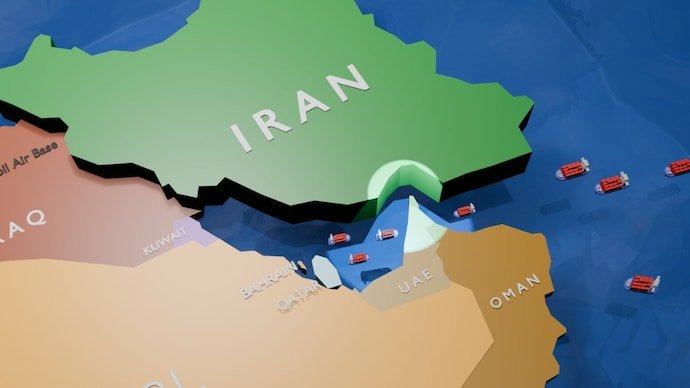
Even as the United States and Iran agreed to a two-week ceasefire, uncertainty continues to loom over the reopening of the strategically critical Strait of Hormuz. For India, the situation carries significant economic implications, with at least 20 Indian-linked vessels-including LPG and crude oil tankers-still waiting near the chokepoint for safe passage.
The ceasefire, announced just before a key US deadline, was expected to ease tensions and restore maritime traffic. However, early indicators suggest that shipping activity has not yet returned to normal levels, leaving vital energy cargo in a holding pattern and raising concerns over supply stability.
Indian Vessels Still Waiting Near Hormuz
Data tracking vessel movement shows that multiple Indian ships have repositioned closer to the Strait of Hormuz but are yet to transit through it. Many are currently stationed near Khasab, forming a loose cluster that suggests they are awaiting clearance or improved security conditions.
Among these are two LPG tankers and four crude oil carriers, all carrying significant volumes of energy resources critical to India’s supply chain.
Key Indian Vessels Near Hormuz
| Type | Number of Vessels | Status |
|---|---|---|
| LPG Tankers | 2 | Waiting near Strait |
| Crude Oil Tankers | 4 | Holding position |
| Other Indian Vessels | 14+ | Clustered west of Hormuz |
While some vessels have successfully crossed after diplomatic efforts, a significant number remain stranded, highlighting the fragile nature of the ceasefire’s impact on maritime trade.
LPG Cargo: Enough to Supply Millions of Homes
The two LPG tankers near Hormuz are estimated to be carrying substantial quantities of liquefied petroleum gas, a key household fuel in India.
Using standard cargo estimates based on vessel capacity and historical loading patterns, the combined LPG on board these ships could supply nearly 48 lakh domestic cylinders.
Estimated LPG Cargo Details
- BW Loyalty: Approx. 46,000 MT LPG (~32.4 lakh cylinders)
- Jag Vikram: Approx. 22,080 MT LPG (~15.5 lakh cylinders)
For perspective, this volume represents a significant portion of daily household consumption, underlining the importance of timely delivery.
In simpler terms, if delayed long enough, it’s not just a shipping issue-it could eventually become a kitchen issue.
Crude Oil Cargo: Feeding India’s Energy Backbone
In addition to LPG, four crude Oil Tankers are also waiting near the Strait, carrying millions of barrels of oil that are crucial for India’s refining sector.
Unlike LPG, crude oil is not directly consumed but processed into fuels such as petrol, diesel, aviation fuel, and other petrochemical products.
Estimated Crude Oil Cargo
| Vessel | Estimated Cargo (MT) | Approx. Barrels |
|---|---|---|
| Desh Vaibhav | 155,212 MT | ~11.38 lakh barrels |
| Desh Suraksha | 56,306 MT | ~4.13 lakh barrels |
| Desh Vibhor | 155,323 MT | ~11.39 lakh barrels |
| Desh Garima | 56,309 MT | ~4.13 lakh barrels |
These volumes are critical inputs for India’s refineries, which convert crude into essential fuels powering transportation, industries, and households across the country.
Why Hormuz Matters So Much
The Strait of Hormuz is one of the world’s most important maritime chokepoints, handling a significant share of global oil and gas trade. Any disruption here has immediate ripple effects on Global energy markets.
For India, which relies heavily on energy imports, smooth passage through Hormuz is vital for maintaining supply stability and controlling costs.
Even a short disruption can lead to:
- Delays in fuel supply chains
- Increased shipping and insurance costs
- Potential price volatility in domestic markets
Signs of Movement, But Not Full Normalcy
Following diplomatic engagement between India and regional stakeholders, several vessels have managed to cross the Strait. These include multiple LPG carriers and crude tankers that successfully transited after negotiations.
However, the movement remains selective rather than widespread, suggesting that the situation is still stabilizing rather than fully resolved.
Officials have indicated that efforts are ongoing to ensure safe passage for all remaining vessels, with communication channels active across multiple countries in the Gulf region.
Uncertainty Around Strait Reopening
Despite the ceasefire agreement, it is still unclear whether the Strait of Hormuz is fully operational for all commercial traffic. Observations suggest that while some ships are moving, many are still waiting for confirmation of safety.
Additionally, vessels directly linked to Iranian trade appear to be moving independently, which does not necessarily reflect a broader reopening for international shipping.
This selective movement creates ambiguity, making it difficult for shipping companies and governments to make operational decisions.
What This Means for India
India’s immediate concern is ensuring the safe and timely return of its vessels and cargo. While there is no immediate indication of shortages, prolonged delays could tighten supply chains.
Key implications include:
- Energy security: Delayed crude supply could impact refinery operations
- Household consumption: LPG delays may affect distribution cycles
- Economic impact: Higher logistics costs could influence fuel pricing
That said, India typically maintains strategic reserves and diversified supply sources, which may help cushion short-term disruptions.
Conclusion: A Fragile Recovery for Global Energy Flows
The US-Iran ceasefire has provided a temporary window of relief, but the situation around the Strait of Hormuz remains uncertain. With multiple Indian vessels still waiting to cross, the full restoration of normal shipping activity is yet to be seen.
For now, India’s energy lifelines are in a cautious holding pattern-moving, but slowly. The coming days will be crucial in determining whether the ceasefire translates into real stability or remains a short-lived pause.
In global energy terms, Hormuz is not just a waterway-it’s a pressure point. And right now, that pressure hasn’t fully eased.
For breaking news and live news updates, like us on Facebook or follow us on Twitter and Instagram. Read more on Latest India on thefoxdaily.com.






COMMENTS 0