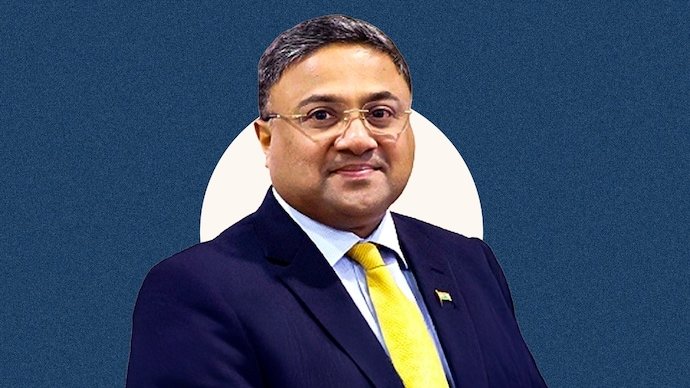
- A Senior Diplomat at the Heart of India’s Foreign Policy
- The Norway Press Exchange That Went Viral
- A Career Built Across Global Flashpoints
- His Most Important Diplomatic Postings
- Experience in Pakistan, Iran and Saudi Arabia
- Why Japan Was a Defining Assignment
- An Academic and Administrative Background
- The Changing Nature of Modern Diplomacy
- India’s Diplomatic Messaging Has Become More Assertive
- Recognition Inside the Foreign Service
- A Diplomat Shaped by Multiple Worlds
- Conclusion: Why Sibi George Matters Beyond the Viral Clip
Diplomats rarely become social media headlines. Their work usually unfolds quietly behind conference tables, inside negotiation rooms, and through carefully crafted statements designed to avoid Controversy.
But that changed dramatically when senior Indian diplomat Sibi George engaged in a sharp and unusually direct exchange with Norwegian journalist Helle Lyng during a Ministry of External Affairs briefing in Norway.
The interaction quickly went viral online after George strongly defended India’s democratic structure and criticised what he described as selective narratives surrounding press freedom and Human Rights in India.
The confrontation instantly turned public attention toward a diplomat who, despite holding one of the Indian government’s most strategically important foreign policy positions, has largely stayed outside public spotlight for most of his career.
So who exactly is Sibi George, and why does he occupy such an influential place in India’s diplomatic establishment?
A Senior Diplomat at the Heart of India’s Foreign Policy
Sibi George is one of India’s senior-most diplomats and currently serves as Secretary (West) in the Ministry of External Affairs (MEA).
In diplomatic terms, this is one of the most influential positions inside India’s foreign policy structure.
As Secretary (West), George oversees India’s political and strategic engagements with several key regions, including:
- Europe
- West Asia (Middle East)
- Parts of Africa
- Multilateral diplomatic engagements linked to those regions
The role places him directly at the centre of some of India’s most complex geopolitical relationships, particularly at a time when global diplomacy is increasingly shaped by energy security, Indo-Pacific strategy, Russia-West tensions, and emerging multipolar alliances.
In simple terms, Sibi George is not merely a spokesperson or bureaucrat. He is among the diplomats responsible for helping shape India’s strategic global positioning.
The Norway Press Exchange That Went Viral
The recent attention surrounding Sibi George emerged during Prime Minister Narendra Modi’s visit to Norway, where a press briefing took an unexpectedly combative turn.
Norwegian journalist Helle Lyng repeatedly questioned Indian officials over issues related to:
- Press freedom
- Minority rights
- Human rights concerns
- Democratic institutions in India
At one point, she reportedly questioned why India should be “trusted” regarding democratic freedoms.
George responded forcefully, defending India’s democratic ecosystem and arguing that critics often misunderstand the country’s scale and diversity.
His remarks about critics relying on reports from “godforsaken, ignorant NGOs” quickly spread online and triggered strong reactions across political and media circles.
Supporters praised him for aggressively defending India’s position against what they viewed as biased questioning, while critics argued the response was unusually blunt for a senior diplomat.
Regardless of political interpretation, the moment highlighted a broader trend in global diplomacy: diplomats today increasingly operate under intense public scrutiny amplified by viral social media clips.
A Career Built Across Global Flashpoints
To understand why Sibi George occupies such a significant role, it is important to look at the breadth of his diplomatic career.
A 1993-batch Indian Foreign Service officer, George has spent more than three decades serving in politically sensitive and strategically important regions.
His career trajectory reflects deep experience across:
- South Asia
- West Asia
- Europe
- The Indo-Pacific
- US diplomatic engagement
Unlike diplomats who specialise narrowly in one geographic region, George’s assignments span some of the world’s most geopolitically complex theatres.
His Most Important Diplomatic Postings
Before becoming Secretary (West), Sibi George served as India’s Ambassador to Japan one of New Delhi’s most strategically critical foreign postings.
The India-Japan relationship has grown enormously in recent years due to:
- Shared Indo-Pacific concerns
- China’s regional rise
- Technology and infrastructure partnerships
- Defence cooperation
- Supply chain diversification efforts
Handling India’s diplomatic relationship with Tokyo requires both strategic and economic expertise, making the appointment a sign of strong institutional trust.
George has also served as ambassador to:
- Switzerland
- The Holy See (Vatican)
- Liechtenstein
- Kuwait
- The Republic of Marshall Islands
Each posting involved very different diplomatic priorities, ranging from finance and global governance to energy security and diaspora relations.
Experience in Pakistan, Iran and Saudi Arabia
One of the most notable aspects of George’s career is his experience in politically sensitive regions central to India’s strategic interests.
He served as Political Counsellor at the Indian High Commission in Islamabad one of the most demanding diplomatic assignments for any Indian diplomat.
India-Pakistan diplomacy involves constant management of:
- Security tensions
- Terror-related concerns
- Military escalation risks
- Political sensitivities
Very few diplomatic environments demand the same level of caution, strategic communication, and crisis management.
George also held senior assignments in:
- Tehran (Iran)
- Riyadh (Saudi Arabia)
- Washington DC
This combination is particularly significant because these regions remain central to:
- Global energy Politics
- India’s diaspora interests
- Defence partnerships
- US-West Asia strategic equations
- Regional security dynamics
His exposure to all these geopolitical theatres gives him a rare breadth of diplomatic experience.
Why Japan Was a Defining Assignment
Among George’s many postings, his tenure as ambassador to Japan stands out as especially important.
India and Japan have rapidly deepened cooperation in recent years across:
- Infrastructure development
- Defence coordination
- Semiconductor supply chains
- Maritime security
- Quad partnership initiatives
At a time when Indo-Pacific competition intensified, managing India’s diplomatic engagement with Tokyo required balancing economics, defence strategy, and regional Geopolitics simultaneously.
The assignment positioned George at the centre of one of Asia’s most important emerging strategic partnerships.
An Academic and Administrative Background
Sibi George’s profile also reflects a strong academic background.
Originally from Kerala’s Kottayam district, he reportedly earned gold medals in both graduation and post-graduation studies.
He also pursued studies and training at several prominent institutions, including:
- The American University in Cairo
- LBSNAA Mussoorie
- IIM Ahmedabad
- IIM Bengaluru
- IIFT Delhi
- ISB Hyderabad
This mix of diplomatic, administrative, and management training is increasingly important in modern foreign policy, where diplomacy now intersects heavily with trade, technology, security, and economics.
The Changing Nature of Modern Diplomacy
The viral Norway exchange also reveals how diplomacy itself is changing.
Traditionally, diplomats were expected to maintain carefully measured language and avoid public confrontation. But modern geopolitics increasingly involves aggressive information battles, rapid media cycles, and highly polarised international debates.
Today’s diplomats often find themselves responding not only to governments, but also to:
- Global media narratives
- Social media controversies
- Human rights debates
- Public opinion campaigns
- Digital misinformation ecosystems
This has transformed diplomatic communication into a far more public and politically visible activity.
The Norway exchange reflected that shift clearly.
India’s Diplomatic Messaging Has Become More Assertive
Another important context behind the viral moment is the broader evolution of India’s diplomatic style.
Over the past decade, Indian diplomacy has increasingly adopted a more assertive public posture on international criticism.
Indian officials today are often quicker to:
- Challenge foreign media narratives
- Reject external commentary on internal issues
- Emphasise India’s democratic scale and diversity
- Push back against international NGO assessments
Supporters view this as a sign of growing confidence from a rising global power. Critics argue it sometimes risks escalating tensions unnecessarily.
Sibi George’s remarks in Norway reflected this broader diplomatic shift.
Recognition Inside the Foreign Service
George’s long diplomatic career has also earned institutional recognition.
In 2014, he received the SK Singh Award for Excellence in the Indian Foreign Service an honour associated with distinguished diplomatic service.
The recognition reflected both administrative capability and strategic contribution within the MEA.
A Diplomat Shaped by Multiple Worlds
What makes Sibi George particularly interesting as a diplomatic figure is the diversity of environments he has operated in.
| Region | Type of Diplomatic Challenge |
|---|---|
| Pakistan | Security and political tensions |
| Japan | Strategic Indo-Pacific partnership |
| Saudi Arabia & Gulf | Energy and diaspora diplomacy |
| Washington DC | Strategic and commercial engagement |
| Europe | Political coordination and global governance |
Few diplomats gain such broad exposure across both Conflict-sensitive and strategically critical regions.
Conclusion: Why Sibi George Matters Beyond the Viral Clip
The viral Norway exchange may have introduced Sibi George to a wider public audience, but it represents only a small moment in a diplomatic career spanning more than three decades.
As Secretary (West) in India’s Ministry of External Affairs, George occupies one of the country’s most strategically important foreign policy roles during a period of rapidly shifting global alliances and geopolitical tensions.
His career stretching from Islamabad to Tokyo, Tehran to Washington reflects the complexity of modern Indian diplomacy itself: balancing security, economics, strategic competition, and increasingly public global debates.
The Norway confrontation may continue to generate political reactions online, but it also highlighted something larger:
Modern diplomats are no longer operating only behind closed doors. They are now frontline participants in global information battles where every word can instantly become international news.
And few understand that changing diplomatic landscape better than veterans like Sibi George.
For breaking news and live news updates, like us on Facebook or follow us on Twitter and Instagram. Read more on Latest India on thefoxdaily.com.





COMMENTS 0