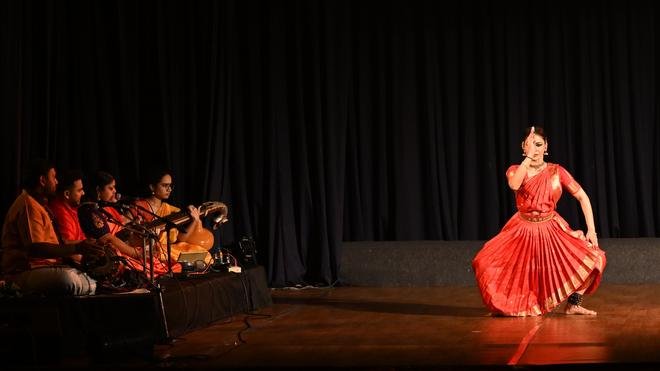
Navia Natarajan’s choreographic exploration of Agni turns one of India’s oldest elemental symbols into a deeply contemporary artistic question: what happens when the same force that gives light can also consume everything in its path? Presented as part of Natyarangam’s Pancha Bhootha Bharatham festival in Chennai, the work draws upon mythology and Tamil literary traditions to explore fire not as a single, fixed idea, but as a constantly shifting presence.
Agni can illuminate darkness, carry offerings in ritual, generate warmth and make transformation possible. Yet fire can also represent anger, desire, destruction and the terrifying loss of control. By bringing these apparently contradictory qualities together through Bharatanatyam, Natarajan creates a framework in which the audience can encounter fire as both an external natural force and an internal human emotion.
The performance is significant not merely because it takes up an ancient theme. Its larger value lies in how it demonstrates the continuing possibilities of Indian classical dance. Mythology need not remain frozen in the past, and classical choreography need not become a museum piece. When an artist approaches inherited material with curiosity, an ancient symbol can become a language for discussing contemporary ideas of identity, transformation, conflict and renewal.
What Is Agni and Why Has Fire Been So Important in Indian Thought?
Agni occupies a central position in Vedic tradition. Associated with fire, ritual and sacrifice, Agni is among the most prominent deities of the early Vedic corpus. Fire also has an important role in numerous Hindu ceremonies, where it can function as a sacred presence and witness.
But the cultural significance of fire extends far beyond religious ritual.
Human beings have always depended on fire for cooking, warmth, light and technological development. It can turn raw material into something usable, alter landscapes and enable entire industries. At the same time, uncontrolled fire represents one of nature’s most destructive forces.
That duality explains why fire has remained such a powerful metaphor across cultures.
In Indian literature and philosophy, fire can signify purity, knowledge, passion, sacrifice, anger, transformation and destruction. The meaning changes according to the story, character or context.
For a choreographer, this multiplicity is an advantage. There is no need to force fire into one definition. Its contradictions are the subject.
Navia Natarajan’s Agni Goes Beyond a Literal Portrayal of Fire
The easiest way to depict fire on stage would be to reproduce its physical characteristics: flickering fingers, rising movements and rapid gestures. But such an approach would only capture the appearance of a flame.
The deeper challenge is to communicate what fire represents.
Natarajan’s use of mythology and Tamil literature creates space for that deeper interpretation. The choreography can move from the physical to the emotional, from the ritual to the philosophical and from the ancient to the contemporary.
In Bharatanatyam, meaning is built through several interconnected elements. Abhinaya, mudras, rhythmic movement, facial expression, posture, music and spatial design can work together to suggest an idea without having to explain it literally.
Fire therefore becomes something the dancer embodies rather than merely imitates.
Fire as Creator: The Flame That Gives Life
Fire is commonly remembered for what it destroys, but its creative role is just as fundamental.
Cooking is perhaps the simplest example. Raw ingredients are transformed through heat into food. Pottery, metalworking and several traditional crafts have similarly depended on controlled fire.
In ritual, fire transforms offerings and occupies a position between the material and the sacred.
These associations give the choreographer a rich starting point. Creation can be expressed through movement that begins in stillness and gradually expands. A single gesture can generate another, just as a small flame can grow into a larger blaze.
At a symbolic level, the creative fire can also represent the beginning of an idea, the birth of artistic expression or the energy required to change an existing condition.
This is an important distinction. Fire does not simply create objects; it creates change.
Fire as Destroyer: When Energy Escapes Control
The opposite face of Agni is destruction.
Fire does not negotiate with the material it consumes. Once it escapes human control, its energy can become devastating. That physical reality has made fire a natural metaphor for anger, violence and emotional excess.
In dance, destruction can be communicated through changes in tempo, stronger rhythmic accents, sharper lines and movements that appear to break away from earlier restraint.
Yet the idea of destruction becomes more interesting when it is not presented simply as evil.
In many philosophical traditions, destruction can be part of transformation. An old form must sometimes disappear before a new one can emerge.
That interpretation prevents the performance from dividing fire into a simplistic good-versus-bad equation. The same flame that destroys one thing may prepare the conditions for something else.
Purification: The Spiritual Dimension of Agni
Fire’s association with purification is among its most enduring symbolic meanings.
Because flames consume impurities and transform what is placed within them, fire has naturally become connected with ideas of cleansing, sanctification and renewal.
In performance, however, purification need not mean physical cleanliness.
It can represent an internal process: overcoming fear, releasing attachment, confronting grief or emerging from confusion with a different understanding of oneself.
This makes the theme especially suited to Bharatanatyam, where external gesture and internal emotion are closely connected.
A dancer may appear almost still while communicating an enormous emotional shift. The audience does not necessarily see the transformation taking place; it experiences it through expression and context.
Tamil Literature Adds a Different Emotional Vocabulary
The incorporation of Tamil literary thought gives the exploration of Agni an important regional and cultural dimension.
Tamil literature has a long tradition of using nature as a means of expressing human experience. Landscape, weather, animals, plants and natural elements can become mirrors for love, separation, longing, conflict and emotional change.
Fire is particularly suited to this literary imagination because its qualities resemble intense human feeling.
Desire can burn. Anger can flare. Separation can feel like heat. Knowledge can illuminate. Grief can consume. Renewal can emerge after devastation.
Such associations allow the performance to move away from mythology as mere storytelling.
The audience may begin with Agni as a divine or elemental presence and gradually encounter fire as a metaphor for the human mind.
The Pancha Bhootha Bharatham Framework
Natarajan’s work was presented within Natyarangam’s Pancha Bhootha Bharatham festival, whose thematic foundation is the idea of the five great elements: earth, water, fire, air and space.
For classical dancers, this framework offers an opportunity to investigate how abstract concepts can be translated into movement.
| Element | Key symbolic qualities | Possible choreographic language |
|---|---|---|
| Earth | Stability, nourishment and physical grounding | Weight, stillness and grounded movement |
| Water | Flow, emotion and adaptability | Continuity, softness and fluid transitions |
| Fire | Energy, transformation and purification | Expansion, intensity, rhythm and sharpness |
| Air | Movement, breath and freedom | Lightness, speed and changing direction |
| Space | Expansion, possibility and the unseen | Stillness, openness and spatial awareness |
The comparison also explains why fire is particularly demanding as a choreographic subject. Earth can be suggested through weight; water through flow; air through movement. Fire constantly changes between stillness and motion, containment and expansion.
How Bharatanatyam Can Make an Invisible Force Visible
One of the remarkable features of Bharatanatyam is its ability to communicate ideas that cannot literally be seen.
Fire itself is visible, but its heat is not. Its danger is not visible until it begins to act. Its symbolic meanings cannot be photographed at all.
This is where choreography becomes more than physical movement.
The dancer can use the body to suggest heat without touching a flame. A change in facial expression can turn an image of warmth into one of anger. A controlled sequence can suddenly become expansive, creating the impression of a flame growing beyond its original boundary.
Such transitions are particularly valuable because they allow the audience to experience the instability inherent in fire.
The Most Interesting Contradiction: Fire Needs Control to Be Useful
A unique way of understanding Agni is to consider the relationship between power and control.
Fire is useful precisely when human beings can contain and direct it. A cooking flame serves one purpose when controlled, but becomes a threat when it spreads beyond its intended space.
The same principle applies metaphorically to human emotion.
Passion can drive creativity. Anger can expose injustice. Ambition can inspire achievement. But without restraint, each can become destructive.
This makes Agni a compelling metaphor for contemporary life. Modern societies have more energy, technology and information than ever before, but possessing power and knowing how to control it are two different things.
Seen through this lens, Natarajan’s fire is not simply an ancient symbol. It becomes a meditation on responsible power.
From Sacred Flame to Human Emotion
Perhaps the strongest artistic possibility in an Agni-based performance is the journey from the cosmic to the intimate.
A story may begin with a sacred fire, a mythological episode or a ritual association. But eventually the audience can recognise something much closer to everyday human experience.
Everyone knows what it means to feel consumed by an emotion.
Love, jealousy, grief, rage and ambition can all behave like fire. They begin as small sensations and can grow until they dominate attention.
This makes the elemental theme accessible even to an audience that does not possess detailed knowledge of Vedic mythology or Tamil literary traditions.
The cultural references provide depth, but the emotional experience provides entry.
Why Darkness Is Essential to Understanding Fire
The movement from sacred fire toward darkness carries an important conceptual implication.
Light has meaning because darkness exists.
A flame in a brightly lit room may barely attract attention. The same flame in darkness becomes the centre of the visual field.
This relationship between light and darkness also works as a metaphor for knowledge and ignorance, hope and despair, awareness and uncertainty.
Fire can reveal what is hidden, but it can also cast shadows.
That final point is often overlooked. Illumination is not always complete. A single light source may make some things visible while leaving others concealed.
For a choreographer, this creates an unusually sophisticated visual and philosophical territory: the question is not simply whether fire brings light, but what the light allows us to see and what remains in darkness.
Agni and Abhinaya: When Fire Becomes Feeling
Abhinaya is central to the expressive power of Bharatanatyam. Through facial expression, gesture and physical suggestion, dancers can communicate emotional states and narrative meaning.
Agni provides a natural bridge between elemental imagery and rasa, the aesthetic experience evoked in the spectator.
A flame can suggest anger, but the dancer can also communicate the vulnerability beneath anger. Fire can represent desire, yet desire may contain fear, longing or uncertainty.
This layered emotional vocabulary is what prevents elemental choreography from becoming merely decorative.
The audience is not asked only to recognise fire. It is invited to feel what fire might mean.
Mythology Without Turning Classical Dance Into a History Lesson
There is a delicate balance involved in using mythology on the contemporary stage.
A literal retelling can become predictable, particularly when audiences already know the story. But removing the narrative context entirely can make the work difficult to understand.
The strongest solution is often reinterpretation.
Mythology supplies the cultural memory. Literature adds emotional complexity. Choreography creates a present-tense experience.
Natarajan’s approach to Agni belongs to this larger possibility: classical dance can preserve the architecture of tradition while allowing each generation to ask its own questions.
Why This Matters for the Future of Indian Classical Dance
Element-based productions have an important role to play in keeping classical arts connected to contemporary audiences.
Young viewers may not approach a performance because they want a lesson in ancient philosophy. They may, however, respond to questions about identity, emotion, nature, conflict and transformation.
The challenge for artists is to create an entry point without simplifying the tradition.
Agni offers an excellent example because it operates simultaneously at several levels. It is mythology, nature, ritual, metaphor and lived experience.
That layered quality gives classical dance an opportunity to demonstrate that tradition can remain intellectually alive.
Fire and the Contemporary World
There is also an environmental dimension to the symbolism that makes Agni particularly relevant today.
Fire remains essential to human civilisation, but uncontrolled fires have become an increasingly visible environmental and social concern in many parts of the world. At the same time, societies continue to debate energy use, industrialisation and the consequences of human intervention in natural systems.
An elemental performance does not need to become an environmental lecture to engage with these questions.
Simply reminding audiences that fire is both necessary and dangerous can encourage a broader reflection on humanity’s relationship with nature.
This is one of the most promising directions for contemporary classical choreography: using traditional symbols to ask modern questions without sacrificing artistic subtlety.
What Makes an Agni Performance Successful?
The success of an elemental dance work cannot be judged only by how convincingly it depicts its chosen element.
The more important question is whether the theme changes the way the audience sees the world after the performance ends.
If fire remains merely a visual motif, the experience may be impressive but limited. If fire becomes a way of understanding desire, destruction, renewal and human responsibility, the choreography acquires greater resonance.
This is where the combination of mythology and literature becomes valuable. They prevent the element from becoming one-dimensional.
A Prediction: Elemental Choreography Could Become a Strong Bridge Between Tradition and New Audiences
The growing interest in thematic productions suggests that the five elements can provide contemporary choreographers with a powerful framework for experimentation.
Future works could explore water through ecological anxiety, air through breath and climate, earth through displacement and agriculture, and space through technology and virtual life.
Fire could be particularly fertile territory because it connects ritual, energy, emotion, conflict and environmental change.
The opportunity, however, comes with a responsibility. Contemporary relevance should emerge from genuine engagement with the classical vocabulary rather than being added as a fashionable layer.
When that balance works, the result can appeal to audiences familiar with tradition as well as those encountering it for the first time.
The Larger Insight: Agni Is a Metaphor for Transformation Itself
The deepest idea emerging from an exploration of Agni is that fire is not defined solely by what it is. It is defined by what it does.
It changes things.
Wood becomes ash. Food becomes nourishment. Metal becomes workable. Darkness becomes visibility. Ritual offerings become symbols of communication with the divine.
Human beings undergo similar transformations. Experiences alter relationships, beliefs and identities. Pain can change priorities. Knowledge can make old assumptions impossible to maintain. Love can reshape a life.
In this sense, fire becomes an almost perfect metaphor for choreography itself.
A performance begins with bodies, rhythm, music and inherited technique. By the end, those same ingredients have been transformed into an experience that exists only in the minds and emotions of the audience.
Conclusion: When Agni Becomes More Than Fire
Navia Natarajan’s choreographic exploration of Agni at Natyarangam’s Pancha Bhootha Bharatham festival demonstrates how a classical Indian dance form can revisit an ancient subject without reducing it to nostalgia.
Through mythology, Tamil literature and Bharatanatyam, fire emerges as creator, destroyer, purifier, illuminator and a metaphor for the volatile nature of human emotion.
The most compelling aspect of such an exploration is its refusal to make fire simple. It is neither wholly benevolent nor wholly destructive. Its value depends on how it is understood, contained and directed.
That ambiguity is precisely what gives Agni its enduring power.
In an age defined by rapid transformation, the ancient image of a flame remains surprisingly current. It reminds us that change can create and destroy, that illumination can reveal as well as conceal, and that power becomes meaningful only when it is understood.
Ultimately, the journey from sacred fire to darkness is not simply a journey through mythology. It is a journey through the human condition. And in Natarajan’s choreographic world, Agni becomes not just something to watch, but something to recognise within ourselves.
For breaking news and live news updates, like us on Facebook or follow us on Twitter and Instagram. Read more on Latest Entertainment on thefoxdaily.com.


COMMENTS 0