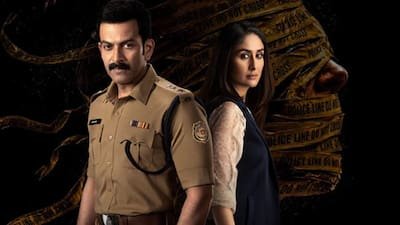
Daayra, Meghna Gulzar’s latest crime drama starring Kareena Kapoor Khan and Prithviraj Sukumaran, examines the uneasy distance between the rule of law and the public’s demand for instant justice. Set in an unnamed city and presented as “a work of fiction based on a narrative of events available to the public at large,” the film draws on the atmosphere surrounding real cases while constructing its own police procedural. The result is a morally complicated drama driven by two contrasting officers and two sharply different ideas of justice.
Daayra Review: A Police Drama About Two Ideas of Justice
At the centre of Daayra are two senior police officers who approach their jobs from very different directions. Kareena Kapoor Khan plays DCP Ajooni Kohli, an officer who believes that due process must be allowed to run its course. Prithviraj Sukumaran plays DCP Raman Kumar, a more impatient and forceful cop who believes that a slow-moving system can fail victims all over again.
The contrast between them becomes the film’s central dramatic engine. Neither character is presented as a conventional action hero. Instead, Meghna Gulzar places both inside a system where policing, public anger, media pressure and questions of accountability constantly collide.
NDTV’s Saibal Chatterjee describes the film as a police drama that blends thriller conventions with a procedural structure, with the two leads carrying the film through parallel investigations and competing approaches to law enforcement. 0
A Story Inspired by Familiar Headlines
The film’s premise recalls the 2019 Hyderabad gang-rape and murder case and the subsequent killing of four accused men in a police encounter. Daayra does not present itself as a direct recreation of that case; instead, it uses a fictional setting and fictional characters to explore the questions that followed similar real-world events.
The story revolves around the rape and murder of a young woman and the subsequent police action against the alleged perpetrators. The encounter becomes a second point of investigation, forcing the film to examine not only the original crime but also the conduct of those entrusted with bringing its perpetrators to justice.
That structure allows Gulzar to place two disturbing events beside each other: a brutal crime against a woman and an alleged abuse of police power. The film’s larger question is not simply who deserves punishment, but who gets to decide what justice should look like.
Kareena Kapoor as DCP Ajooni Kohli
Kareena Kapoor Khan plays Ajooni as a controlled and methodical officer. She does not rely on dramatic speeches or conventional heroic gestures. Her authority comes from her ability to observe, question and follow the evidence.
Ajooni is tasked with investigating the police encounter involving Raman and his team. As she reconstructs the sequence of events, she begins to uncover the failures that preceded the original crime, including the handling of the missing-person complaint and the response of the police machinery.
India Today’s review noted that Kareena brings composure and precision to the role, while also pointing to a potentially deeper personal dimension involving Ajooni’s father, a retired judge. 1
That family history is significant because Ajooni’s faith in procedure is not presented as an abstract professional belief. Her relationship with the judicial system is also personal, giving the character an opportunity for greater internal conflict.
Prithviraj Sukumaran Is a Major Strength
Prithviraj Sukumaran plays Raman Kumar with a restrained intensity. Raman is convinced that the conventional system can take too long to deliver justice, particularly in cases involving brutal crimes against women.
His impatience is not portrayed simply as anger. It becomes an ideological position. He believes that police officers sometimes have to act decisively when the system appears incapable of protecting victims or punishing offenders.
At the same time, the film does not completely excuse his methods. Instead, it asks viewers to understand how institutional failure and public anger can create an environment in which extra-legal action begins to appear acceptable.
Several reviews have singled out Prithviraj’s performance. The Indian Express, for instance, described his work as contained and effective, while noting that his character emerges as one of the film’s strongest elements. 2
The Film’s Most Difficult Question: Law Versus Instant Justice
The most interesting aspect of Daayra is its refusal to make the debate entirely comfortable.
On one side is Ajooni’s belief that the law must be followed even when the process is frustratingly slow. On the other is Raman’s conviction that victims cannot be asked to wait indefinitely while institutions move at their own pace.
The film builds this conflict against the backdrop of public outrage over the young woman’s death. The audience is therefore confronted with a familiar emotional dilemma: when people believe that the formal system has failed, does that justify a faster and more aggressive form of punishment?
Daayra does not reduce the issue to a simple hero-versus-villain confrontation. Both perspectives emerge from recognisable concerns, even though the consequences of crossing legal boundaries remain central to the story.
Meghna Gulzar Keeps the Focus on Procedure
Rather than turning Daayra into a conventional action-heavy cop thriller, Gulzar spends considerable time on investigations, interrogations and reconstruction of events.
The narrative moves between different moments rather than proceeding entirely in chronological order. This parallel structure gradually connects the original crime with the police encounter and the subsequent investigation.
NDTV’s review particularly praised the film’s editing and narrative rhythm, crediting Gulzar, who also co-wrote and co-edited the film, and editor Charu Shree Roy for maintaining momentum while moving between different lines of action. 3
The Film’s Treatment of the Victim and Her Family
The young woman at the heart of the story is not merely a plot device. The film spends time showing the institutional failures surrounding her disappearance and the devastation experienced by her family.
Her mother, played by Kshitee Jog, becomes an important emotional presence. The family’s attempts to get help before the crime is discovered underline one of the film’s central concerns: justice can fail long before a case reaches a courtroom.
That element gives the police investigation a second layer. Ajooni is not only examining whether Raman’s encounter was legitimate; she is also confronting the chain of decisions and indifference that preceded the young woman’s death.
A Strong Technical Framework
The film’s restrained approach benefits from its technical execution. Cinematographer Saurabh Goswami uses lighting and camera movement to create an atmosphere that is tense without constantly resorting to spectacle.
The editing is particularly important because the story repeatedly shifts between different investigations and timelines. The parallel cutting allows the two strands of the story to echo one another and reinforces the film’s interest in the relationship between crime, policing and punishment.
NDTV also highlighted the contribution of the film’s cinematography and editing to its exploration of the tension between police ethics and excess amid public pressure for immediate justice. 4
Where Daayra Falls Short
While the film has substantial material to work with, some reviews have found that its execution does not always match the ambition of its subject.
India Today argued that the film raises sharp questions but does not push its central ideas far enough, particularly in developing Ajooni’s personal history and building the final confrontation between the two officers. 5
The Indian Express was more critical of the balance between the two leads, arguing that Prithviraj’s character comes through more strongly while the film struggles to decide how much of Kareena’s star persona and how much of Ajooni the audience should see. 6
These differing reactions point to the film’s central challenge: Daayra wants the audience to sit with moral ambiguity, but the dramatic payoff of that ambiguity may not feel equally powerful to every viewer.
Does Kareena and Prithviraj’s Pairing Work?
The two actors have distinctly different screen energies, which works in the film’s favour. Kareena’s Ajooni is restrained and analytical, while Prithviraj’s Raman carries an undercurrent of impatience.
Their characters do not need constant confrontations to establish their differences. Their opposing approaches to policing are enough to create tension, and the film gradually moves them towards an inevitable collision.
Meghna Gulzar has also spoken about working with both actors and said their experience meant she did not need to over-direct them during the making of the film. 7
Daayra Review: Final Verdict
Daayra is an ambitious police drama that uses a fictional story to examine questions raised by real-world debates around sexual violence, police encounters and the rule of law. Its strongest feature is the central conflict between Ajooni and Raman, brought to life by Kareena Kapoor Khan and Prithviraj Sukumaran.
The film is less interested in delivering a conventional thriller payoff than in examining how people arrive at radically different ideas of justice after institutional failure. Its measured storytelling, parallel investigations and strong performances give the subject weight, even when the screenplay does not explore every character conflict as deeply as it could.
NDTV’s Saibal Chatterjee gave the film 3.5 out of 5 stars, praising Gulzar, the editing and the two lead performances. 8 Other reviews have been more divided, particularly over the film’s pacing, character development and final impact. 9
Ultimately, Daayra works best when it refuses to offer easy answers. It asks whether justice can remain justice when it abandons due process, and whether a system that repeatedly fails vulnerable people can still demand unquestioning faith in its procedures. Kareena and Prithviraj give those opposing positions considerable force, making Meghna Gulzar’s latest film a serious, conversation-driven addition to the Hindi crime-drama space.
“`10
For breaking news and live news updates, like us on Facebook or follow us on Twitter and Instagram. Read more on Latest Entertainment on thefoxdaily.com.

COMMENTS 0