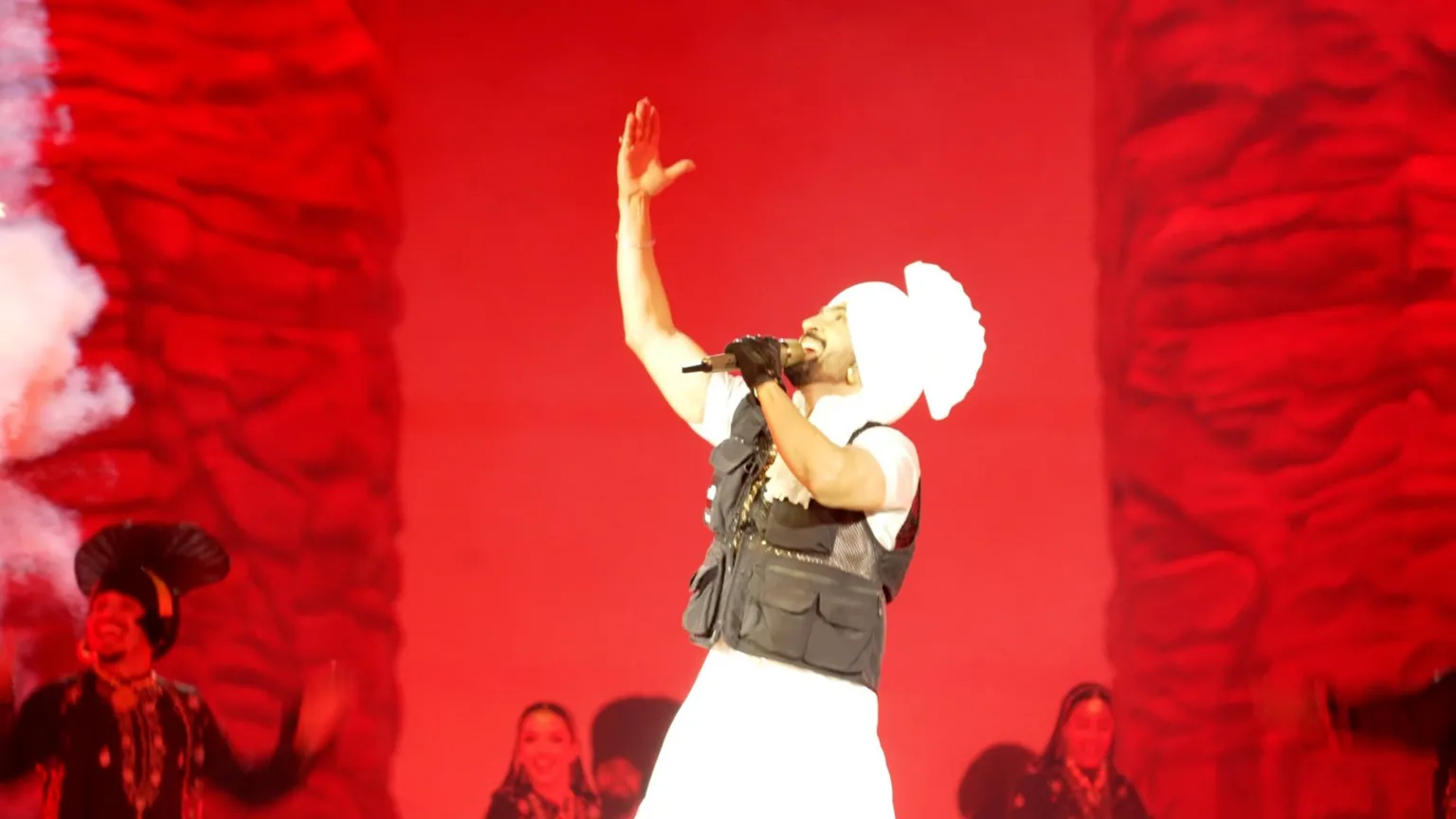
Diljit Dosanjh has created history at London’s iconic Wembley Stadium, becoming the first Punjabi artist to headline a concert at the legendary venue. On September 12, the singer-actor brought his Aura World Tour to Wembley, turning the landmark concert into a major moment for Punjabi music, Indian entertainment and South Asian representation on the global stage.
As the massive crowd gathered beneath the famous Wembley arch, Diljit opened the night with a line that has become closely associated with his international journey: “Punjabi Aa Gaye Wembley Oye!” The declaration was more than a concert catchphrase. It captured the significance of a Punjabi-language artist commanding one of the world’s best-known stadium stages.
Wembley Stadium had officially billed the performance as a historic first for a Punjabi artist. The venue also described Diljit’s show as the event that would bring its biggest summer of music to a close. 0
Diljit Dosanjh Creates History at Wembley Stadium
For Diljit, performing at Wembley represents another major milestone in an international career that has steadily expanded beyond the traditional boundaries of Indian music.
The September 12 concert was part of his ongoing Aura World Tour and attracted a huge audience to the 90,000-capacity London venue. Reports described the show as sold out, underlining the scale of his overseas following. 1
Wembley is a venue associated with some of the biggest names in global music. For a Punjabi-language performer to headline the stadium is therefore significant not only as an individual career achievement but also as a reflection of the growing international reach of Punjabi popular culture.
The concert demonstrated how an artist can take a regional musical identity to an international audience without abandoning the language, sounds and cultural references that helped build his original fan base.
“Punjabi Aa Gaye Wembley Oye!” Becomes a Defining Moment
The opening declaration, “Punjabi Aa Gaye Wembley Oye!”, immediately captured the mood of the night.
The phrase carries a simple message: Punjabi music had arrived at one of Britain’s most recognisable stadiums in a way that was impossible to ignore.
Diljit has frequently incorporated Punjabi language, clothing, humour and cultural references into his performances abroad. At Wembley, that identity was not presented as something that needed to be softened for an international audience. Instead, it was placed at the centre of a huge global-scale production.
That cultural confidence has become an important part of Diljit’s appeal. His international performances have shown that audiences do not necessarily need to understand every lyric to connect with the energy, rhythm and emotion of Punjabi music.
Why the Wembley Concert Is Bigger Than One Artist
Diljit’s Wembley milestone is significant because it represents the increasing visibility of Punjabi music outside India.
Punjabi songs have long had a global audience through diaspora communities in the UK, Canada, the US, Australia and elsewhere. Streaming platforms and social media have accelerated that reach, allowing Punjabi music to travel far beyond communities that traditionally consumed it.
Diljit has become one of the most recognisable faces of that international movement.
His career has developed across music, cinema and fashion, while his ability to communicate directly with audiences online has helped create a global persona that extends beyond conventional Bollywood stardom.
The Wembley performance consequently becomes part of a much larger cultural story: Punjabi music is no longer being presented only as a regional genre or diaspora phenomenon. It is increasingly participating in the mainstream global live-music economy.
From Punjab to Coachella and Now Wembley
Diljit’s journey to Wembley did not happen overnight.
He had already achieved an important international milestone when he performed at Coachella, becoming the first Punjabi-language singer to perform at the festival. That appearance introduced his music to an even wider global audience and established him as an artist capable of representing Punjabi music on major international stages.
Since then, his international concerts have continued to attract attention, while collaborations and appearances involving global entertainers have further expanded his profile.
His Wembley performance can therefore be viewed as another step in a trajectory that has taken Punjabi music from regional popularity to some of the world’s most prestigious entertainment platforms.
Wembley Was the Perfect Stage for the Aura World Tour
The Wembley show formed part of Diljit’s Aura World Tour, which has become one of the most ambitious phases of his live-performance career.
The scale of the tour reflects the growing demand for his music internationally. His London date was announced as a major stadium event, with Wembley itself highlighting the concert as part of its record-breaking 2026 summer music programme.
Wembley Stadium said it was hosting a record 34 concerts between June and September 2026, with around three million fans expected to attend music events during the summer. 2
Having Diljit as the artist closing that summer programme added another layer of significance to the event.
Punjabi Culture Took Centre Stage
The Wembley concert was not simply about performing a collection of hit songs. It also became a celebration of Punjabi identity.
Reports from the event highlighted cultural elements surrounding the concert, including free turban-tying services for fans. The initiative allowed attendees to participate in an aspect of Punjabi culture while attending one of the biggest shows of Diljit’s career. 3
That cultural dimension is important because Diljit’s international success has rarely depended on distancing himself from his roots.
His trademark Punjabi attire, bhangra-inspired performances and language have become central to his identity as an international performer. At Wembley, those elements were amplified rather than hidden.
Diljit’s Global Appeal Goes Beyond Music
Part of Diljit’s international popularity comes from the fact that his appeal is not restricted to music.
He is also an actor, fashion personality and social-media figure. His appearances in Bollywood films have introduced him to audiences who may not have originally followed Punjabi music, while his fashion choices and humorous online presence have helped him develop a distinctive public image.
This combination has made him particularly effective at crossing cultural boundaries.
For audiences already familiar with Punjabi music, he represents a familiar cultural voice on a global stage. For international listeners discovering him for the first time, he offers a direct entry point into contemporary Punjabi pop culture.
Why the UK Holds Special Importance for Punjabi Music
The United Kingdom has a long-standing connection with Punjabi music and South Asian culture.
Large Punjabi and South Asian communities have helped create a thriving ecosystem of music, radio, festivals, clubs and live performances. British Punjabi artists and producers have also played an important role in developing new sounds by combining traditional Punjabi music with hip-hop, R&B, electronic music and other international influences.
For that reason, a Punjabi artist performing at Wembley carries particular cultural resonance.
It connects the history of Punjabi music in the British diaspora with the current global popularity of artists such as Diljit. The concert effectively brought together generations of Punjabi musical identity in one of Britain’s most recognisable venues.
Wembley Success Comes as Diljit’s International Profile Grows
Diljit’s Wembley achievement comes during a period of strong international momentum.
His Aura World Tour has already generated significant demand in the UK, with additional Birmingham and Manchester dates announced following the London show’s sell-out. 4
The scale of the demand indicates that his overseas audience is no longer limited to occasional festival appearances or smaller arena performances.
Instead, there is now sufficient demand for large-scale stadium concerts, signalling a significant evolution in the commercial potential of Punjabi music internationally.
Diljit Announces Ahmedabad Show From Wembley Stage
The Wembley concert also became the launchpad for another major announcement.
Diljit announced that he would return to India for a massive concert at Narendra Modi Stadium in Ahmedabad as part of the Aura Tour. The announcement gives Indian fans another major event to look forward to after the singer’s landmark international performance. 5
The choice of Ahmedabad is itself notable because Narendra Modi Stadium is one of the world’s largest cricket stadiums by capacity. A large-scale Diljit concert there would bring his international stadium-show format back to India.
It also creates an interesting contrast: the artist who just performed at Wembley will return to a giant stadium in his home country, bringing the global scale of the Aura Tour closer to Indian audiences.
What Diljit’s Wembley Moment Means for the Next Generation
Perhaps the most lasting impact of the Wembley concert could be on aspiring Punjabi artists.
For decades, musicians from regional-language industries have had to navigate a perception that international success requires crossing over into English or Hindi. Diljit’s career offers a different model.
He has demonstrated that an artist can perform predominantly in Punjabi and still build a global audience.
That does not mean language barriers have disappeared. Instead, it shows how music can create a connection that does not depend entirely on understanding every word.
For young musicians from Punjab and the wider Indian music scene, seeing a Punjabi artist headline Wembley can make an international career feel considerably more achievable.
From Regional Star to Global Performer
Diljit Dosanjh’s career illustrates how the definition of an Indian global music star is changing.
Earlier generations of Indian artists seeking international recognition often relied heavily on Bollywood or collaborations with Western musicians. Today’s artists have more opportunities to build audiences directly through streaming platforms, social media and global touring.
Diljit has benefited from that changing ecosystem while also creating demand through the strength of his live performances.
His Wembley show demonstrates the commercial and cultural possibilities that emerge when a strong regional identity meets global entertainment infrastructure.
Wembley Concert Marks Another Milestone for Punjabi Music
The significance of Diljit’s Wembley performance goes beyond the size of the stadium or the number of people inside it.
It represents a moment when Punjabi music occupied one of the world’s most recognisable stages on its own terms. The artist did not need to abandon his language or cultural identity to headline Wembley.
Instead, those elements became the reason the performance mattered.
From his early career in Punjab to international festival stages and now a sold-out Wembley Stadium, Diljit Dosanjh has built a path that few Indian regional-language artists have travelled before.
“Punjabi Aa Gaye Wembley Oye!” may have been a line shouted to energise a concert crowd, but it also captured the larger achievement of the night.
Punjabi music had arrived at Wembley—and Diljit Dosanjh had made sure the world was listening.
For breaking news and live news updates, like us on Facebook or follow us on Twitter and Instagram. Read more on Latest Entertainment on thefoxdaily.com.



COMMENTS 0