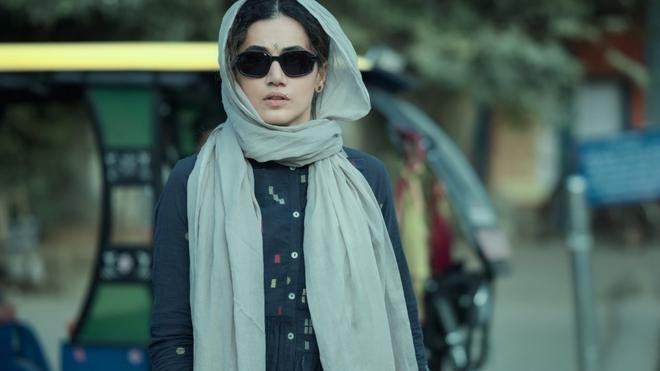
‘Gandhari’ begins with the kind of premise that should immediately command attention. A woman pushed to the edge, a dangerous mission, buried trauma and the promise of a morally complicated confrontation give the film the ingredients for a gripping thriller. Yet the finished product struggles to turn those ingredients into a satisfying whole.
Taapsee Pannu brings intensity to the central role, and there are moments when her physical commitment and emotional urgency suggest the sharper film hiding underneath. But the screenplay repeatedly moves away from its strongest ideas, while the direction lacks the consistency needed to turn scattered possibilities into sustained tension.
Written by Kanika Dhillon and directed by Devashish Makhija, ‘Gandhari’ appears to be reaching for something larger than a straightforward revenge thriller. It touches on motherhood, violence, trauma, justice and the moral compromises created by desperation. The problem is that these ideas are introduced faster than they are developed.
The result is a film that is often more interesting to think about than it is to watch.
‘Gandhari’ story: A promising setup that struggles to take shape
At its core, the film follows a woman whose personal circumstances force her into a dangerous confrontation. The setup creates an immediate emotional stake, because the protagonist’s actions are connected to deeply personal consequences rather than an abstract mission.
That emotional foundation could have provided the film with a powerful engine.
Instead, the narrative keeps introducing additional layers without giving enough time to explore their consequences. Characters appear to represent particular ideas, conflicts are established and then rushed, and potentially significant revelations sometimes feel like plot devices rather than organic developments.
This makes the story feel less like a carefully constructed thriller and more like several ambitious concepts competing for attention.
Taapsee Pannu is committed, but the character is underwritten
Taapsee Pannu has built a reputation for choosing roles that place women at the centre of difficult, often physically demanding stories. In ‘Gandhari’, she once again gives the protagonist considerable physical and emotional force.
Her performance is strongest when the character’s vulnerability and determination collide. The actor understands how to communicate anger without constantly verbalising it, and her body language frequently does more work than the screenplay.
Unfortunately, the writing does not always give her enough material to build a fully convincing character.
The protagonist’s motivations are clear in broad terms, but the psychological journey between those motivations and her increasingly extreme choices is not developed with sufficient detail. We understand what she wants, but the film does not always make us feel the full weight of why she has become this person.
That gap matters in a revenge-driven thriller. The audience needs to believe not only in the character’s objective but also in the emotional transformation that makes the pursuit inevitable.
Kanika Dhillon’s screenplay has too many ideas fighting for space
The screenplay is arguably the film’s biggest weakness.
There is nothing inherently wrong with ambition. In fact, ‘Gandhari’ is clearly attempting to combine a genre story with questions about trauma, parenthood, violence and power.
The difficulty is prioritisation.
Several themes are introduced, but few are developed to the point where they acquire genuine dramatic power. The film repeatedly hints at complexity without allowing that complexity to breathe.
A stronger screenplay would have identified one central emotional question and allowed every major subplot to deepen it. Instead, the narrative occasionally feels as though it is ticking through ideas that sounded compelling on paper.
This is particularly damaging to the thriller elements. Suspense depends on clarity of stakes. When the story becomes distracted by underdeveloped subplots, the tension loses momentum.
Devashish Makhija’s direction lacks tonal control
Devashish Makhija is a filmmaker associated with darker, uncompromising material, and ‘Gandhari’ contains traces of that sensibility.
There is an interest in damaged characters, difficult moral choices and uncomfortable situations. However, the film does not always maintain a consistent tone.
Some sequences aim for gritty realism, while others feel more conventionally constructed. Moments of emotional intensity are followed by scenes that lack equivalent dramatic weight. Instead of building pressure continuously, the film sometimes seems to reset itself.
That unevenness prevents the thriller from becoming genuinely absorbing.
The biggest missed opportunity is the film’s emotional core
The most compelling aspect of ‘Gandhari’ is not its action or its twists. It is the emotional conflict created when an ordinary human bond collides with extraordinary violence.
The film understands this in principle, but it does not always explore it deeply enough.
For a revenge story to work, the audience should feel the cost of revenge. Every step forward should make the protagonist’s victory feel simultaneously more necessary and more destructive.
Here, the emotional consequences are sometimes pushed aside in favour of narrative movement. The film wants the protagonist to be formidable, but it could have been far more powerful if it had spent more time showing what that transformation costs her.
Action and suspense: More functional than thrilling
A thriller lives or dies by its ability to create anticipation. Unfortunately, ‘Gandhari’ rarely sustains the level of suspense its premise promises.
Individual sequences have energy, and Taapsee Pannu’s physical performance gives several confrontations credibility. But the set pieces do not consistently build toward the kind of escalating tension that keeps viewers emotionally invested.
Too often, the mechanics of the plot become more noticeable than the danger facing the characters.
That is a problem because the film’s premise is inherently suited to suspense. With tighter pacing, stronger character development and more disciplined reveals, the same material could have generated considerably more anxiety and anticipation.
Where ‘Gandhari’ works
- Taapsee Pannu’s commitment: She gives the protagonist physicality, determination and emotional intensity.
- The central premise: The story has the foundation for a compelling survival-and-revenge thriller.
- Serious themes: The film attempts to explore trauma, motherhood, violence and justice rather than relying entirely on action.
- Dark atmosphere: Several sequences capture the bleak emotional world the story is aiming for.
- Ambition: The film clearly wants to be more than a conventional revenge movie.
Where the movie falls short
- Underdeveloped ideas: Too many themes are introduced without adequate exploration.
- Uneven pacing: The narrative loses momentum between stronger sequences.
- Thin characterisation: Several characters function primarily to advance the plot.
- Inconsistent tone: The film moves between gritty drama and conventional thriller territory without always finding a natural balance.
- Limited suspense: The story’s potential for tension is not fully realised.
- Emotional shortcuts: Important character developments sometimes arrive before the audience has been given enough reason to feel them.
‘Gandhari’ compared with a stronger revenge thriller
| Element | What a strong revenge thriller needs | ‘Gandhari’ |
|---|---|---|
| Central motivation | Simple enough to understand but emotionally layered | Strong premise, but the emotional progression is uneven |
| Character development | Transformation should feel earned | Taapsee brings intensity, but the writing leaves gaps |
| Suspense | Each sequence should increase uncertainty or danger | Several promising moments fail to build sustained tension |
| Villain/conflict | Should create a compelling personal threat | Conflict can feel more functional than psychologically developed |
| Themes | Should strengthen the central story | Ambitious themes sometimes compete with the main narrative |
| Payoff | Emotional and narrative consequences should feel inevitable | The execution does not fully match the premise’s potential |
Why the film feels like two different movies
The most revealing criticism of ‘Gandhari’ is that the writing and direction do not always appear to be pursuing exactly the same film.
Kanika Dhillon’s screenplay appears interested in a larger thematic examination of trauma, identity and motherhood, while Makhija’s direction often pushes toward a harder-edged genre experience.
Neither approach is inherently wrong. The problem is the lack of synthesis.
The strongest films in this space use genre as a vehicle for theme. The action makes the emotional argument; the suspense reveals character; the violence has consequences beyond spectacle.
In ‘Gandhari’, those elements sometimes operate separately. That makes the film feel conceptually busy but dramatically thin.
The real missed opportunity
The film’s biggest weakness is also the source of its greatest potential.
A woman-driven revenge thriller can be particularly powerful when it refuses to treat vengeance as simple empowerment. It can ask what happens when survival requires someone to become the very thing she fears.
‘Gandhari’ occasionally approaches that territory but does not consistently stay there.
A more focused version of the film could have reduced some of its narrative clutter, developed the protagonist’s relationships more deeply and allowed the moral consequences of her choices to accumulate.
That would not necessarily require more action. It would require more patience.
Final verdict
‘Gandhari’ is built around an intriguing idea but never turns that idea into the gripping thriller it could have been.
Taapsee Pannu remains watchable and committed, particularly in the physical and emotionally charged portions of the film. The movie also deserves credit for attempting to combine genre entertainment with heavier questions about trauma, motherhood and violence.
But ambition cannot compensate for uneven execution. The screenplay introduces more ideas than it develops, the pacing struggles to maintain suspense, and the emotional journey does not always feel earned.
The result is a thriller with flashes of promise but too many blind spots.
‘Gandhari’ works best as a reminder of how much potential exists in its premise. Unfortunately, the film itself does not quite unlock that potential.
For breaking news and live news updates, like us on Facebook or follow us on Twitter and Instagram. Read more on Latest Entertainment on thefoxdaily.com.

COMMENTS 0