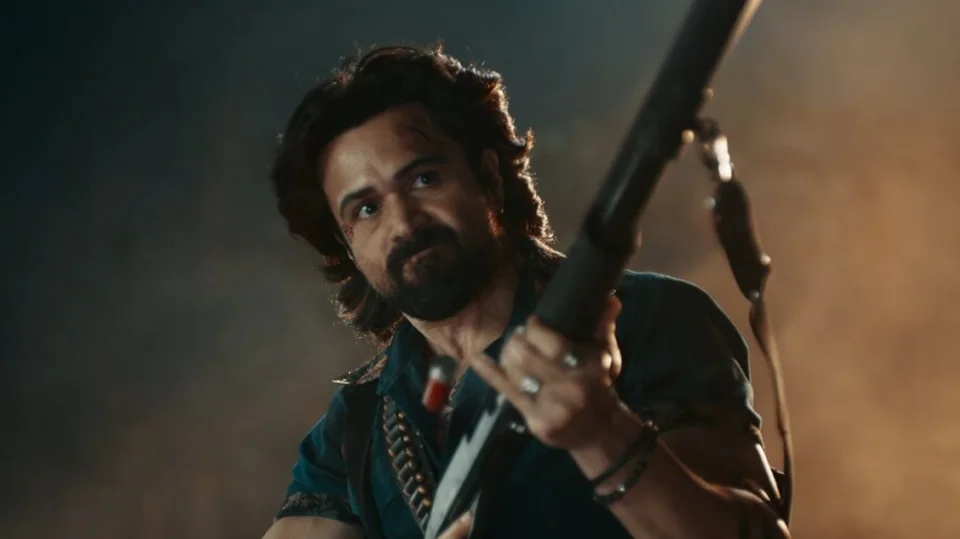
Gunmaaster G9 brings Emraan Hashmi back to a space that audiences have seen him occupy several times before: a man with a troubled past, a seemingly ordinary present and a dangerous side that emerges when his family is threatened. Directed by Aditya Datt, the action thriller combines organised crime, police pressure, family secrets and violent confrontations. However, its familiar storytelling approach makes it difficult for the film to establish a distinct identity.
At the centre of the narrative is Eshwar, played by Emraan Hashmi, a dairy business owner who appears to have left his violent history behind. His relatively peaceful existence is disrupted when a police officer approaches him with a request that quickly turns into a threat. What follows is a journey involving a drug cartel, concealed identities and the return of a man who knows his way around firearms.
The premise offers enough ingredients for a conventional commercial action thriller. There is a conflicted protagonist, a criminal network, an unpredictable antagonist and a family whose safety becomes central to the story. Yet having all these elements in place does not automatically make a compelling film. Gunmaaster G9 repeatedly relies on familiar narrative shortcuts instead of developing its characters and conflicts in unexpected ways.
Although the film finds occasional energy through its action sequences and gives Genelia D’Souza an opportunity to make an impression, its overall execution remains uneven. The result is a thriller that has moments of entertainment but struggles to maintain suspense across its runtime.
Gunmaaster G9 Story: A Dairy Business Owner With a Dangerous Past
The story revolves around Eshwar, a dairy business owner played by Emraan Hashmi. He appears to have moved away from his violent past and built a family life with his wife Aarti, portrayed by Genelia D’Souza, and their daughter Jiya, played by Inayat Verma.
His attempt to maintain a peaceful existence comes under pressure when Inspector Rana, played by Abhishek Singh, approaches him with a proposal. Rana wants Eshwar’s help in dismantling a drug cartel operated by Desu, an influential criminal played by Aparshakti Khurana.
Eshwar refuses to become involved. However, Rana knows enough about his past to make the refusal difficult to maintain. He threatens to expose Eshwar’s history to his family, leaving the protagonist with little choice but to return to the violent world he seemingly abandoned.
This setup establishes the film’s central conflict: a man trying to protect his present while being forced to confront the person he once was. The emotional stakes are straightforward because Eshwar’s family represents everything he stands to lose.
However, the conflict also exposes the screenplay’s biggest limitation. The familiar combination of a retired criminal, a threatening police officer and a dangerous cartel does not offer much room for surprise when the film follows an established action-thriller formula so closely.
The protagonist’s transformation from an ordinary businessman into a gun-wielding action hero is expected almost from the beginning. Instead of building tension around the consequences of his decision, the screenplay frequently moves towards predictable confrontations.
Emraan Hashmi’s Gunmaaster G9 Feels Too Familiar
Emraan Hashmi has developed a recognisable screen presence in crime dramas and action-oriented stories. His performances often combine emotional restraint, personal anguish and an underlying sense of danger. Gunmaaster G9 attempts to use those qualities again, but the familiarity works against the film.
Eshwar is designed as a man whose violent history continues to influence his present. He wants to protect his family, but circumstances push him towards the very life he is trying to escape. It is a character structure that can work when supported by strong writing and meaningful emotional development.
The problem is that the film does not sufficiently distinguish Eshwar from the brooding characters Emraan has portrayed in other projects. His performance contains the expected intensity and emotional pain, but the character does not receive enough fresh dimensions to make this another memorable addition to his filmography.
The comparison with Awarapan 2 is particularly noticeable. The source material points out that Emraan’s latest characters share similarities in their emotional temperament and troubled pasts. While playing variations of a familiar character is not necessarily a weakness, the audience needs something different in the surrounding story.
That difference is difficult to find here. Eshwar’s motivations are understandable, but his journey follows a predictable route. The film offers limited opportunities to explore the psychological cost of returning to violence or the difficult relationship between his past identity and present responsibilities.
For viewers who enjoy Emraan Hashmi’s established action persona, the film may provide some familiar entertainment. Those expecting a significant departure from his previous crime dramas may find the characterisation disappointing.
Aparshakti Khurana Brings a Different Energy as the Villain
One of the more interesting aspects of Gunmaaster G9 is Aparshakti Khurana’s portrayal of Desu. Known for roles that have often explored comedy, supporting characters and lighter dramatic situations, Aparshakti gets an opportunity to move into darker territory.
Desu operates at the centre of the drug cartel and provides the criminal threat that drives the narrative. Unlike the protagonist, whose personality and emotional conflicts feel familiar, the antagonist brings a slightly different energy to the film.
Aparshakti appears willing to experiment with the character’s unpredictable nature. His portrayal gives the villain a distinct presence, helping some of the confrontational scenes feel more engaging than the surrounding narrative.
This casting choice is valuable because crime thrillers depend heavily on the relationship between the hero and the antagonist. A compelling villain can create tension even when audiences already understand the broad direction of the story.
Unfortunately, the screenplay does not consistently take advantage of this potential. Desu is an interesting starting point, but the film needs stronger character development and more substantial conflicts to make the rivalry genuinely gripping.
Nevertheless, Aparshakti remains one of the film’s more effective performers. His willingness to step outside his familiar acting territory adds a welcome variation to an otherwise conventional narrative.
Genelia D’Souza’s Character Gives the Second Half a Much-Needed Boost
Genelia D’Souza plays Aarti, Eshwar’s wife, whose character initially appears to occupy a familiar position in the story. As the narrative progresses, however, the film reveals that she has a darker history of her own.
This development gives the second half a different direction. Rather than keeping the entire dramatic burden on Emraan’s character, the screenplay allows Aarti to become more involved in the unfolding conflict.
Genelia makes effective use of the opportunity. Her performance becomes particularly interesting when the film explores the character’s hidden side and places her at the centre of an action sequence.
The sequence is among the more entertaining portions of Gunmaaster G9 because it changes the expected dynamic between the central characters. Aarti is no longer simply someone whose safety motivates the hero. She becomes an active participant in the film’s dangerous world.
This is arguably the direction the screenplay should have explored more extensively. Giving secondary characters independent motivations, secrets and meaningful decisions can make a familiar action story feel considerably fresher.
However, Aarti’s development arrives relatively late. The film could have benefited from introducing more clues about her past earlier, allowing the eventual revelation to feel like the natural culmination of carefully constructed storytelling rather than a device used to inject excitement into the second half.
Even with these limitations, Genelia’s performance provides some welcome variety. Her involvement also highlights the potential of a story in which both partners have complicated histories rather than one character carrying the entire action narrative.
Why the Screenplay Struggles to Maintain Suspense
The biggest creative problem with Gunmaaster G9 is its screenplay. Written by Sarim Momin and Junaid Wasi, the story uses familiar action-thriller elements without developing a sufficiently distinctive narrative identity.
The audience is introduced to a protagonist with a dark past, a police officer who uses that past as leverage, a criminal mastermind and a family caught in the middle. Each element has a clear function, but the film rarely finds an unexpected way to connect them.
Predictability is not automatically a problem in commercial cinema. Many successful action films operate within recognisable storytelling structures. Audiences often watch these films precisely because they enjoy familiar character types, dramatic confrontations and action-driven resolutions.
What matters is how filmmakers use those conventions. Strong performances, carefully constructed suspense, memorable dialogue, interesting relationships or innovative action choreography can make an established formula entertaining.
Gunmaaster G9 does not consistently provide these elements. Its conflicts often unfold in ways that are easy to anticipate, reducing the tension that should drive a crime thriller.
Excessive Flashbacks Interrupt the Narrative
Another weakness is the film’s repeated use of flashbacks. Backstories are useful when they reveal information that changes how viewers understand the present. They can also create suspense by gradually explaining a character’s motivations.
However, flashbacks need to be integrated carefully into the main narrative. When they appear too frequently or interrupt important developments, they can make the storytelling feel fragmented.
In Gunmaaster G9, the flashbacks do not always add enough meaningful information to justify their interruptions. Instead of deepening the central conflict, they frequently slow the narrative and weaken its momentum.
This is particularly noticeable in a genre where pacing is essential. An action thriller needs to balance exposition with movement. Viewers should understand why characters make certain decisions without feeling that the film repeatedly pauses to explain information that could have been introduced more naturally.
A more disciplined approach to the backstory could have helped the film maintain a stronger connection between Eshwar’s past and his present circumstances.
Gunmaaster G9 Music and Cinematography: A Mixed Technical Experience
Music has historically played an important role in Emraan Hashmi’s filmography. Several of his films have benefited from memorable romantic and emotional tracks that continue to contribute to their popularity beyond their theatrical runs.
That musical expectation becomes relevant when evaluating Gunmaaster G9. The film does not offer the kind of memorable soundtrack that audiences might associate with an Emraan Hashmi crime drama.
Himesh Reshammiya is credited with the music, but the soundtrack does not emerge as one of the film’s strongest attractions. The absence of particularly memorable melodies also means that the emotional portions do not receive the additional musical support that could have made them more effective.
The contrast is noticeable given that Reshammiya has also composed music for Yeh Prem Mol Liya, another film released around the same time. While musical preferences are subjective, Gunmaaster G9 does not make a similarly strong impression through its songs.
The cinematography, handled by Keiko Nakahara and Anik Ram Verma, fares better. The visual presentation provides a competent foundation for the film’s action-driven storytelling.
However, good cinematography cannot compensate entirely for an underdeveloped screenplay. Strong visuals can make individual sequences more engaging, but the overall impact still depends on how effectively the story connects those moments.
Performances: Who Makes the Biggest Impression?
Gunmaaster G9 has a cast that brings together performers with different screen personalities. However, the effectiveness of their contributions varies according to the material available to them.
- Emraan Hashmi as Eshwar: Emraan delivers the brooding intensity associated with his familiar action and crime-drama roles. However, the character lacks sufficient originality to make the performance feel significantly different from his recent work.
- Genelia D’Souza as Aarti: Genelia makes the most of her character’s development in the second half. Her involvement in the action narrative provides one of the film’s more refreshing moments.
- Aparshakti Khurana as Desu: Aparshakti brings an effective, unpredictable quality to the antagonist. His performance offers a different dimension to the film’s otherwise conventional character dynamics.
- Abhishek Singh as Inspector Rana: Abhishek is adequate as the police officer who pushes Eshwar back into his violent past, although the role does not leave a particularly strong impression.
- Inayat Verma as Jiya: Inayat plays Eshwar and Aarti’s daughter, whose presence helps establish the family’s emotional stakes within the story.
The central issue is not necessarily the cast’s ability but the limitations of the writing. When characters are constructed around familiar dramatic functions, even capable performers can struggle to create genuinely memorable moments.
How Gunmaaster G9 Fits Into Bollywood’s Action-Thriller Formula
Gunmaaster G9 belongs to a recognisable tradition of Hindi action thrillers built around protagonists who have attempted to leave criminal or violent lives behind. Their peaceful existence is disrupted by an external threat, forcing them to return to their previous identities.
This narrative structure has considerable commercial appeal because it creates an immediate conflict. The hero has something to protect, the antagonist provides a direct threat and the audience understands what is at stake.
However, the formula also places additional responsibility on the screenplay. When the central premise is familiar, filmmakers need to find other ways to distinguish their films.
One approach is to give the protagonist a genuinely complicated moral dilemma. Another is to make the antagonist more than a conventional obstacle. A third is to build the family relationships with enough emotional depth that the action feels connected to the characters rather than simply functioning as spectacle.
Genelia’s character offers a glimpse of what such an approach could achieve. Her hidden past creates an opportunity to expand the film’s central conflict beyond Eshwar’s personal journey.
Similarly, Aparshakti’s casting provides an opportunity to create a villain who does not feel like a standard crime-film antagonist. These are promising elements, but the screenplay does not develop them consistently enough.
The film also raises a broader question about franchise storytelling. Its ending sets up the possibility of a sequel, but continuing a story requires more than leaving the protagonist’s journey unfinished. A successful follow-up needs a fresh conflict, meaningful character progression and a reason for audiences to return.
Will There Be a Gunmaaster G9 Sequel?
The ending of Gunmaaster G9 appears to leave room for another instalment. This suggests that the filmmakers may be interested in developing the story into a larger action franchise.
However, a sequel would need to address the creative limitations of the first film. Repeating the same combination of a troubled protagonist, family threats and criminal confrontations could make the franchise increasingly predictable.
The more interesting possibility would be to build on the characters who received comparatively less attention in the first instalment. Aarti’s background, for instance, provides an opportunity for a different perspective on the story’s criminal world.
Desu’s characterisation also demonstrates the value of giving antagonists distinct personalities rather than relying entirely on their capacity for violence. A sequel could benefit from making the conflict more psychologically and emotionally complex.
For now, the film’s ending should be viewed as a setup for a possible continuation rather than confirmation of a completed sequel plan. Any future instalment would need to establish its own identity instead of relying exclusively on the recognition of the existing characters.
Final Verdict: Is Gunmaaster G9 Worth Watching?
Gunmaaster G9 has the basic ingredients of a commercial action thriller, but it struggles to turn them into a consistently engaging cinematic experience. Emraan Hashmi brings his familiar intensity to Eshwar, Aparshakti Khurana makes an impression as the antagonist, and Genelia D’Souza adds welcome energy when the narrative finally explores her character’s darker side.
The cinematography is another positive, while the action sequences provide occasional entertainment. Unfortunately, these strengths are undermined by predictable writing, excessive flashbacks and a soundtrack that fails to leave a lasting impression.
The film’s biggest missed opportunity is its failure to make the central characters feel sufficiently different from those audiences have encountered in previous Hindi crime dramas. Eshwar’s troubled past and determination to protect his family provide a workable foundation, but the screenplay rarely moves beyond the expected developments.
There is nothing inherently wrong with revisiting a successful Bollywood action formula. The problem begins when familiarity replaces creativity. Gunmaaster G9 occasionally finds the energy needed to entertain, particularly through Genelia’s second-half involvement, but it does not sustain that momentum.
Ultimately, Emraan Hashmi’s guns can deliver action, but they cannot solve a screenplay that runs short of fresh ideas. The film may appeal to viewers looking for a conventional crime thriller and familiar star performances. Those expecting an original story or a significant reinvention of the genre, however, may find themselves disappointed.
For breaking news and live news updates, like us on Facebook or follow us on Twitter and Instagram. Read more on Latest Entertainment on thefoxdaily.com.






COMMENTS 0