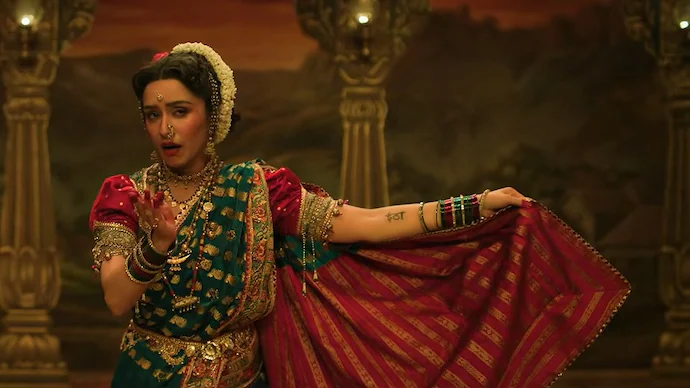
Shraddha Kapoor is preparing for one of the most demanding theatrical releases of her career with Eetha, a biographical drama inspired by the life of legendary Marathi Lavani performer Vithabai Narayangaonkar. The film has cleared the Central Board of Film Certification (CBFC), marking an important step ahead of its scheduled theatrical release on December 4.
However, the certification announcement has drawn attention for another reason: Eetha is now the longest film of Shraddha Kapoor’s acting career. With an approved runtime of 2 hours, 52 minutes and 8 seconds, the Laxman Utekar directorial narrowly surpasses her previous record-holder, Saaho, which was released in 2019.
The extended runtime suggests that audiences can expect a substantial cinematic presentation of Vithabai Narayangaonkar’s life and artistic journey. The film’s central subject also places it within a tradition of Indian biographical dramas that explore the lives of performers whose contributions have often remained outside mainstream historical narratives.
Eetha Receives UA 16+ Certificate Ahead of December 4 Release
According to the certification details listed on the CBFC website, Eetha was granted a UA 16+ certificate on November 27. The film was submitted for certification by Maddock Films and Kathputli Creations Private Limited.
The approved runtime is 2 hours, 52 minutes and 8 seconds, making the film one of the lengthiest theatrical projects in Shraddha’s filmography. The certification is a significant pre-release milestone, indicating that the film has completed the required censor board review before its planned arrival in cinemas.
A UA 16+ classification indicates that the film is considered suitable for viewers aged 16 and above, while younger audiences may watch it under adult guidance. The classification provides viewers with an indication of the content category before they decide to watch the film.
For a biographical drama centred on a performer who challenged social restrictions, the film’s nearly three-hour duration could allow its narrative to explore different stages of her life, including personal struggles, artistic development and the social environment in which she built her reputation. However, the exact distribution of the film’s story across these themes will become clearer when audiences watch it.
Eetha Surpasses Saaho to Become Shraddha Kapoor’s Longest Film
Before Eetha, Shraddha Kapoor’s longest theatrical release was the 2019 action thriller Saaho, starring Prabhas in the lead role. The film had a runtime of approximately 2 hours and 51 minutes. Eetha exceeds that duration by just over a minute, establishing a new record in Shraddha’s career.
The difference may be small, but it places the upcoming biographical drama at the top of a notable list of longer films featuring the actor. Several of her previous projects have also had runtimes extending beyond two and a half hours.
Shraddha Kapoor’s longest theatrical films
- Eetha: 2 hours, 52 minutes and 8 seconds.
- Saaho (2019): 2 hours and 51 minutes.
- Batti Gul Meter Chalu: 2 hours and 43 minutes.
- Haider: 2 hours and 42 minutes.
- Tu Jhoothi Main Makkaar: 2 hours and 39 minutes.
The list reflects the range of projects Shraddha has been associated with, from romantic comedies and social dramas to action thrillers and literary adaptations. Her upcoming film now adds a biographical performance to that mix.
Runtime alone does not determine whether a film will connect with audiences. A longer duration can give filmmakers room to develop characters, establish historical settings and build emotional context, but it also places greater responsibility on the screenplay, performances and editing to maintain narrative momentum.
For Eetha, the challenge will be to make the extended duration feel justified by the scale of Vithabai Narayangaonkar’s story. The subject offers an opportunity to explore not only an individual artist’s achievements but also the social structures that shaped her experiences.
Who Was Vithabai Narayangaonkar? The Real-Life Story Behind Eetha
Eetha draws inspiration from the life of Vithabai Narayangaonkar, a renowned Marathi Lavani artist. Her story forms the foundation of the film, which focuses on a woman who built an enduring artistic identity despite facing social discrimination and restrictions.
Lavani is a traditional performance form associated with Maharashtra, combining music, rhythm, poetry and expressive dance. It has developed through different cultural and performance traditions, becoming an important part of the state’s artistic heritage. Performers have historically played a significant role in keeping the form alive through stage performances and community traditions.
Yet the social position of Lavani performers has often been complicated. Their artistic contributions have not always translated into equal social recognition, and performers have frequently faced prejudice connected to gender, caste and the circumstances in which the art form has been practised.
That tension between artistic recognition and social acceptance appears central to the premise of Eetha. Rather than presenting its protagonist’s journey only as a story of professional achievement, the film aims to examine the barriers she had to confront while establishing her identity.
Vithabai’s life therefore offers a subject through which the film can explore wider questions about women’s independence, the social perception of traditional performers and the relationship between cultural heritage and social hierarchy.
Eetha Explores Caste, Tradition and a Woman’s Fight for Recognition
The official synopsis describes Eetha as the story of a gifted Lavani artist born into a marginalised community who dreams beyond the boundaries of caste, convention and tradition. It highlights her struggle against prejudice, unequal power structures and the demands of a male-dominated society in post-Independence India.
The synopsis reads:
“Eetha follows a gifted Lavani artist born into the margins of society who dares to dream beyond the boundaries of caste, convention, and tradition. Battling prejudice, power, and the relentless demands of a male-dominated, post-Independence India, she forges her own identity and a legacy that can never be erased.”
The emphasis on post-Independence India is important to the film’s historical setting. India’s independence brought political change, but social inequalities did not disappear overnight. Caste-based discrimination, restrictions on women’s choices and unequal access to opportunities continued to influence everyday life across communities.
For women working in traditional performance industries, these challenges could be particularly complex. Their talent might attract public attention while their personal lives and social identities remained subject to judgement. This contrast provides a meaningful backdrop for a story about a performer determined to be recognised for her work.
The film’s premise also raises questions about how Indian cultural history remembers artists. Performers who contribute significantly to regional traditions do not always receive the same visibility as mainstream cultural figures. Biographical films can help bring such stories to a wider audience, although their impact ultimately depends on how carefully they represent the people and communities involved.
By placing Vithabai Narayangaonkar at the centre of its narrative, Eetha has the opportunity to introduce audiences to an important figure from Maharashtra’s performance heritage while examining the social conditions surrounding her journey.
Shraddha Kapoor Leads a Cast Featuring Randeep Hooda and Nana Patekar
Shraddha Kapoor plays the central character in Eetha, with the film bringing together a supporting ensemble that includes several established performers. The cast features Randeep Hooda, Mohammed Zeeshan Ayyub, Anant Joshi, Akshara Singh and Ulka Gupta, alongside the late Nana Patekar.
The ensemble is an important part of a biographical drama that seeks to recreate a particular social and cultural environment. Supporting characters can help establish the relationships, conflicts and institutions that shape the protagonist’s journey. Their roles may also provide context for the different pressures faced by the central character.
For Shraddha, the project represents a departure from the horror-comedy space that defined her most recent theatrical appearance. Playing a historical personality inspired by a real performer also brings a different set of expectations, particularly regarding characterisation, physical expression and the portrayal of a culturally specific art form.
Lavani is a performance tradition in which rhythm, movement and expression are central. Consequently, portraying a Lavani artist on screen involves more than recreating a character’s appearance. The performance must also communicate the artistic discipline and emotional expression associated with the form.
How effectively Shraddha approaches these aspects will be among the key points of interest when the film reaches theatres.
Laxman Utekar Directs the Biographical Drama
Eetha is directed by Laxman Utekar, who is known for working across different genres and stories rooted in Indian social settings. His involvement places the film within a body of Hindi cinema that has increasingly explored stories inspired by real people, regional cultures and historical experiences.
Biographical filmmaking requires a balance between storytelling and historical responsibility. Real-life subjects often have complex personal histories that cannot always be accommodated in a conventional feature-film structure. Filmmakers must decide which events and relationships to emphasise while ensuring that dramatic choices do not distort the central identity of the person being portrayed.
In the case of Eetha, the challenge is particularly significant because the story involves both an individual life and a traditional performance culture. The film needs to make Vithabai’s experiences accessible to contemporary audiences while retaining the cultural and social context that shaped her journey.
The nearly three-hour runtime gives the production considerable space to develop its narrative. Whether that space translates into a layered account of the artist’s life will depend on the film’s screenplay, direction and performances.
Eetha Faces Box Office Competition From Salman Khan’s Maatrubhumi
Alongside its biographical subject and lengthy runtime, Eetha will also have to navigate a competitive theatrical release period. The film is scheduled to arrive in cinemas on December 4, the same week as Salman Khan and Chitrangda Singh’s war drama Maatrubhumi: May War Rest in Peace.
The two films belong to different genres and are built around distinct storytelling approaches. While Eetha centres on the life of a Marathi Lavani performer and the social barriers she challenged, Maatrubhumi is positioned as a war drama.
Their simultaneous arrival could give audiences contrasting cinematic choices. One offers a character-driven biographical narrative rooted in regional cultural history, while the other brings a military-themed story to the big screen.
However, a shared release period does not automatically determine the commercial performance of either film. Audience interest, promotional campaigns, screen availability, reviews and word of mouth can all influence a film’s theatrical journey.
For Eetha, the central appeal will likely rest on Shraddha’s portrayal of Vithabai, the film’s treatment of Lavani culture and its ability to communicate a relatively unfamiliar real-life story to a broad audience.
Stree 2 Was Shraddha Kapoor’s Last Theatrical Release
Before Eetha, Shraddha Kapoor’s last theatrical release was Stree 2, directed by Amar Kaushik and released in 2024. The horror-comedy featured Rajkummar Rao, Pankaj Tripathi, Abhishek Banerjee and Aparshakti Khurana in key roles.
Stree 2 continued the story established by the earlier film and brought Shraddha back into a popular cinematic universe built around horror, comedy and folklore. Her role in the franchise helped maintain her association with a genre that has attracted considerable attention in Hindi cinema.
Eetha offers a noticeably different setting and narrative focus. Instead of supernatural humour, the upcoming film explores the life of a real-life cultural figure and the social inequalities surrounding her artistic journey.
The transition also highlights the variety of roles available within Shraddha’s filmography. While Stree 2 was part of a commercially established franchise, Eetha is built around a biographical subject whose story is closely connected to Maharashtra’s cultural history.
What to Expect From Shraddha Kapoor’s Eetha
With its CBFC clearance secured and its December 4 release date approaching, Eetha is entering the final stage of its pre-release journey. The film has already attracted attention for becoming the longest theatrical release of Shraddha Kapoor’s career, but its significance extends beyond the runtime milestone.
Its subject offers an opportunity to bring Vithabai Narayangaonkar’s life and contribution to Lavani into wider public discussion. The story also touches on issues that remain relevant to conversations about gender, caste, cultural labour and the recognition of traditional artists.
The nearly three-hour duration gives the filmmakers room to present a detailed account of the protagonist’s experiences. At the same time, it creates an expectation that the narrative will use its length effectively, keeping the audience engaged while doing justice to the complexity of the real-life inspiration.
Shraddha’s performance will be central to that effort, particularly because the role involves portraying an artist whose identity is inseparable from her cultural environment and performance tradition. The supporting cast, direction and treatment of the historical setting will also shape the film’s overall impact.
Ultimately, Eetha will be judged not simply by whether it becomes Shraddha Kapoor’s longest film, but by how convincingly it brings an overlooked artistic journey to the screen. Its December 4 theatrical release will reveal whether the biographical drama can turn that promising subject into a compelling cinematic experience.
For breaking news and live news updates, like us on Facebook or follow us on Twitter and Instagram. Read more on Latest Entertainment on thefoxdaily.com.






COMMENTS 0