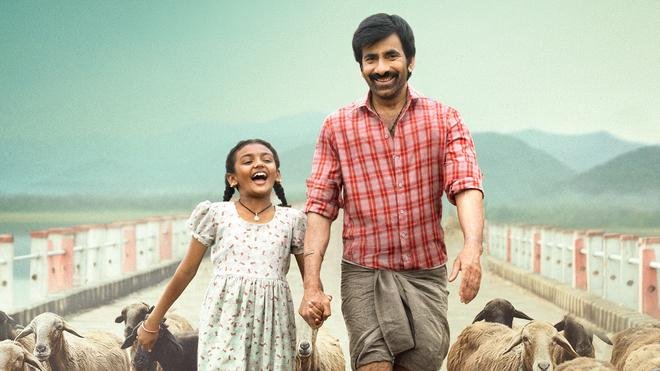
Shiva Nirvana’s Irumudi is most effective when it stops being a conventional rural drama and becomes a conversation about what adults teach children about fear. At the centre of the Telugu film is a deceptively simple question: when a child faces something wrong, should she be taught to remain cautious and silent, or should she be given the confidence to speak about it?
The film does not treat that question as an abstract social issue. It places it inside families, schools and a village community where information travels quickly but uncomfortable truths can still remain hidden. Through Trinath, played by Ravi Teja, and the younger generation represented by child actor Nakshatra, Irumudi explores the difference between protecting a child from danger and preparing that child to confront it.
That distinction gives the film its emotional core.
Set in a village in Andhra Pradesh where even basic bus connectivity can be difficult, the story uses geography to underline the vulnerability of children. A nearby high school can be difficult to access. Parents have to weigh distance, safety and opportunity. Within the school itself, the promise of education exists alongside practices and attitudes that can put children at risk.
Shiva Nirvana builds this world with a persistent sense of unease. Rather than rushing towards dramatic revelations, he allows fear to settle into the atmosphere.
The result is a film that finds its strongest moments not in spectacle but in the conversations between parents and children.
What Is ‘Irumudi’ About?
Irumudi follows Trinath, a father whose relationship with his daughter becomes central to the film’s exploration of parenting, safety and trust.
The story begins with an incident of corporal punishment involving an adolescent girl. That early sequence immediately establishes the school as a place where authority does not necessarily translate into protection.
The film then creates a striking contrast through the behaviour of two fathers.
When one girl encounters abuse and wants to complain, her father tells her not to turn the matter into a major issue. His reasoning comes from a familiar but damaging idea: that fear itself can keep a girl safe.
Another father takes the opposite approach. He encourages his daughter to be transparent about what happens at school and in the village. Instead of teaching her that silence is protection, he creates an environment in which she can speak without fear of punishment or disbelief.
That contrast is the central idea of Irumudi.
Fear Can Protect a Child — Until It Prevents Them From Speaking
The film’s most valuable insight lies in its treatment of fear.
Parents naturally want children to understand danger. Stranger awareness, caution around unfamiliar situations and an understanding of personal boundaries can all be important parts of growing up safely.
But there is a difference between teaching caution and teaching fear.
A child who is taught that the world is dangerous may become careful. A child who is taught that speaking about danger will create trouble may instead learn to remain silent.
Irumudi understands that distinction.
Its fathers represent two different philosophies of protection. One sees silence as a shield. The other sees communication as one.
That makes the film’s parenting message more nuanced than a simple “protect your daughters” slogan.
The deeper argument is that children need both safety rules and the confidence to report when those rules fail.
Why the Village Setting Matters
Shiva Nirvana’s decision to locate the story in a rural Andhra Pradesh setting is more than an aesthetic choice.
Infrastructure becomes part of the narrative.
When buses are infrequent and schools are located outside the immediate village, education itself involves negotiation. Parents have to consider how children will travel, how far they must go and who will be responsible for them along the way.
That physical distance can also create social distance.
A child who spends part of the day away from the immediate protection of family enters an environment where teachers, older students, transport workers and other adults become part of her daily world.
The film uses that reality to ask a difficult question: what happens when a child encounters a problem in a place where her parents are not present?
The answer cannot simply be that parents should watch children more closely.
At some point, children have to be equipped to recognise inappropriate behaviour and communicate what has happened.
The Opening Establishes the Film’s Moral Universe
Irumudi opens with corporal punishment inflicted on an adolescent girl at school.
It is an important choice because the film establishes the problem through the child’s experience rather than beginning with an explanation of the adults around her.
The incident also introduces the complicated relationship between authority and safety.
A school is supposed to be a place of learning and protection. But authority figures can misuse power, and children can struggle to understand whether they are allowed to challenge adults.
That uncertainty is central to the film.
If a child is repeatedly taught that adults must never be questioned, speaking up becomes extraordinarily difficult when the adult is the problem.
Ravi Teja’s Trinath Is More Than a Protective Father
Ravi Teja brings the necessary emotional weight to Trinath.
The character is introduced through a moment that tells us a great deal about his personality. Early in the morning, he lashes out at a truck driver for honking loudly while his daughter is sleeping.
It is an almost comic demonstration of paternal protectiveness, but it also contains the seed of a contradiction.
Trinath wants to control the environment around his daughter.
But the world cannot always be controlled.
A truck can honk. A bus can arrive late. A school can contain people a parent does not trust. A child will eventually experience situations outside the parent’s immediate supervision.
That makes Trinath’s emotional journey more interesting than a straightforward “good father” narrative.
The film gradually asks whether loving a child means eliminating every danger or teaching the child what to do when danger cannot be eliminated.
Nakshatra Gives the Film Its Emotional Centre
Child actor Nakshatra is crucial to the film’s impact.
The danger in a story like this is that a child character can become merely a device through which adults learn lessons. Irumudi works better when the child’s emotional world remains visible.
Nakshatra’s performance gives the story vulnerability without making the character feel helpless.
That distinction matters.
A film about empowering children should not constantly portray them only as victims waiting for adults to rescue them. The more meaningful approach is to show children as people who can observe, understand, question and communicate.
Nakshatra’s presence helps the film move towards that idea.
The Two Fathers Are the Film’s Most Powerful Device
The contrast between the two fathers is perhaps the clearest example of Shiva Nirvana’s storytelling strategy.
Rather than presenting a long lecture about parenting, the film places two opposing approaches side by side.
| Parenting approach | Underlying belief | Potential consequence |
|---|---|---|
| Teach fear and discourage complaints | Silence prevents trouble and keeps a girl safe | The child may hesitate to report harmful behaviour |
| Encourage openness and communication | Trust helps children seek help when something is wrong | The child is more likely to share difficult experiences |
The film’s argument is not that parents should abandon caution.
It is that caution without communication can become another form of vulnerability.
Shiva Nirvana Builds Suspense Without Relying Only on Action
Known for relationship-driven storytelling, Shiva Nirvana takes a different tonal route here.
Irumudi maintains a sense of foreboding from its opening moments. The village is not presented as a picturesque space untouched by social problems. Instead, everyday life contains small signs of tension.
That approach allows the film to create suspense through anticipation.
The audience begins to wonder what might happen, who can be trusted and whether the adults surrounding the children will recognise the warning signs in time.
This is particularly effective because the threat does not have to be exaggerated to feel serious.
For a child, an adult’s misuse of authority can be frightening precisely because the child may not know how to challenge it.
Education Is at the Heart of the Conflict
The school in Irumudi represents more than a physical location.
For families in the village, education is a route towards opportunity. But access to education does not automatically guarantee a safe educational environment.
The film therefore connects two questions that are often discussed separately: Can children reach school, and are they safe once they get there?
Transportation, distance and infrastructure determine whether children can attend regularly. Institutional culture determines whether they feel secure enough to learn and speak.
Both matter.
A school can have classrooms and teachers, yet still fail a child if that child believes that reporting mistreatment will result in punishment, humiliation or disbelief.
What ‘Irumudi’ Gets Right About Child Safety
The film’s strongest contribution is its understanding that child safety is not simply about physical protection.
There is also psychological safety.
A child needs to know that an adult will listen.
They need to know that reporting something uncomfortable will not automatically result in blame.
They need language for discussing experiences they may not fully understand.
And they need trusted adults who will take those disclosures seriously.
These principles are relevant far beyond the village setting depicted in the film.
They apply at schools, sports academies, tuition centres, neighbourhoods and even online spaces where children increasingly interact without direct adult supervision.
Where the Film Could Have Gone Further
The film’s emotional approach is its strength, but its commitment to message-driven storytelling can occasionally make its larger ideas feel too clearly signposted.
The contrast between the two fathers is powerful precisely because it is simple. However, real families often exist somewhere between those two extremes.
Parents may simultaneously want children to be cautious and encourage openness. Some may understand the importance of speaking up but struggle with their own fears about social consequences.
A more complicated exploration of these contradictions could have made the film’s argument even richer.
Still, the clarity of its central message gives Irumudi accessibility. The film wants its audience to leave with an idea they can apply beyond the theatre.
The Bigger Conversation: Protection Versus Empowerment
The most useful way to read Irumudi is not as a film arguing that parents should stop protecting their daughters.
It is arguing for a different definition of protection.
Traditional protection often means controlling the child’s environment: deciding where she goes, who she meets and what risks she encounters.
Empowerment adds another layer.
It asks whether the child knows what to do when something feels wrong.
Can she say no?
Can she identify inappropriate behaviour?
Can she tell a trusted adult?
Will that adult believe her?
Can she expect support rather than blame?
These questions transform child safety from a system of restrictions into a system of trust.
Why the Film Matters Beyond Its Story
Indian cinema has frequently explored the relationship between parents and children, but films about daughters and safety can easily become either melodramatic or didactic.
Irumudi finds a more productive route by making parenting itself part of the conflict.
The film suggests that children learn how to respond to danger partly from the messages adults give them every day.
“Be careful” is useful advice.
“Don’t tell anyone because it will create trouble” can be dangerous.
“Tell me if anything happens, even if you think it is your fault” creates an entirely different environment.
The distinction is small in language but enormous in consequence.
Ravi Teja and Shiva Nirvana Find Their Rhythm Again
Another significant aspect of Irumudi is the collaboration between Ravi Teja and Shiva Nirvana.
For Ravi Teja, the film offers a role that allows him to move beyond the familiar rhythms of star-driven entertainment and explore a character whose emotional stakes are rooted in fatherhood.
Shiva Nirvana, meanwhile, returns to the relationship-focused emotional storytelling that has been central to his strongest work.
The combination works because the film gives the actor room to express vulnerability without completely abandoning the energy associated with his screen persona.
There are moments of humour and aggression, but they exist within a larger emotional framework.
That balance helps Ravi Teja make Trinath feel like a father rather than simply a star playing one.
A Different Kind of Rural Telugu Drama
Rural settings in Indian cinema can easily become shorthand for innocence, tradition or hardship.
Irumudi avoids making the village purely idyllic.
It recognises the warmth of community while also showing how closely knit communities can carry their own pressures. Everyone knows everyone, but that does not necessarily mean every child feels free to speak.
That contradiction gives the setting authenticity.
The village becomes a place where social relationships can offer protection and simultaneously make disclosure difficult.
When everyone knows each other, a complaint can feel like a threat to the entire social order.
That is precisely why the film’s insistence on listening to children becomes important.
Verdict: An Emotional Film With a Message That Matters
Irumudi is most compelling when it trusts its characters to carry its message.
Ravi Teja brings emotional strength to Trinath, while Nakshatra provides the film with a sensitive child perspective. Shiva Nirvana uses the rural setting and school environment to build a quiet sense of danger rather than depending entirely on conventional thrills.
The film’s central contrast between two fathers gives it its most memorable idea: fear may make a child cautious, but trust gives a child somewhere to turn when caution is not enough.
That is an especially important distinction in conversations about protecting girls.
Children cannot be kept away from every difficult situation. Parents cannot accompany them everywhere. Schools cannot eliminate every risk. Communities cannot guarantee that every adult will behave responsibly.
What adults can build is a culture in which children know that speaking is safe.
Irumudi turns that principle into the emotional foundation of its story.
Conclusion: The Safest Child Is Not Always the Most Sheltered One
Irumudi ultimately argues for a form of parenting that replaces silence with trust.
Its story begins with fear — a girl encountering abuse, adults deciding how seriously to take it and parents struggling with their instincts to protect their children.
But its deeper destination is empowerment.
The film asks parents to consider what happens after a child leaves the home, enters a classroom or steps into a world that cannot be completely controlled.
The answer, it suggests, cannot simply be more restrictions.
Children also need confidence, language and trusted relationships.
That is where Irumudi finds its most lasting emotional resonance.
A child should not have to choose between being safe and being heard.
And in making that idea central to a Telugu family drama, Shiva Nirvana and Ravi Teja deliver a film that reaches beyond its plot to address a question every parent, school and community must eventually confront: when a child says something is wrong, will we teach her to stay quiet — or will we teach her that her voice matters?
For breaking news and live news updates, like us on Facebook or follow us on Twitter and Instagram. Read more on Latest Entertainment on thefoxdaily.com.


COMMENTS 0