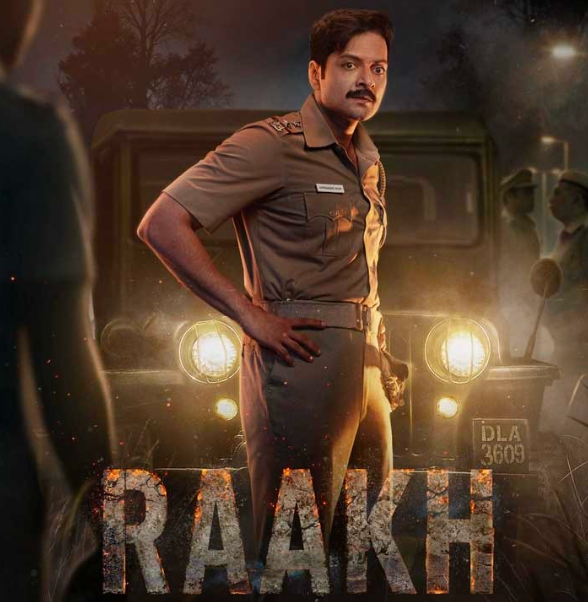
Crime dramas have become a dominant force in the streaming era, but only a handful manage to transcend the boundaries of the genre and become meaningful reflections of society. Raakh, written and co-directed by Anusha Nandakumar and Sandeep Saket with dialogues by Ayush Trivedi, belongs firmly in that category.
While the series revolves around a horrifying crime and the hunt for those responsible, its true strength lies in its ability to use that tragedy as a window into the social, political, and psychological realities of a transformative period in Indian history. Rather than relying solely on suspense and shock value, Raakh examines how systems, prejudices, and circumstances shape both victims and perpetrators.
The result is a Crime Thriller that is as emotionally devastating as it is intellectually engaging.
A Story Told Across Two Timelines
One of Raakh’s most effective storytelling choices is its dual-timeline structure. The narrative constantly shifts between a present-day investigation and the backstory of the killers, gradually revealing how events unfolded and why they happened.
This approach serves two important purposes. First, it sustains suspense by allowing viewers to uncover information piece by piece. Second, and more importantly, it transforms the series from a conventional whodunit into a deeper examination of human behavior.
Instead of merely asking who committed the crime, Raakh asks a more uncomfortable question:
What creates a killer?
By exploring the lives, frustrations, and circumstances of its antagonists, the series avoids simplistic explanations and presents a disturbing portrait of violence emerging from social neglect, personal trauma, and toxic relationships.
The Banality of Evil Makes Raakh Truly Disturbing
Many crime dramas rely on larger-than-life villains to create fear. Raakh takes a completely different approach.
Babu and Rajjo are not criminal masterminds or cinematic monsters. They are ordinary individuals whose casual cruelty and emotional dysfunction make them far more unsettling.
Akash Makhija delivers a chilling performance as Babu, a character portrayed as deeply violent, manipulative, and morally hollow. His menace does not come from dramatic outbursts but from the frightening normalcy with which he commits horrific acts.
Ramandeep Yadav’s Rajjo is equally compelling. Initially appearing as a submissive and hesitant figure, Rajjo becomes trapped in a toxic relationship that gradually strips away his remaining humanity.
The dynamic between the two characters resembles a dysfunctional marriage built on dependence, resentment, fear, and emotional manipulation.
This portrayal highlights one of the series’ most powerful themes: evil often appears ordinary before it becomes catastrophic.
The Emergency Era’s Lasting Shadow
Raakh skillfully incorporates the historical backdrop of India’s Emergency period without allowing it to overwhelm the central narrative.
The series uses subtle visual and narrative details to demonstrate how political decisions can leave lasting scars on individuals and communities.
Rajjo’s forced sterilization during the government’s controversial family-planning campaign becomes a significant element of his character development. Unable to fulfill traditional expectations of masculinity and fatherhood, he struggles with feelings of inadequacy and frustration.
The recurring imagery of government slogans serves as a reminder that policies often affect ordinary citizens in deeply personal ways long after headlines disappear.
Rather than presenting history as background decoration, Raakh integrates it into the emotional and psychological fabric of its characters.
Jayprakash: A Beacon of Integrity in a Broken System
At the heart of the story stands Jayprakash, a young police officer determined to uncover the truth despite institutional obstacles and social prejudice.
Crime dramas frequently feature heroic investigators, but Jayprakash feels refreshingly grounded. He is not portrayed as a flawless savior. Instead, he is an ordinary individual attempting to navigate a deeply flawed system while holding onto his principles.
His investigation becomes more than a search for justice—it becomes a test of character.
As bureaucracy, hierarchy, and discrimination complicate his work, Jayprakash represents the possibility that individual conscience can still make a difference even when institutions fail.
This moral clarity gives the series much of its emotional weight.
A Nuanced Exploration of Caste Identity
One of Raakh’s most significant achievements is its treatment of caste.
Many contemporary narratives either oversimplify caste issues or reduce them to predictable story beats. Raakh adopts a more nuanced and realistic approach.
Jayprakash’s Dalit identity is neither ignored nor sensationalized. Instead, it emerges naturally through his relationship with his father, Ghanshyam, played brilliantly by Rakesh Bedi.
Ghanshyam represents a generation that survived discrimination through compromise and strategic accommodation. Having spent years navigating an unequal system, he views adaptation as a necessary survival skill.
Jayprakash, however, belongs to a new generation. Educated, ambitious, and preparing for civil services, he seeks dignity through merit rather than accommodation.
The tension between father and son reflects a larger social transformation occurring across India.
| Ghanshyam’s Generation | Jayprakash’s Generation |
|---|---|
| Survival through compromise | Advancement through merit |
| Acceptance of limitations | Challenge to limitations |
| Pragmatic adaptation | Idealistic reform |
| System navigation | System transformation |
This generational contrast gives the series additional depth and emotional complexity.
Shared Marginalisation and Social Alliances
An interesting narrative choice is the presence of several Muslim characters within Jayprakash’s professional and personal life.
His colleague Javed and journalist Nisar become important figures in his journey. Their inclusion broadens the social landscape of the series and highlights how different marginalized communities often encounter similar barriers within rigid systems.
Rather than reducing these characters to symbols, Raakh uses them to demonstrate how solidarity can emerge across social boundaries.
This layered representation contributes to the show’s broader examination of power structures and social inequality.
The Evolution of Justice Through Science
Another fascinating aspect of Raakh is its portrayal of forensic investigation.
While the crime itself is rooted in primal violence, the investigation increasingly relies on modern methods and scientific reasoning.
This transition symbolizes a larger societal shift.
The series suggests that justice evolves when institutions embrace evidence, rationality, and professionalism instead of relying solely on assumptions or traditional practices.
In this sense, forensic science becomes a symbol of progress and hope.
A Performance-Led Drama
The success of Raakh rests heavily on its performances, and the cast delivers across the board.
Akash Makhija and Ramandeep Yadav create two of the most unsettling characters seen in recent crime dramas. Their performances feel frighteningly authentic because they avoid exaggeration.
Rakesh Bedi brings tremendous emotional depth to Ghanshyam, portraying a man shaped by years of compromise yet unwilling to surrender his dreams for his son.
Meanwhile, Ali anchors the narrative with remarkable restraint. His portrayal of Jayprakash captures determination, vulnerability, frustration, and hope without ever slipping into melodrama.
His performance provides the moral center around which the entire series revolves.
Why the Final Episodes Matter
The later portions of Raakh deliberately move away from sensational crime storytelling.
Some viewers may find the final episode slower compared to the preceding chapters, but this shift serves an important purpose.
Instead of focusing exclusively on the perpetrators and the investigation, the series redirects attention toward the victims and the futures they were denied.
This creative decision transforms the narrative from a crime story into a meditation on loss.
By emphasizing the humanity of Suman and Sahil, Raakh refuses to reduce them to statistics or plot devices. Their lives become symbols of innocence, possibility, and the responsibilities society must uphold.
Why Raakh Stands Above Typical Crime Thrillers
Most crime dramas prioritize suspense over substance. Raakh manages to excel at both.
- It delivers a compelling mystery.
- It examines the roots of violence.
- It explores caste without oversimplification.
- It addresses historical trauma with sensitivity.
- It highlights institutional failures and individual courage.
- It honors victims instead of exploiting tragedy.
These qualities elevate the series beyond genre conventions and position it as an important social drama disguised as a crime thriller.
Conclusion
Raakh is not an easy watch, nor is it intended to be. Its subject matter is disturbing, its themes are challenging, and its emotional impact lingers long after the final episode. Yet these very qualities make it one of the most significant crime dramas to emerge in the streaming era.
Through exceptional performances, thoughtful writing, and a nuanced understanding of Indian society, the series transforms a horrifying crime into a profound exploration of justice, identity, masculinity, caste, and hope.
More importantly, Raakh reminds viewers that behind every crime headline are real lives, shattered dreams, and unanswered questions. By restoring dignity to its victims while exposing the failures that enabled tragedy, the series achieves something rare: it entertains, educates, and challenges audiences in equal measure.
For breaking news and live news updates, like us on Facebook or follow us on Twitter and Instagram. Read more on Latest Entertainment on thefoxdaily.com.



COMMENTS 0