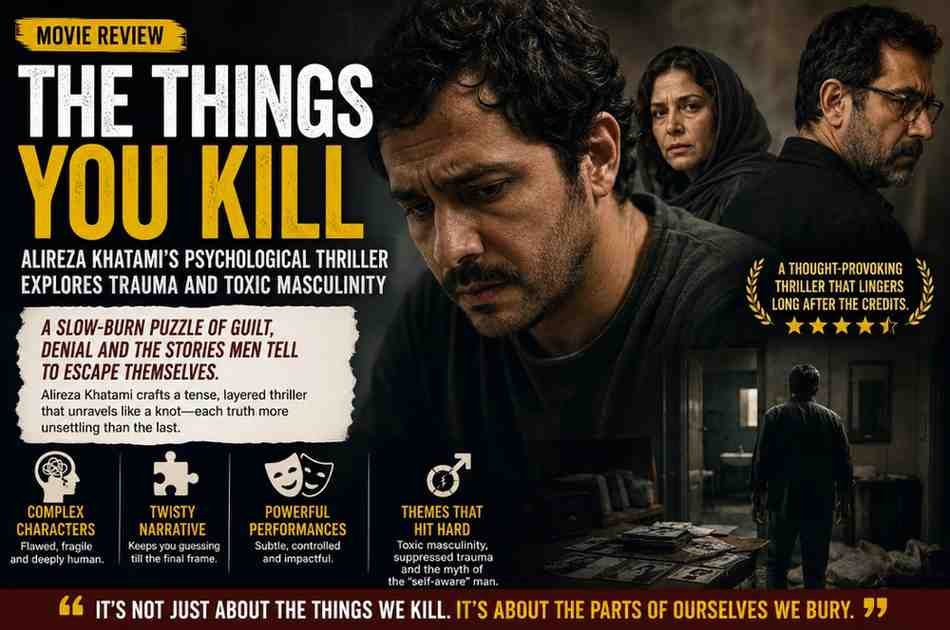
‘The Things You Kill’ Movie Review: Alireza Khatami’s Shape-Shifting Psychological Thriller Dismantles the Myth of the Self-Aware Man
Iranian writer-director Alireza Khatami transforms a domestic mystery into a slippery slow-burn thriller with major trust issues around men who claim to have broken the cycle
Some films tell you a story. The Things You Kill makes you interrogate one scene by scene, cut by cut, until you’re no longer sure which version of events, or which version of its protagonist, you’re actually watching. Written and directed by Iranian filmmaker Alireza Khatami, this Turkish-language psychological thriller premiered at Sundance in early 2025, has since travelled the festival circuit, and opened in New York theaters on November 14 through Cineverse. It also carries the distinction of being Canada’s official submission for the Best International Feature Oscar a notable choice for a film shot almost entirely in Turkish, in rural Anatolia, about a crisis that is deeply, specifically Turkish, yet unmistakably universal.
Who: Ali (Ekin Koç), a literature and translation professor who spent fourteen years teaching in the United States before returning to his native Turkey. What: his mother’s sudden, suspicious death sends him spiraling into confrontation with his abusive father, Hamit (Ercan Kesal), and into an uneasy alliance with a mysterious drifter named Reza (Erkan Kolçak Köstendil), who shows up to tend Ali’s barren mountain garden. When and where: present-day rural Turkey, largely split between Ali’s home with his partner Hazar (Hazar Ergüçlü) and the isolated, drought-choked land he’s inherited. Why it matters: because Khatami isn’t interested in a straightforward revenge plot he’s interested in what happens to a man who believes he’s escaped his father’s violence, only to discover the same violence quietly rerouting itself through him.
Background: Who Is Alireza Khatami, and Why This Story?
To understand what Khatami is doing here, it helps to know where he’s come from. The Things You Kill is his third feature, following his 2017 debut Oblivion Verses and 2023’s Terrestrial Verses, the latter co-directed with fellow Iranian filmmaker Ali Asgari. That earlier film used dry, satirical vignettes to expose how an authoritarian bureaucracy polices ordinary Iranian lives. Khatami’s new film keeps the interest in systems of control, but shrinks the lens down to a single household proving that patriarchy doesn’t need a government stamp to function as an institution. It just needs a father, a son, and enough silence passed between generations to let the pattern repeat.
It’s worth noting the film is dedicated to Khatami’s sisters, and that its two central male names Ali and Reza are, notably, split from the director’s own first name. That’s not a trivia footnote; it’s a structural key. The film is quietly built as a study of a man divided against himself, and Khatami has embedded that division directly into his characters’ names before a single frame acknowledges it out loud.
The Plot, Without Giving Away the Trapdoor
On its surface, The Things You Kill sets up like a classic moral thriller in the Asghar Farhadi mold: a family secret, a suspicious death, a son who suspects his father of covering up abuse. Ali’s mother is found dead from what’s ruled an accidental fall, except the autopsy reveals blunt-force trauma to the back of her head inconsistent with falling face-down. Ali, already convinced his father spent years abusing his mother, becomes obsessed with proving Hamit killed her.
Around the same time, Reza an oddly literate drifter with a notebook full of scribbles and an English paperback tucked under his arm wanders into Ali’s remote, dying garden looking for work. Their relationship curdles from employer-employee into something far more dangerous: Ali, unable to act on his own rage, asks Reza to do what he can’t bring himself to do himself.
Then, roughly at the midpoint, the film does something few mainstream thrillers would risk. Following a sudden act of violence, the narrative essentially fractures. A key character is swapped. The story loops back into what feels like the same events, the same rooms, the same conversations except everything is subtly displaced, like a memory replaying itself with different actors reading the same lines. Whether this is dream, delusion, guilt, or literal alternate reality is never resolved, and that refusal to resolve is the entire point.
Why the Structure Matters More Than the Mystery
It would be easy to read The Things You Kill as a puzzle box demanding to be solved Reza is real, Reza isn’t real, this is a dream, this is a delusion. But treating it purely as a riddle undersells what Khatami is actually doing with the doubling. Ali has spent his adult life building an identity in opposition to his father: educated, foreign-trained, gentle, modern. The film’s structural collapse the moment the narrative starts repeating itself with a slightly altered cast is the moment that identity stops holding up under pressure. Khatami isn’t hiding a twist ending behind the fractured second half; he’s staging the exact process by which a man who believes he has evolved past his father’s cruelty discovers he hasn’t, not really, not when it counts.
That’s the “myth of the self-aware man” this review’s headline points to. Ali is fluent in the language of self-awareness he teaches literature, he understands narrative, he can explain the etymology of translation to his students. But intellectual fluency turns out to be a poor defense against inherited rage. Khatami’s clever needling detail: in the film, Ali notes that the Arabic root behind the word “translation” is linked etymologically to stoning, and by extension, to killing. Understanding, in this film’s logic, isn’t innocent. To translate, interpret, or comprehend something is already, in some sense, to do violence to it — which reframes Ali’s constant self-narration not as insight, but as another form of the same control his father exercised.
Comparisons: Kiarostami’s Ghost, Lynch’s Fingerprints
Critics have reached for two very different reference points to describe this film, and both are useful. There’s the influence of the late Abbas Kiarostami particularly Taste of Cherry in the film’s patient, static long takes and its comfort with narrative ambiguity that never resolves into tidy meaning. And there’s David Lynch, specifically Lost Highway, in the way the film’s midpoint fracture swaps identities and loops reality back on itself without ever confirming which version, if any, is “true.”
That combination is rarer than it sounds. Most films borrow either Kiarostami’s stillness or Lynch’s dread, not both. Khatami fuses a patient, almost meditative Iranian arthouse pacing with a genuinely unsettling genre engine underneath it which explains why so many reviews describe the film as simultaneously hypnotic and disorienting. It rewards patience in its first half and demands total recalibration in its second.
Performances and Craft
Ekin Koç carries the film’s first half as a man visibly corroding from the inside — someone whose composure reads less like strength and more like a held breath. Erkan Kolçak Köstendil’s Reza is the film’s most ambiguous creation: never quite menacing, never quite trustworthy, playing every scene with just enough opacity that you can’t decide whether he’s a catalyst, a mirror, or a hallucination. Ercan Kesal, as the domineering father Hamit, doesn’t lean into cartoonish villainy his cruelty is mundane, procedural, the kind that’s been normalized in the household for decades, which makes it more disturbing, not less.
Cinematographer Bartosz Swiniarski, who also shot the acclaimed Apples, is doing some of the year’s most intentional visual work here. Long, static takes with slow push-ins quietly destabilize domestic spaces a technique used early on as Ali and Hazar stand outside their home recounting a dream, with the camera pushing steadily toward the window until logic itself seems to dissolve. Rack focus becomes a recurring device to blur Ali’s sense of self, and recurring images a cracked mirror, malfunctioning plumbing, a garden that refuses to grow anything build a consistent visual vocabulary around decay, blockage, and infertility, both literal and generational.
Where the Film Stumbles
The film isn’t flawless, and it’s worth being honest about where the ambition outpaces the execution. Several critics have flagged the same issue: once Khatami commits to thematic literalism the sterile garden as an on-the-nose stand-in for Ali’s infertility, the cracked mirror as a symbol for his fractured psyche the film’s otherwise disciplined ambiguity slackens. The second half, for all its formal daring, also runs the risk of overstaying its welcome, stretching its central conceit slightly past the point where its tension continues to build. It’s a film that trusts its audience enormously in its first hour and, in its back half, occasionally second-guesses that trust by explaining what it had previously shown so elegantly.
Khatami’s Three Features, Compared
| Film | Year | Focus | Mode of Storytelling |
|---|---|---|---|
| Oblivion Verses | 2017 | Grief and memory, magical realism | Allegorical, dreamlike |
| Terrestrial Verses | 2023 (co-directed with Ali Asgari) | Bureaucratic control in Iran | Satirical vignettes |
| The Things You Kill | 2025 | Inherited patriarchal violence | Fractured psychological thriller |
Seen together, Khatami’s filmography reveals a director steadily narrowing his aperture — from national allegory to institutional satire to, now, a single household standing in for both. That trajectory suggests his next project is likely to push even further inward, perhaps toward something even more intimately psychological.
Real-World Impact: Why This Film Matters Beyond the Festival Circuit
Films about toxic masculinity and generational trauma aren’t rare, but most resolve into a clean redemption arc or a clean condemnation. The Things You Kill refuses both. Its real cultural value is in denying the audience the comfort of watching a “good man” triumph over a “bad” inherited pattern. Instead, it argues that the pattern doesn’t care how educated, well-traveled, or self-aware you believe yourself to be it will find a route through you anyway, often through the exact mechanisms, like intellect and language, that you thought would protect you.
As a Canadian Oscar submission shot in Turkish with a largely Turkish cast, the film also quietly complicates the usual national-cinema categories that awards bodies rely on a co-production between Canada, Turkey, Poland, and France that resists being neatly filed under any single national identity, fittingly, for a film obsessed with identity that won’t hold still.
Conclusion: A Demanding, Rewarding Watch
The Things You Kill won’t work for viewers who want their thrillers to resolve cleanly. It will linger, uncomfortably, for those willing to sit with a film that treats masculinity, guilt, and inheritance as forces too slippery to fully diagnose. Despite a second half that occasionally over-explains its own symbolism, Khatami has made a genuinely distinctive piece of genre filmmaking one that uses the shape of a thriller to ask a much harder question: can a man who understands his father’s violence intellectually ever actually escape it, or does understanding just become his own, quieter version of the same trap? Expect this film to keep generating debate long after its awards run ends, precisely because it refuses to answer that question for you.
For breaking news and live news updates, like us on Facebook or follow us on Twitter and Instagram. Read more on Latest Entertainment on thefoxdaily.com.






COMMENTS 0