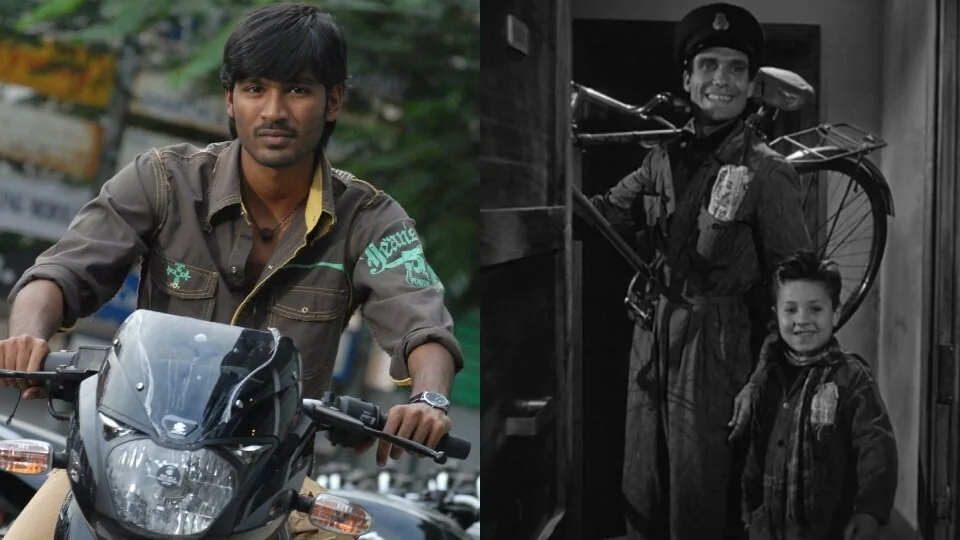
Filmmaker Vetrimaaran has pushed back against a long-standing comparison between his directorial debut, Polladhavan (2007), and Italian neorealist classic Bicycle Thieves (1948). Speaking at the 16th edition of IFP during a conversation with Raunaq Mangottil, the director described comparing the two films as a “disgrace” to Vittorio De Sica’s acclaimed work.
The comparison has followed Polladhavan since its release, largely because both films place a stolen bicycle at the centre of their narratives. But Vetrimaaran argued that a shared storytelling element does not make the films equivalent. He also explained that the idea for his Dhanush-starrer came from a personal incident involving a friend whose bicycle went missing.
His comments offer a glimpse into how the film developed, why its original protagonist changed and how the director adapted the conflict to suit Dhanush’s screen persona. They also reopen a broader discussion about the difference between cinematic inspiration, thematic similarities and direct imitation.
Why Vetrimaaran Rejects the Polladhavan and Bicycle Thieves Comparison
During the IFP16 conversation, Vetrimaaran was asked about the similarities often drawn between Polladhavan and Bicycle Thieves. Rather than accepting the comparison as a compliment, he said that he considered it unfair to De Sica’s film.
“When I started writing only, I knew that people are going to say that it’s lifted from Bicycle Thieves. And I had an answer for it. I always say that comparing Polladhavan to Bicycle Thieves is a disgrace to Bicycle Thieves. Don’t do it. I always say this to everybody. Again, I am saying it here also,” he said.
Vetrimaaran also described his film as more argumentative than the Italian classic. His explanation suggests that he sees the two works as having different narrative concerns and dramatic approaches, despite the prominent role played by a stolen bicycle in each story.
The director’s response is significant because Polladhavan was his first film as a director and became a major success after its 2007 release. The film also went on to inspire remakes in several languages, establishing the story as a commercially successful property beyond its original Tamil audience.
Yet the recurring comparison with an internationally celebrated film has remained part of the conversation around Vetrimaaran’s debut. His latest remarks make clear that he does not believe the similarity in the central object justifies placing the films on the same creative footing.
How a Friend’s Lost Bicycle Inspired Polladhavan
According to Vetrimaaran, the starting point for Polladhavan was not an attempt to recreate Bicycle Thieves. The idea came from an incident involving his friend Andrew, whose bicycle was lost.
A missing bicycle may appear to be a simple everyday problem, but it can become a source of considerable tension when the owner depends on it. A vehicle can represent independence, mobility, work and personal freedom. Losing it can disrupt a person’s routine and bring them into conflict with people they might otherwise never encounter.
That basic situation gave Vetrimaaran a starting point for a story that would eventually move into the world of gangsters, family relationships and a young man’s struggle to reclaim something important to him.
The director also explained that the protagonist and the nature of the conflict changed during development. His initial idea involved an older man who buys a bicycle for his younger brother and subsequently finds himself caught in trouble. The story was later reshaped to suit Dhanush, who was 24 when the film was released.
This change was not merely about making the lead character younger. It affected the balance of power in the central conflict and the kind of confrontation the audience could reasonably expect from the protagonist.
Why Vetrimaaran Changed the Hero to Suit Dhanush
Vetrimaaran said that he adjusted the story to fit Dhanush’s age and established on-screen image. The original version involved a direct fight between a gangster and an ordinary man. However, the filmmaker felt that this confrontation would not be convincing if Dhanush’s character were expected to defeat a powerful gangster.
“His screen persona would not allow him to fight a gangster and win. It doesn’t feel plausible even to me,” the director remarked.
He therefore altered the dramatic arrangement. Instead of making the main antagonist a gangster who directly faces the protagonist, the film introduced the gangster’s brother as a central figure in the conflict.
This gave the story room to build tension without requiring the young protagonist to overcome an opponent whose power and influence would make such a victory difficult to believe. Vetrimaaran also spoke about finding a way to make the gangster’s brother a powerful character by the end of the film.
The decision illustrates an important aspect of adapting a screenplay to an actor. A character’s age, physical presence, established image and perceived strengths can influence how a conflict is written. Rather than forcing the performer into a role that feels unconvincing, a filmmaker may reshape the surrounding characters and circumstances.
In Polladhavan, the adjustment helped create a conflict in which an ordinary young man becomes entangled with a dangerous group after losing his bicycle. The stakes grow from a personal loss into a much larger struggle.
Polladhavan’s Story: A Stolen Bike Turns Into a Dangerous Fight
Polladhavan follows Prabhu Shankar, played by Dhanush, a young middle-class man whose desire to own a motorcycle becomes a point of tension within his family.
After an argument, Prabhu receives money from his father, played by Murali, and buys a bike. His family does not necessarily share his excitement, but he believes the purchase has changed his fortunes. He associates the bike with a new phase of independence and confidence, particularly after securing a job.
The vehicle becomes more than a possession. It represents a sense of achievement and the freedom to move through the world on his own terms. For a young man trying to establish himself, losing it is therefore an emotional as well as a practical setback.
The turning point arrives when the bike is stolen during a date with his girlfriend. Prabhu’s attempt to recover it draws him into a dangerous confrontation with gangsters. What begins as a search for personal property gradually becomes a struggle involving power, survival and the consequences of challenging people with far greater influence.
The film’s appeal comes partly from the way it turns an everyday frustration into a tense crime drama. A missing vehicle is a familiar experience for many people, but the consequences in Prabhu’s case are far more serious because of the people connected to the theft.
By grounding the conflict in an ordinary middle-class setting, the film gives its protagonist a recognisable starting point before moving him into a world of violence and intimidation.
How Bicycle Thieves Tells a Different Story
Released in 1948, Bicycle Thieves, directed by Vittorio De Sica, is one of the best-known works associated with Italian neorealism. The film is set in post-World War II Rome, where economic hardship and unemployment shape the lives of ordinary people.
Its central character, Antonio Ricci, played by Lamberto Maggiorani, needs a bicycle to perform a job that offers his family a chance at financial stability. To obtain one, his wife pawns household possessions. The bicycle is not a luxury or a symbol of youthful independence; it is essential to Antonio’s ability to earn a living.
On his first day at work, the bicycle is stolen. Antonio then searches the city with his young son, Bruno, played by Enzo Staiola, hoping to recover the vehicle before the loss destroys his opportunity to support his family.
The search becomes the film’s central emotional journey. As father and son move through the city, the story explores poverty, desperation, dignity and the pressures that economic insecurity can place on ordinary people.
The bicycle has a practical and symbolic role in the narrative. It represents employment and the fragile possibility of a better life. Without it, Antonio risks losing the job that his family desperately needs.
This context is central to understanding why Vetrimaaran objects to treating the two films as equivalent. While both narratives begin with a stolen bicycle, the circumstances surrounding the theft, the protagonists’ motivations and the wider dramatic conflicts are different.
Polladhavan vs Bicycle Thieves: The Key Story Differences
The most obvious similarity between the films is the stolen bicycle. Beyond that, their narrative settings and character motivations create different dramatic experiences.
| Aspect | Polladhavan (2007) | Bicycle Thieves (1948) |
|---|---|---|
| Director | Vetrimaaran | Vittorio De Sica |
| Lead character | Prabhu Shankar, played by Dhanush | Antonio Ricci, played by Lamberto Maggiorani |
| Setting | Contemporary Tamil middle-class and criminal underworld setting | Post-World War II Rome |
| Reason the bicycle matters | It represents personal independence, aspiration and a young man’s sense of achievement | It is essential for the protagonist to keep his job and support his family |
| Central conflict | The protagonist’s attempt to recover his stolen bike leads to trouble with gangsters | A father and son search for a stolen bicycle amid economic hardship |
| Broader themes | Family approval, masculinity, power and confrontation | Poverty, unemployment, dignity and desperation |
The comparison shows why a shared plot device should not automatically be treated as evidence that one film copies another. A stolen object can serve as the starting point for very different stories depending on the characters, setting and social circumstances around it.
Vetrimaaran’s Interest in Multiple Perspectives and Family Approval
Vetrimaaran also discussed the broader idea behind Polladhavan. He wanted both the protagonist and antagonist to have a role in telling the story, with each trying to win the approval of their respective family heads.
This approach adds another dimension to the conflict. Instead of presenting the central struggle only as a straightforward contest between a good individual and a bad opponent, the narrative gives attention to the motivations and relationships on both sides.
Family approval becomes part of the characters’ emotional worlds. Their actions are connected not only to the immediate fight over the stolen bike but also to how they are viewed by people whose opinions matter to them.
This is an important distinction in a crime drama. The antagonist is not simply a source of danger placed in the protagonist’s path. The character’s position within a family and the desire to establish authority can also shape the conflict.
By giving both sides a stake in the story, Vetrimaaran creates a broader dramatic framework around what initially appears to be a personal dispute over a stolen vehicle.
Why the Bicycle Thieves Comparison Has Followed Polladhavan
Comparisons between films are common, particularly when a familiar narrative device appears in works from different countries and periods. A stolen bicycle is such a memorable element in Bicycle Thieves that its presence in another film can immediately invite discussion.
However, cinematic influence is not always the same as direct borrowing. Two filmmakers can begin with similar objects or situations and develop them into stories with different themes, character arcs and social meanings.
In this case, Vetrimaaran has directly addressed the comparison and explained the origin of his screenplay. His account places the lost bicycle belonging to his friend at the starting point of the writing process, while his description of the revisions reveals how the story was adapted for Dhanush.
The discussion also highlights the importance of examining a film beyond its central plot device. A meaningful comparison should consider why an object matters to the protagonist, what the characters are trying to achieve and what the story ultimately says about their lives.
For Antonio Ricci, the bicycle is tied to employment and family survival in a society marked by post-war hardship. For Prabhu, it is connected to independence, self-confidence and a confrontation that draws him into the criminal world. The distinction lies in what each film builds around the loss.
What Is Next for Vetrimaaran?
Vetrimaaran’s next film, Arasan, stars Silambarasan TR, popularly known as Simbu, in the lead role. The project is set within the universe of Vada Chennai, another of the filmmaker’s acclaimed crime dramas.
A release date for Arasan has not been announced. Its connection to the Vada Chennai universe makes it a notable upcoming project for audiences familiar with Vetrimaaran’s treatment of crime, power and the lives of people caught within complex social structures.
For now, his comments about Polladhavan offer a reminder of how a film’s identity can be shaped by the decisions made during writing and casting. The stolen bicycle may invite an immediate comparison with Bicycle Thieves, but Vetrimaaran insists that the two films should be understood on their own terms. His explanation centres on the different motivations, relationships and conflicts that give each story its distinct character.
For breaking news and live news updates, like us on Facebook or follow us on Twitter and Instagram. Read more on Latest Entertainment on thefoxdaily.com.






COMMENTS 0