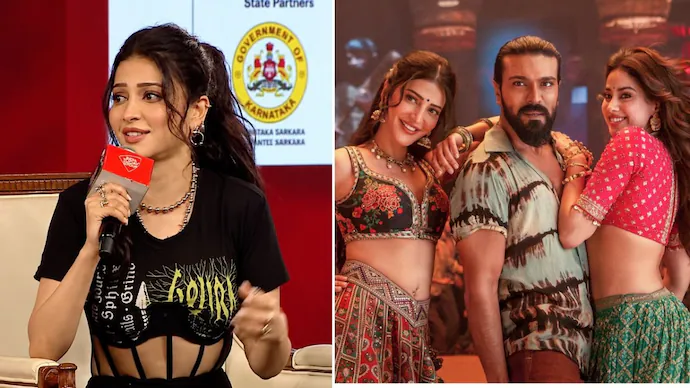
The debate surrounding the portrayal of women in filmmaker Buchi Babu Sana’s Peddi has resurfaced following comments from actor Shruti Haasan, who appeared in the film’s special song, Hellallallo. The discussion centres on the objectification of Janhvi Kapoor, whose character and representation in the film have drawn criticism from viewers and renewed conversations about how women are portrayed in mainstream Indian cinema.
Addressing the controversy in a conversation with Galatta Plus, Shruti explained why she agreed to perform in the song and how she approaches visual sexuality on screen. She made it clear that she is comfortable expressing herself through dance, costumes and performance, provided the choices are her own.
At the same time, the actor drew a distinction between her personal experience and Janhvi’s. Although the two appeared in the same song, Shruti said she could not speak for her co-star or determine how Janhvi felt about the film’s portrayal of women.
Shruti Haasan Explains Why She Said Yes to Hellallallo
During the interview, Shruti was asked why special dance numbers continue to be included in commercial films and what persuaded her to take up Hellallallo in Peddi. Responding to the question, she said dancing and dressing up were activities she genuinely enjoyed, making the song a personal choice rather than an obligation.
“I enjoy dancing; let me be very, very clear. I enjoy dressing up. And that’s the approach that I have to it. My approach to visual sexuality has been very liberating for myself,” she said.
The actor explained that she does not agree to a performance simply to satisfy someone else’s expectations. Her comfort with the costume, choreography and overall presentation is an important part of deciding whether to take on a project.
Shruti also said she has never been hesitant to refuse something that does not align with her preferences. She explained that she has had disagreements over creative decisions and has sometimes been labelled difficult for standing by her boundaries.
“So, when I’m not comfortable with something, I’m gonna say I’m not gonna wear this. Rest assured, if I’m doing it, I am comfortable with it. If I’m uncomfortable, I am not gonna do it,” she added.
Her comments underline her belief that an actor should be able to make personal choices about how they appear on screen. For Shruti, participating in a glamorous or sensual performance does not automatically mean surrendering control over how she is presented. She considers the ability to say yes or no an essential part of maintaining creative and personal independence.
Actor Says Visual Sexuality Can Be a Personal Choice
Shruti’s response also brings attention to a wider discussion about the difference between self-expression and objectification in cinema. Dance numbers featuring glamorous costumes and sensual choreography have long been part of commercial Indian films. However, their presentation can lead to questions about whether female performers are being represented as individuals or primarily as visual attractions.
The actor’s position is that her own participation should be understood through her comfort and willingness. She enjoys dancing and dressing up, but does not believe that this means she must accept every creative suggestion made by a filmmaker or production team.
Her remarks also highlight the importance of professional boundaries in an industry where actors work within collaborative creative environments. Costumes, choreography, camera angles and editing all influence how a performance appears in the final film. Having the ability to communicate discomfort and negotiate changes can therefore be significant for performers.
Shruti said she has been willing to face disagreements rather than agree to something that makes her uncomfortable. Being called difficult, she suggested, is not a reason to abandon her preferences.
Her statement that visual sexuality has been liberating for her is a personal description of her relationship with performance. It does not necessarily determine how another actor might experience a similar situation. That distinction became particularly relevant when the discussion moved to Janhvi Kapoor and the criticism surrounding Peddi.
Shruti Haasan Refuses to Speak on Janhvi Kapoor’s Experience
When asked about Janhvi’s experience of working on Peddi, Shruti chose not to offer an interpretation on her behalf. While the two actors shared screen space in Hellallallo, Shruti maintained that her own comfort with the song did not give her the authority to explain how Janhvi felt about the film or its portrayal of her character.
This distinction is important because conversations about objectification can involve different experiences, even when performers are part of the same production. An actor may feel comfortable with a particular costume or performance, while another may have concerns about the larger narrative, the character’s treatment or the way a scene is presented.
By declining to speak for Janhvi, Shruti kept her comments focused on her own choices rather than making assumptions about her co-star’s perspective. Her response also separated two questions that have become closely connected in the public debate: whether an individual performer is comfortable with a sensual dance number and whether the overall film represents women responsibly.
These questions can overlap, but they are not necessarily identical. An actor’s consent to participate in a performance does not automatically settle wider criticism about the film’s storytelling, visual language or social implications.
Janhvi Kapoor Previously Acknowledged Criticism of Peddi
Janhvi Kapoor had earlier addressed the criticism surrounding Peddi during her appearance on Koffee With Karan in October. Reflecting on the film, she acknowledged concerns about how women were portrayed and admitted that aspects of the narrative could have a negative influence on society.
She also raised concerns about the film’s representation of sexual assault, suggesting that the way such subjects are depicted on screen deserves careful consideration. Her comments brought attention to the responsibility filmmakers have when handling sensitive themes, particularly those involving violence against women.
Janhvi further wondered whether she could have been more vigilant about the possibility of objectification while working on the project. She indicated that she would be more careful about such issues in her future films to ensure that a similar situation did not arise again.
Her response was significant because it showed that the discussion was not limited to costumes or the presence of a special dance number. It also involved the wider context of the film, the treatment of female characters and the possible effect of certain portrayals on audiences.
The contrast between the two actors’ comments reflects how performers can approach the same project from different personal perspectives. Shruti has spoken about her comfort with her own performance, while Janhvi has acknowledged concerns about the film’s representation of women. Neither perspective should automatically be treated as a substitute for the other’s experience.
Why the Peddi Debate Goes Beyond Special Dance Numbers
The controversy surrounding Peddi has renewed a familiar debate in Indian cinema: where does personal expression end and objectification begin? Special songs are often designed to create a memorable visual moment, add entertainment value or support a film’s commercial appeal. Yet the way these sequences are written, filmed and connected to the larger story can influence how audiences interpret them.
One important distinction is between an actor choosing to perform a sensual sequence and a film presenting a woman primarily through her physical appearance. The former concerns the performer’s personal agency, while the latter involves questions about storytelling, camera choices and the broader representation of female characters.
A performer may willingly take part in a glamorous song and still have opinions about how women are represented elsewhere in the film. Similarly, an actor’s comfort with a particular sequence does not mean every audience member will consider the overall portrayal appropriate.
Shruti also suggested that the tendency to pander should not be discussed only in relation to item songs. She pointed out that the issue exists across different aspects of society and filmmaking. This broadens the conversation beyond revealing outfits or dance performances to include the larger ways in which commercial entertainment responds to audience expectations.
For filmmakers, the challenge is to balance entertainment with thoughtful representation. The context of a song, the agency of the character, the way the camera frames performers and the relationship between a sequence and the main narrative can all shape how a scene is received.
The discussion also demonstrates why individual consent and broader representation need to be considered separately. Respecting an actor’s choice to participate is important, but it does not prevent audiences or fellow performers from examining the messages communicated by the finished film.
Shruti Haasan’s Recent and Upcoming Films
Beyond the conversation around Peddi, Shruti Haasan has continued to work across different film industries. She was recently seen in Aakasamlo Oka Tara, which released on November 20, 2026.
Her next project is the Tamil thriller Train, directed by Mysskin and starring Vijay Sethupathi. The film is scheduled to release on December 4, 2026. The project brings Shruti together with the filmmaker and actor for a thriller that adds another title to her upcoming slate.
Janhvi Kapoor, meanwhile, remains at the centre of the discussion surrounding Peddi because of the questions raised about her character and the film’s portrayal of women. Her earlier remarks and Shruti’s recent interview have given audiences two different perspectives on the controversy.
Shruti Haasan’s Message: Comfort and Choice Matter
Shruti Haasan’s comments offer a clear explanation of how she approaches glamorous and sensual performances. She enjoys dancing and dressing up, but insists that her participation depends on her own comfort. She is also prepared to disagree with filmmakers when a costume or creative decision does not meet her expectations.
At the same time, she has avoided presenting her personal experience as a universal one. By refusing to speak for Janhvi Kapoor, she acknowledged that two actors involved in the same film can have different responses to its presentation.
The wider Peddi controversy therefore raises questions that extend beyond one song or one performance. It highlights the importance of personal agency for actors, responsible storytelling by filmmakers and thoughtful representation of women in mainstream cinema.
For Shruti, being comfortable with her own expression is a matter of choice. Her central point is that enjoying a sensual performance should not be confused with being willing to accept every demand, while another person’s experience should be understood on its own terms.
For breaking news and live news updates, like us on Facebook or follow us on Twitter and Instagram. Read more on Latest Entertainment on thefoxdaily.com.






COMMENTS 0