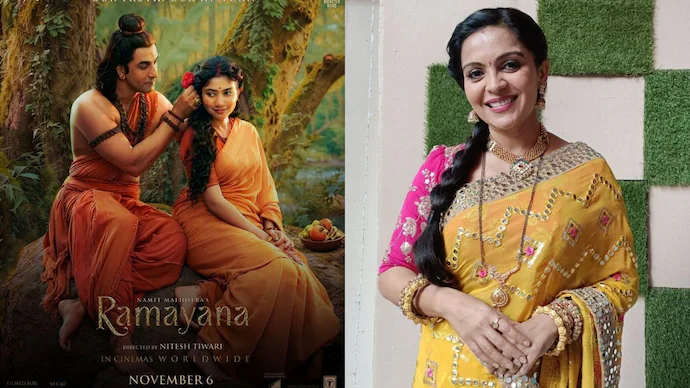
Sai Pallavi may be portraying Sita on screen in Nitesh Tiwari’s much-anticipated Ramayana, but Hindi-speaking audiences will hear another performer bringing the character’s emotions to life. Actor and voice artist Ami Trivedi has been selected to dub for Sai Pallavi, taking on the responsibility of translating the actor’s performance into Hindi without losing its emotional depth.
For Ami, the opportunity is a significant milestone in a career spanning television, theatre, films and voice acting. She had been following the development of Ramayana and hoped to become associated with the project. However, she initially expected to experience the film as a viewer rather than become part of its creative team.
In an interview with India Today, Ami opened up about auditioning for Sita, preparing to match Sai Pallavi’s vocal texture, meeting the actor before the dubbing sessions and receiving guidance from director Nitesh Tiwari. She also spoke about the scenes that tested her performance and the unexpected compliment she received from a family member after watching the film.
How Ami Trivedi Got the Role of Sita in Ramayana
Ami revealed that she had been interested in the project since Ramayana was announced. The film’s reported budget of Rs 4,000 crore had already generated considerable curiosity, and she was eager to see how the filmmakers would bring the epic story to the screen.
She recalled approaching people and looking for an opportunity to become part of the production. Her interest was initially driven by the scale of the project and the possibility of witnessing an ambitious cinematic interpretation of the epic.
Things took an unexpected turn when she auditioned for Sita around August. The audition led to her selection, giving her an opportunity she had not anticipated when she first started pursuing the project.
“Honestly, I was more excited about watching the film and seeing how big a scale it was going to be. I never expected to be associated with it in such a beautiful way. I couldn’t have imagined that I would get to be a part of Sita’s character. I auditioned for this around August this year and got the part. I feel truly blessed,” she said.
Her selection also highlights the importance of voice artists in multilingual film productions. While Sai Pallavi provides the expressions, movements and original performance on screen, Ami is responsible for recreating the character’s voice for Hindi-speaking viewers.
The work involves more than translating dialogue. A dubbing artist must understand the original actor’s delivery, emotional choices and timing so that the voice feels naturally connected to the performance. In a story as familiar as the Ramayana, maintaining the character’s emotional identity becomes particularly important.
Who Is Ami Trivedi? Her Career in Acting and Voice Dubbing
Ami Trivedi is an experienced actor and voice artist who has worked across television, films, theatre and dubbing. Although her association with Ramayana has brought renewed attention to her voice work, she has previously lent her voice to several well-known international characters.
One of her notable dubbing assignments was Harry Potter in the Hindi version of Harry Potter and the Philosopher’s Stone. She has also voiced Lois Lane in projects from the Superman and Batman universe.
These assignments have required her to adapt her vocal delivery to different characters and storytelling styles. Dubbing an animated or fictional character often involves creating a distinct voice identity, while working on a live-action performance requires close attention to the original actor’s expressions, rhythm and vocal texture.
Television Shows That Made Ami Trivedi Familiar to Audiences
Alongside her voice acting career, Ami has appeared in several television productions. Her familiar credits include shows such as Khichdi, Papad Pol and Sajan Re Jhoot Mat Bolo.
Her experience as an on-screen performer has also contributed to her understanding of character development and emotional expression. Acting requires performers to communicate through facial expressions, body language and dialogue, while dubbing places much of that responsibility on the voice alone.
Ami’s work across these different formats has given her experience in adjusting her performance according to the requirements of a character. Her role as Sita brings these skills together in a project where vocal accuracy and emotional interpretation are equally important.
How Ami Trivedi Prepared to Match Sai Pallavi’s Voice
One of Ami’s primary responsibilities was to create a voice that complemented Sai Pallavi’s original performance. She explained that the filmmakers initially wanted a voice match, particularly in terms of vocal texture.
To achieve this, Ami worked on voice modulation and adjusted her delivery to resemble the qualities of Sai Pallavi’s voice. However, she stressed that matching the sound was only one part of the assignment. The emotional performance also needed to feel authentic.
“I believe what they were initially looking for was a voice match. They wanted the texture of my voice to match hers. I worked on voice modulation and adjusted my delivery accordingly. Beyond that, the performance was equally important,” she explained.
Voice matching is a specialised skill in film dubbing. The artist must pay attention to pitch, pronunciation, pauses, emphasis and the rhythm of the original dialogue. The Hindi delivery also needs to fit the movement of the actor’s lips and expressions as closely as possible.
For Ami, the challenge was to ensure that her voice did not feel disconnected from Sai Pallavi’s portrayal. The character needed to sound consistent across different scenes, whether she was expressing affection, responding to a difficult situation or engaging in an emotionally intense conversation.
The responsibility was especially significant because Sita is one of the most recognisable characters in Indian storytelling. Audiences may already have expectations about her personality, dignity and emotional strength. Ami needed to bring those qualities into her voice while remaining faithful to the film’s interpretation.
Ami Trivedi Met Sai Pallavi Before Beginning the Dubbing Process
Ami’s preparation included a meeting with Sai Pallavi before the dubbing sessions began. The two reportedly spoke for more than an hour, during which Sai shared insights into her approach to performing particular scenes.
For a dubbing artist, understanding the original performer’s thoughts can provide valuable context. A line of dialogue may carry a particular emotional meaning that is not immediately apparent from the words alone. Knowing what the actor was thinking while performing can help the voice artist recreate the intended feeling.
Ami said Sai’s inputs helped her understand the emotional layers of the character and approach the dubbing process with greater clarity.
“She gave me some lovely inputs. Understanding what she was thinking while performing a particular scene helped me immensely,” Ami recalled.
The conversation allowed Ami to connect the dialogue with the emotions behind Sai’s performance. Instead of treating each line as an isolated recording task, she could approach the scenes with a better understanding of the character’s state of mind.
This becomes particularly important when dubbing a character such as Sita, whose portrayal can involve affection, compassion, resilience and emotional restraint. Each situation calls for a different vocal approach, and the artist must ensure that these variations remain believable.
What Nitesh Tiwari Told Ami Trivedi During Ramayana Dubbing
Ami also praised director Nitesh Tiwari for his involvement throughout the dubbing process. She described him as someone who knows exactly what he wants from a scene and pays attention to even the smallest details.
According to her, Tiwari guided her on aspects such as diction, expressions and delivery. His instructions helped her understand how each line should fit into the larger performance and the emotional atmosphere of the film.
“He knows exactly what he wants. He pays attention to the smallest details. He is brilliant,” she said.
Dubbing is an important part of a film’s final presentation, particularly when a production is released in multiple languages. Directors need to ensure that translated dialogue retains the intended meaning and that the voice performance remains consistent with the original characterisation.
In a large-scale mythological film, the challenge extends beyond individual lines. The character’s voice must maintain continuity throughout the story, including intimate conversations and emotionally demanding sequences.
Ami’s comments indicate that Tiwari remained closely involved in shaping the Hindi performance rather than leaving the process entirely to the voice artist. His attention to diction and delivery helped establish the tone required for Sita.
Why Sita’s Romantic Scenes Were Challenging for Ami
Among the most difficult portions for Ami were the romantic scenes involving Sita. She explained that conveying love and affection through voice required careful handling because the emotions had to sound natural rather than exaggerated.
Romantic performances often depend on subtle changes in tone, pauses and vocal intensity. A softer delivery or a slight variation in emphasis can communicate affection without making the dialogue sound overly dramatic.
For Sita, Ami wanted to retain warmth and sincerity while ensuring that the emotions remained believable. She had to recreate the feeling of Sai Pallavi’s performance without making the Hindi delivery sound artificial.
“You have to portray love and affection without making it sound unnatural. That was particularly important for Sita’s character,” she explained.
The challenge illustrates why dubbing requires interpretation rather than mechanical repetition. Even when the words are translated accurately, the emotional impact can change if the delivery does not match the scene.
The Surpanakha Sequence Was Another Difficult Moment
Ami also singled out the sequence involving Surpanakha appearing in Sita’s form as particularly tricky. She indicated that the scene required a careful emotional balance, making it one of the more demanding portions of the dubbing assignment.
Scenes involving deception, changing identities or unusual circumstances can require voice artists to pay close attention to the relationship between the character’s visible appearance and the emotions being communicated. The voice must support the storytelling without confusing the audience about the scene’s emotional context.
For Ami, this sequence required a different level of attention compared with the romantic portions. It was another example of how the character’s voice needed to adapt to the specific demands of each moment.
Ami’s Brother-in-Law Mistook Her Voice for Sai Pallavi’s
One of the most memorable moments from Ami’s experience came after a family member watched the film. She recalled that her brother-in-law initially believed Sai Pallavi’s original voice had been retained in certain portions.
Ami told him that the voice he had heard was actually hers. He then observed that the delivery carried a slight South Indian touch. She explained that this was intentional because she wanted the Hindi voice to retain qualities that would make it sound closer to Sai Pallavi.
“I told him, ‘No, that was my voice!’ He said there was a little South Indian touch to it. I told him that was intentional because you have to ensure it sounds like her. Honestly, that was perhaps the biggest compliment I could have received,” she recalled.
The reaction was meaningful because voice matching is most effective when the audience accepts the dubbed performance as part of the character. If the difference between the original actor and the dubbing artist becomes too noticeable, it can affect the viewing experience.
Her brother-in-law’s initial assumption suggested that Ami had managed to create a close vocal connection with Sai Pallavi’s portrayal. For a voice artist working behind the scenes, such recognition can be a particularly satisfying response.
Will Ami Trivedi Return as Sita in Ramayana Part Two?
Ramayana is planned as a two-part cinematic project, with the second instalment expected in 2028. However, Ami said she does not yet know when the dubbing process for the next film will begin or whether she will return as Sita.
She suggested that if the filmmakers decide to bring her back for the role, they may approach her closer to the second instalment’s production schedule.
“I think if I am dubbing for Sita again, I will probably be approached in 2028,” she clarified.
Her statement does not confirm her involvement in the sequel. The decision will depend on the filmmakers’ plans and the requirements of the Hindi version.
For now, her work on the first film represents a significant association with one of the most closely watched adaptations of the Ramayana. A possible return would allow her to continue the vocal interpretation of Sita, but no official confirmation has been provided in the interview.
What Is Ami Trivedi Working on Next?
While her dubbing assignment in Ramayana has brought attention to her work, Ami is also exploring opportunities in other areas of Entertainment. She said she is interested in experimenting with different genres after completing her long television commitments.
The actor is currently shooting for a couple of Gujarati films and has additional dubbing assignments lined up. These projects will allow her to continue working across different formats while exploring new characters and performance styles.
Her career has involved a combination of on-screen acting and voice work, giving her opportunities to approach storytelling from different perspectives. The role of Sita adds another notable assignment to that journey.
Why Voice Artists Matter in Multilingual Films
Large-scale films released in multiple languages depend on voice artists to make performances accessible to audiences across different linguistic regions. Their work helps preserve the emotional continuity of a story even when the dialogue changes from one language to another.
In a project based on the Ramayana, this responsibility carries additional significance. Sita is a familiar figure in Indian cultural and literary traditions, and audiences may have strong expectations about how the character should be portrayed.
A successful dubbing performance must balance the original actor’s interpretation with the natural rhythm and emotional expression of the target language. It should sound convincing without drawing attention away from the character on screen.
Ami Trivedi’s preparation involved matching Sai Pallavi’s vocal texture, understanding her emotional choices, working under Nitesh Tiwari’s direction and paying close attention to challenging scenes. Her experience demonstrates the amount of creative work that goes into a performance audiences may hear without immediately recognising the artist behind it.
As anticipation builds around Ramayana, Sai Pallavi’s portrayal will remain central to the film’s presentation of Sita. But for Hindi-speaking viewers, Ami’s voice will be an important part of that experience, bringing the character’s emotions and dialogue to life in another language.
For breaking news and live news updates, like us on Facebook or follow us on Twitter and Instagram. Read more on Latest Entertainment on thefoxdaily.com.






COMMENTS 0