Haldi or Coronation? Ranbir Kapoor’s Ramayana Scene Leaves Internet Divided
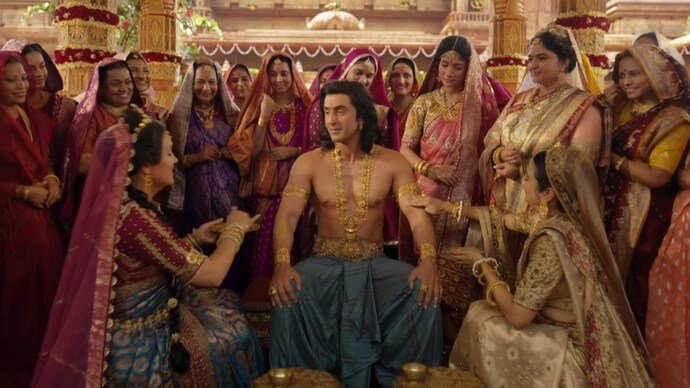
A ritual sequence in Mangal Rang, the newly released song from Nitesh Tiwari’s upcoming film Ramayana: The Rise of Legend, has sparked a debate on social media. Featuring Ranbir Kapoor as Lord Rama and Sai Pallavi as Maa Sita, the song includes a scene in which women apply haldi to Rama while Sita stands beside him. The visuals have left viewers divided over whether the ritual depicts a traditional haldi ceremony or preparations for Rama’s coronation.
While some social media users have questioned the filmmakers’ interpretation of the scene, others believe viewers have misunderstood its context. The discussion has also expanded into a wider debate about portraying religious epics on screen and interpreting traditional rituals through modern cultural practices.
The song was released on Sunday and has attracted attention for both its visuals and musical arrangement. Composed by AR Rahman, with lyrics by Kumar Vishwas and vocals by Arijit Singh and Shreya Ghoshal, Mangal Rang celebrates the love and sacred union of Lord Rama and Maa Sita.
The video appears to depict their wedding and Sita’s arrival in Ayodhya, although the disputed ritual has prompted different interpretations among viewers.
Why Is the Mangal Rang Song Scene Being Debated?
The controversy centres on a sequence in which women are seen applying haldi to Lord Rama while Maa Sita stands beside him.
Some viewers interpreted the scene as a groom’s haldi ceremony and questioned why Sita was present. They argued that, in many contemporary Hindu wedding traditions, the bride and groom participate in separate haldi ceremonies at their respective homes.
One user on X criticised what they perceived as creative liberties in the film’s portrayal of the epic, arguing that Bollywood adaptations should be careful when depicting religious traditions.
The criticism reflects a broader discussion about how filmmakers balance cinematic storytelling with audiences’ expectations of cultural and religious authenticity.
However, other viewers argued that the scene might not depict a haldi ceremony at all. According to these interpretations, the sequence could be connected to preparations for Lord Rama’s coronation, making Sita’s presence more understandable within the context suggested by the viewers.
The film’s creators have not been quoted in the supplied report as confirming the precise meaning of the disputed scene.
Some Viewers Believe the Scene Shows Rama’s Rajyabhishek
Several social media users pushed back against the haldi interpretation, suggesting that the ritual shown in Mangal Rang could instead be associated with Lord Rama’s Rajyabhishek, or coronation.
One user wrote that the sequence was connected to Rama’s coronation preparations and argued that viewers were incorrectly interpreting it as a haldi ceremony.
Another post drew attention to Sita’s costume, claiming that it matched the clothing she wore in a scene connected with the events leading to Rama’s exile.
According to this interpretation, the visuals may refer to the period immediately before Rama was expected to be crowned king. In the traditional narrative, the coronation plans are disrupted when Kaikeyi asks King Dasharatha to fulfil her boons, resulting in Rama’s 14-year exile.
The user argued that comparing Sita’s appearance across the scenes could help viewers understand the intended timeline.
These interpretations remain social media users’ readings of the visuals rather than a confirmed explanation from the filmmakers. Without further clarification, the scene’s precise context remains open to debate.
Did Haldi Ceremonies Exist During the Ramayana Period?
Another point raised in the discussion concerns whether the modern haldi ceremony can be directly associated with the period in which the Ramayana is set.
One social media user argued that people should avoid interpreting the epic entirely through contemporary wedding customs, questioning whether the ritual existed in the same form during the period depicted in the story.
The comment highlights a distinction between traditional narratives and the modern customs audiences may associate with them.
Wedding rituals can vary across regions, communities and historical periods. Practices familiar today should not automatically be assumed to have existed in precisely the same form in ancient times.
At the same time, establishing the historical origins and development of a specific ritual requires evidence beyond a social media post or a brief film sequence.
The discussion therefore raises a broader question about historical interpretation: how should filmmakers represent rituals when adapting stories that have been passed down through religious texts, oral traditions and different cultural interpretations?
For now, the online debate reflects competing readings of the Mangal Rang visuals rather than an established conclusion about the historical accuracy of the scene.
Mangal Rang Song Faces a Separate Debate Over Its Music
The ritual controversy is not the only discussion surrounding Mangal Rang. Some listeners have also questioned the song’s musical arrangement, saying they hear elements reminiscent of qawwali and Sufi music in its chorus and overall composition.
Qawwali is a musical tradition associated with Sufi devotional expression, particularly in South Asia. Its vocal style, rhythmic patterns and ensemble arrangements have influenced a wide range of musical forms.
Some social media users objected to what they perceived as these influences in a song celebrating Lord Rama and Maa Sita. Their reactions have prompted discussion about how musical styles are used in films depicting religious figures and traditions.
However, identifying a musical influence is not necessarily the same as establishing that a song belongs to a particular genre. Musical arrangements can combine elements from different traditions, and listeners may interpret those influences differently.
The debate surrounding Mangal Rang therefore extends beyond the visual representation of religious rituals to questions about the soundtrack’s artistic choices.
Who Is Behind Ramayana: The Rise of Legend?
Directed by Nitesh Tiwari, Ramayana: The Rise of Legend features Ranbir Kapoor as Lord Rama and Sai Pallavi as Maa Sita.
The film also stars Yash, Sunny Deol, Ravi Dubey, Rakul Preet Singh and Lara Dutta in key roles.
The Mangal Rang song brings together several prominent names in Indian music. AR Rahman has composed the music, Kumar Vishwas has written the lyrics, and Arijit Singh and Shreya Ghoshal provide the vocals.
The song celebrates the relationship between Rama and Sita, with its visuals appearing to cover their wedding and Sita’s arrival in Ayodhya.
The film is scheduled for a worldwide theatrical release on November 5, 2026, according to the supplied report.
Why the Ramayana Scene Has Divided Social Media
The debate over Mangal Rang illustrates how visual details in adaptations of religious epics can attract competing interpretations.
For some viewers, the scene appears to resemble a haldi ceremony, raising questions about the way the ritual has been portrayed. Others believe it depicts preparations for Rama’s coronation and argue that the sequence should be understood in relation to the broader narrative.
A separate group has questioned whether contemporary assumptions about wedding customs should be applied directly to an ancient epic. Meanwhile, the song’s perceived musical influences have generated another conversation about artistic choices in religious cinema.
These reactions demonstrate that audiences may approach adaptations of familiar stories with different expectations. Some prioritise historical and ritual accuracy, while others focus on cinematic expression, musical experimentation and storytelling.
Until the filmmakers provide further clarification about the disputed sequence, the haldi-versus-coronation debate remains unresolved.
For Ramayana: The Rise of Legend, the discussion has placed Mangal Rang at the centre of a wider conversation about how Indian cinema interprets mythology, tradition and cultural memory.
For breaking news and live news updates, like us on Facebook or follow us on Twitter and Instagram. Read more on Latest Entertainment on thefoxdaily.com.






COMMENTS 0