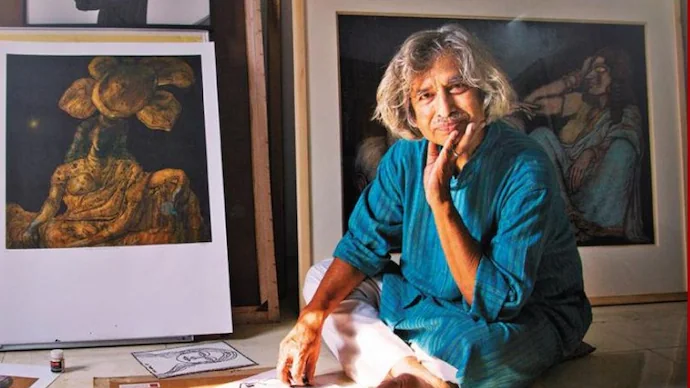
Renowned Indian painter and former Trinamool Congress (TMC) Rajya Sabha MP Jogen Chowdhury died at a private hospital in Kolkata on Sunday morning, following a prolonged illness linked to a rare blood cancer. He was 87.
Chowdhury had been suffering from a myeloproliferative neoplasm, a rare type of blood cancer, for approximately 14 months and was undergoing chemotherapy, Ruby General Hospital said in a statement. He was admitted to the hospital in southeast Kolkata on October 16 and died at 10.15 am on Sunday.
His death prompted tributes from political leaders, artists and writers, who remembered his contribution to Indian art and his lasting influence on Bengal’s cultural life. His career spanned artistic training in India and Paris, teaching, design, public service and a period in Parliament.
Known for developing a distinctive visual language influenced by Indian and European art movements, Chowdhury drew inspiration from political and social themes. His work also maintained a strong connection with Bengal, where his early experiences and the landscape of Santiniketan informed his artistic practice.
Jogen Chowdhury dies after 14 months of illness
Ruby General Hospital confirmed Chowdhury’s death in a statement, describing him as a renowned Indian painter. According to the hospital, he had been receiving treatment for a myeloproliferative neoplasm for around 14 months.
The condition belongs to a group of disorders involving the bone marrow and the production of blood cells. The hospital said Chowdhury had been undergoing chemotherapy during his illness.
He was admitted on October 16 and died four days later, at 10.15 am on Sunday. The hospital also said he had required hospitalisation for urinary tract infections during the course of his illness.
The announcement brought an end to the life of an artist whose career connected several strands of India’s cultural history, from the artistic traditions of Bengal to European training and contemporary public life.
Chowdhury was widely recognised for his contribution to Indian painting. His work drew on a range of influences while retaining a distinctive identity, and his artistic legacy extended beyond galleries into public and institutional spaces.
Political leaders and artists pay tribute to the painter
West Bengal Chief Minister Suvendu Adhikari expressed condolences following Chowdhury’s death, describing the artist’s work as a lasting treasure for the state and the country.
Adhikari said Chowdhury’s artistic contributions would remain “immortal through the ages” and highlighted the presence of his works in government buildings, including Rashtrapati Bhavan.
“Chowdhury’s rich contributions are evident in numerous government buildings, including Rashtrapati Bhavan. The works he left behind will remain for centuries,” Adhikari said.
The tribute emphasised the enduring significance of Chowdhury’s work and its place in India’s cultural heritage. His paintings reached beyond private collections, becoming part of the artistic presence in important public institutions.
Painter Samir Aich also mourned Chowdhury’s death, describing it as a personal loss. Aich said the passing represented the loss of an important artistic tradition in the country, including the Bengal School of Art.
Bengali writer Sirshendu Mukhopadhyay remembered Chowdhury as a longtime friend and associate. Reflecting on their relationship, he recalled the conversations and informal gatherings they had shared.
“Jogen was a long-term friend and associate, and I have memories of ‘adda’ with him. His death is a great loss,” Mukhopadhyay said.
The tributes reflected the breadth of Chowdhury’s connections across artistic and literary circles. For colleagues and friends, his death marked not only the loss of a major painter but also the passing of a familiar presence in Bengal’s cultural life.
Early life in undivided Bengal shaped his artistic journey
Jogen Chowdhury was born on February 16, 1939, in Daharpara village in Faridpur, then part of undivided Bengal. His interest in art developed early, influenced in part by his mother, who was skilled in alpana, a traditional form of decorative floor art.
Alpana is associated with Bengali cultural traditions and uses patterns and designs to decorate floors during religious, seasonal and family occasions. Exposure to this form of visual expression during childhood formed part of Chowdhury’s early artistic environment.
His family moved to Kolkata during Partition, a period that disrupted lives and communities across the subcontinent. In Kolkata, Chowdhury received formal training in art and began building the foundation for a professional career.
His journey from a village in undivided Bengal to the cultural institutions of Kolkata and, later, Paris exposed him to different artistic environments. These experiences would become part of the wider context for his development as a painter.
Although he drew inspiration from both Indian and European art movements, Chowdhury developed a distinctive style rather than simply reproducing the conventions of any one tradition. His work reflected a combination of influences, personal observation and engagement with social and political subjects.
From art teacher to designer and internationally trained painter
Chowdhury began his professional career as an art teacher at Howrah Zilla School. The role marked an early stage in a career that would later extend into design, advanced artistic study and public life.
In 1962, he joined the Handloom Board in Kolkata as a designer. The position placed him in a field closely connected with India’s textile and craft traditions, offering a professional setting distinct from school teaching and independent painting.
His career took an international turn in the late 1960s, when he travelled to Paris to pursue higher studies at the École Nationale Supérieure des Beaux-Arts. The institution provided an opportunity to engage with European artistic traditions and a wider environment of formal art education.
After returning to India, Chowdhury developed the visual language for which he became known. His artistic identity reflected an engagement with different traditions without losing its connection to his own cultural background.
His trajectory illustrates how an artist’s practice can evolve through education, professional experience and exposure to different cultural settings. Chowdhury’s early life in Bengal, formal training in Kolkata and studies in Paris formed distinct stages in that development.
A distinctive visual language influenced by social and political themes
Chowdhury’s work was recognised for its individual visual language and its engagement with both Indian and European art movements. Political and social themes also provided inspiration for his paintings.
Rather than being defined by a single influence, his work emerged from the interaction of different artistic traditions and the experiences that shaped his life. His early exposure to Bengali visual culture, formal education and time in Paris formed part of that broader creative background.
The presence of his paintings in government buildings, including Rashtrapati Bhavan, also reflected the institutional recognition of his contribution to Indian art. Such collections place an artist’s work within public spaces where it can become part of the country’s wider cultural representation.
Adhikari’s tribute highlighted this aspect of Chowdhury’s legacy, describing his body of work as a treasure for both West Bengal and India. The statement underscored the view that the significance of his art would extend beyond his lifetime.
Chowdhury’s passing also prompted reflections on the artistic traditions associated with Bengal. Aich’s reference to the Bengal School of Art connected the loss to a broader discussion of the region’s contribution to Indian painting.
The available information does not attribute every aspect of Chowdhury’s style to a single school or movement. Instead, it presents him as an artist whose work drew inspiration from multiple traditions and from the political and social realities around him.
Santiniketan remained a source of inspiration
Chowdhury also had a house in Santiniketan, a place associated with distinctive landscapes and a long-standing cultural and artistic environment. The region’s red earth and natural surroundings served as inspiration for his work.
The connection added another geographical dimension to his artistic life. Born in Faridpur and trained in Kolkata before studying in Paris, Chowdhury maintained ties with places in Bengal that influenced his experiences and creative outlook.
Santiniketan’s landscape offered a different setting from the urban environment of Kolkata. Its red earth and distinctive scenery provided visual material that could inform an artist’s observation of colour, form and place.
While the supplied account does not identify particular paintings inspired by the region, it records Santiniketan as an important source of inspiration for Chowdhury’s artistic practice.
Jogen Chowdhury’s role in public life
Alongside his career as a painter, Chowdhury entered parliamentary politics as a member of the Trinamool Congress. He was elected to the Rajya Sabha on the party’s ticket and served from April 2014 to April 2020.
His six-year tenure placed him in India’s upper house of Parliament while he remained an established figure in the country’s artistic community. His career therefore connected the cultural sphere with formal political representation.
Chowdhury’s public recognition also extended to state honours. In 2012, the previous TMC government conferred the Banga Bibhushan on him, one of West Bengal’s highest civilian honours.
The award recognised his contribution to the state’s cultural life. His later service in Parliament added another dimension to a career that had already included teaching, design, international study and decades of artistic work.
His experience also illustrates how artists can occupy roles beyond the studio. Through his parliamentary tenure and public recognition, Chowdhury became part of both India’s artistic heritage and its wider public life.
An artistic legacy that extends beyond his lifetime
Jogen Chowdhury’s death at 87 marks the end of a career shaped by Bengal’s cultural traditions, formal artistic training and exposure to European art. From his early interest in visual expression to his studies in Paris and his later development as a painter, his journey crossed geographical and professional boundaries.
His paintings, including works held in public institutions such as Rashtrapati Bhavan, remain part of the legacy highlighted by political leaders and fellow artists. The tributes from Adhikari, Aich and Mukhopadhyay reflected the different ways Chowdhury was remembered as an artist of national stature, a representative of Bengal’s artistic heritage and a longtime friend.
His career also extended beyond painting into teaching, design and parliamentary service. The Banga Bibhushan conferred on him in 2012 and his term in the Rajya Sabha from 2014 to 2020 formed part of that wider public contribution.
Although his prolonged illness brought his life to a close, the body of work he left behind continues to carry his artistic identity into public and cultural spaces. As the tributes following his death made clear, Chowdhury’s influence will be remembered through the paintings, institutions and artistic conversations that remain after him.
For breaking news and live news updates, like us on Facebook or follow us on Twitter and Instagram. Read more on Latest India on thefoxdaily.com.






COMMENTS 0