- Who Was Burhan Hamza?
- The Pulwama Attack Changed India’s Counterterrorism Doctrine
- Why Hamza’s Presence in PoK Was Strategically Significant
- The Pattern of Mysterious Killings Is Becoming Harder to Ignore
- The Intelligence Dimension Behind Modern Counterterrorism
- Pakistan Faces a Difficult Security Contradiction
- Why the Pulwama Legacy Still Matters in India
- The Shadow War Is Reshaping Regional Security
- Why High-Value Militant Eliminations Matter Operationally
- The Information War Is Now Equally Important
- Conclusion
The killing of Burhan Hamza, one of the alleged masterminds behind the 2019 Pulwama terror attack, is more than just another militant death in Pakistan-occupied Kashmir (PoK). It represents the latest chapter in an increasingly complex and opaque security landscape unfolding across South Asia one where high-profile extremists linked to attacks on India are being eliminated under mysterious circumstances.
Hamza, also known as Arjumand Gulzar Dar and by the alias “Doctor,” was reportedly shot by unidentified gunmen in Muzaffarabad before succumbing to injuries at a Military hospital in Rawalpindi. The attack has immediately triggered intense speculation because of who he was, where he was operating from, and the level of protection he reportedly enjoyed.
For India, his death carries both symbolic and strategic significance.
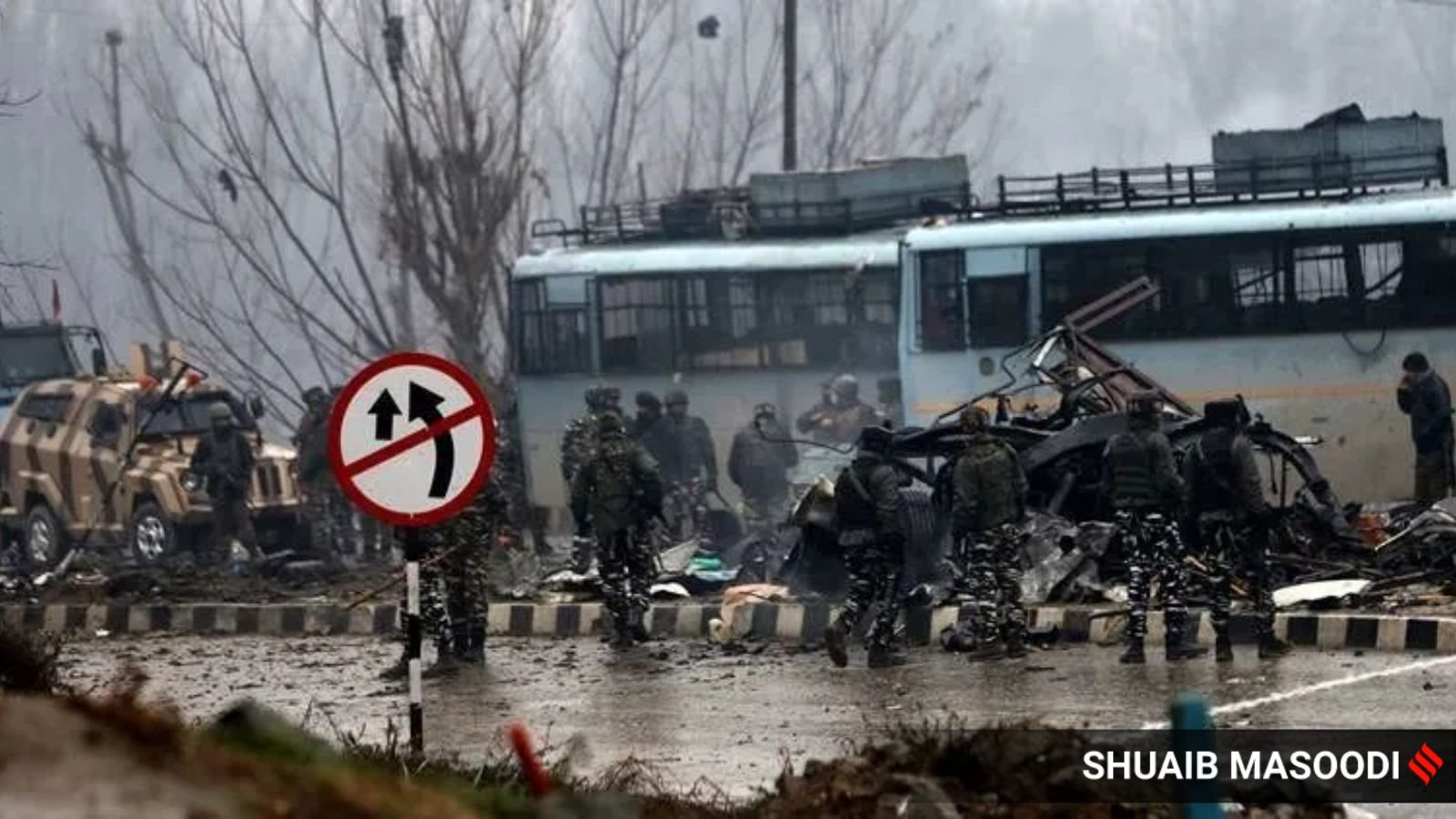
Hamza was accused of playing a central role in one of the deadliest terror attacks in modern Indian history the February 14, 2019 suicide bombing in Pulwama that killed 40 CRPF personnel and dramatically escalated tensions between India and Pakistan.
But beyond the headlines lies a much larger story involving cross-border militancy, intelligence networks, Pakistan’s internal security contradictions, and the changing nature of counterterror operations in the region.
Who Was Burhan Hamza?
Burhan Hamza, originally from Jammu and Kashmir’s Pulwama district, emerged from the ecosystem of militancy that has shaped parts of the Kashmir conflict for decades.
Initially linked to the terror outfit Al Badr, he later became associated with Al Baraq and reportedly developed close operational ties with Pakistan’s intelligence establishment.
Security sources described him as far more than a low-level militant operative.
He was allegedly involved in:
- Recruitment and radicalisation activities
- Cross-border militant coordination
- Arms logistics
- Explosives movement
- Terror planning support
- Operational networking across Kashmir
Indian authorities designated him a terrorist under the Unlawful Activities (Prevention) Act for his alleged involvement in orchestrating the Pulwama suicide bombing.
The attack, carried out by Pakistan-based Jaish-e-Mohammad (JeM), became a defining moment in India’s modern security history.
The Pulwama Attack Changed India’s Counterterrorism Doctrine
The February 14, 2019 attack on a CRPF convoy near Pulwama fundamentally altered India’s strategic response to cross-border terrorism.
A suicide bomber rammed an explosives-laden vehicle into a convoy carrying Indian paramilitary personnel, killing 40 troops in one of the deadliest attacks on Indian security forces in Kashmir.
The attack generated nationwide outrage and pushed India-Pakistan tensions to dangerous levels.
India responded days later with airstrikes targeting a Jaish-e-Mohammad training facility in Balakot, deep inside Pakistani territory.
The Balakot operation marked a major strategic shift.
For the first time in decades, India publicly demonstrated willingness to cross the Line of Control and strike targets beyond Pakistan-administered Kashmir in response to terrorism.
That doctrine significantly reshaped regional deterrence calculations.
| Key Event | Strategic Impact |
|---|---|
| Pulwama Terror Attack (2019) | 40 CRPF personnel killed |
| Balakot Airstrike | India expanded counterterror response doctrine |
| Increased Global Attention | Pressure on Pakistan over terror groups |
| Intelligence Crackdowns | Expanded surveillance and anti-terror operations |
| Diplomatic Escalation | India-Pakistan relations deteriorated sharply |
Why Hamza’s Presence in PoK Was Strategically Significant
One of the most important aspects of Hamza’s story is not simply his militant background, but the environment in which he reportedly operated.
According to officials and security sources, Hamza lived under extensive protection in Muzaffarabad, including armed security escorts and a bullet-resistant vehicle.
That level of protection raises larger questions frequently highlighted by India regarding the presence of terror-linked infrastructure inside Pakistan and Pakistan-occupied Kashmir.
India has long argued that several extremist figures linked to attacks in Kashmir operate openly from Pakistani territory with varying degrees of institutional protection or tolerance.
Pakistan has consistently denied those accusations.
However, incidents involving high-profile militants living in secure compounds or under heavy security arrangements repeatedly fuel international scrutiny.
The Pattern of Mysterious Killings Is Becoming Harder to Ignore
Hamza’s death is not an isolated incident.
Over the past few years, multiple militants linked to anti-India terror operations have been killed under mysterious circumstances inside Pakistan and PoK.
Several were reportedly:
- Shot by unidentified gunmen
- Killed in targeted ambushes
- Attacked near secure facilities
- Eliminated despite heavy protection
The recurring pattern has generated intense speculation across regional security circles.
Officially, most incidents remain unsolved.
Unofficially, theories range from internal factional rivalries to covert retaliation operations and intelligence-linked targeting.
What makes these killings notable is the increasing precision involved.
Many targets were individuals with significant operational knowledge, cross-border networks, or historical involvement in major terror incidents.
The Intelligence Dimension Behind Modern Counterterrorism
Modern Counterterrorism increasingly depends on intelligence dominance rather than large-scale military action.
Tracking high-value militant operatives requires:
- Human intelligence networks
- Digital surveillance
- Financial monitoring
- Movement tracking
- Cross-border coordination analysis
- Communication interception
In conflicts involving asymmetric warfare, information often becomes more important than conventional battlefield strength.
The killing of figures like Hamza highlights how modern security battles increasingly unfold in covert and deniable spaces rather than open confrontation.
This evolution reflects broader global counterterror trends seen in multiple regions where intelligence-led operations target leadership structures instead of relying solely on conventional warfare.
Pakistan Faces a Difficult Security Contradiction
One of the deeper issues exposed by incidents like this is Pakistan’s long-running security contradiction.
For decades, Pakistan itself has suffered enormously from terrorism and militant violence.
Thousands of Pakistani civilians and security personnel have been killed in extremist attacks.
At the same time, accusations regarding selective tolerance toward certain anti-India militant networks have continued damaging Pakistan’s international image.
This duality creates a persistent credibility problem.
Every time a militant linked to cross-border operations is discovered living comfortably inside Pakistan or PoK, global scrutiny intensifies.
That pressure becomes especially significant when such figures appear to possess logistical support, security cover, or operational freedom.
Why the Pulwama Legacy Still Matters in India
Seven years after the attack, Pulwama remains deeply embedded in India’s national memory.
The attack became a defining emotional and political moment because it symbolized vulnerabilities in convoy protection, intelligence coordination, and regional security management.
It also transformed public expectations regarding counterterror responses.
After Pulwama, there was a visible shift in India’s strategic posture:
- More aggressive intelligence operations
- Stronger diplomatic pressure campaigns
- Expanded counterterror coordination
- Greater emphasis on cross-border deterrence
- Increased monitoring of terror financing networks
Hamza’s death therefore carries symbolic resonance because of his alleged connection to that watershed event.
The Shadow War Is Reshaping Regional Security
South Asia’s security landscape is increasingly shaped by what analysts often describe as a “shadow war” a conflict operating below the threshold of open military confrontation.
Unlike traditional wars involving visible troop movements and formal declarations, shadow conflicts involve:
- Covert operations
- Intelligence battles
- Cyber surveillance
- Targeted disruptions
- Deniable actions
- Psychological deterrence
These methods allow states and non-state actors to exert pressure without triggering full-scale conventional escalation.
The mysterious killings of terror-linked figures fit increasingly into this broader pattern.
Why High-Value Militant Eliminations Matter Operationally
The death of a high-profile operative can create disruption beyond immediate symbolism.
Individuals like Hamza often serve as critical connectors within militant ecosystems.
They may possess:
- Recruitment networks
- Funding channels
- Operational contacts
- Smuggling routes
- Safe-house access
- Cross-border logistical knowledge
Removing experienced coordinators can weaken organisational continuity, disrupt communications, and generate mistrust within militant structures.
However, history also shows that militant groups often adapt by decentralizing operations or elevating new leadership.
That is why counterterrorism rarely ends with individual eliminations alone.
The Information War Is Now Equally Important
Another major dimension of incidents like this is narrative control.
Modern conflicts are increasingly shaped not only by physical operations, but by public perception.
Governments, militant groups, Intelligence Agencies, and media ecosystems all compete to shape interpretations of events.
Questions surrounding:
- Who carried out the attack
- How security failed
- Whether intelligence networks were compromised
- What message the killing sends
become part of a larger strategic communication battle.
In many ways, perception itself becomes a security weapon.
Conclusion
The killing of Pulwama attack mastermind Burhan Hamza in Pakistan-occupied Kashmir marks another significant moment in the evolving security dynamics between India and Pakistan.
While many operational details remain unclear, the broader implications are difficult to ignore.
Hamza was not merely another militant figure. He represented a generation of cross-border extremist operatives accused of sustaining violent networks tied to some of the region’s most devastating attacks.
His death also reinforces the growing pattern of mysterious eliminations targeting high-profile terror-linked individuals inside Pakistan and PoK a trend reshaping regional security calculations.
For India, the Pulwama attack remains a defining national trauma that transformed counterterror policy and strategic doctrine.
For Pakistan, incidents involving internationally designated militants operating from protected environments continue raising uncomfortable international questions.
And for South Asia as a whole, the shadow war involving intelligence networks, covert operations, and counterterror pressure is becoming increasingly central to regional stability.
The battlefield today is no longer confined to borders alone.
It increasingly exists in the hidden spaces between intelligence, deterrence, surveillance, and deniable conflict where the consequences are often felt long before the full story becomes visible.
For breaking news and live news updates, like us on Facebook or follow us on Twitter and Instagram. Read more on Latest India on thefoxdaily.com.






COMMENTS 0