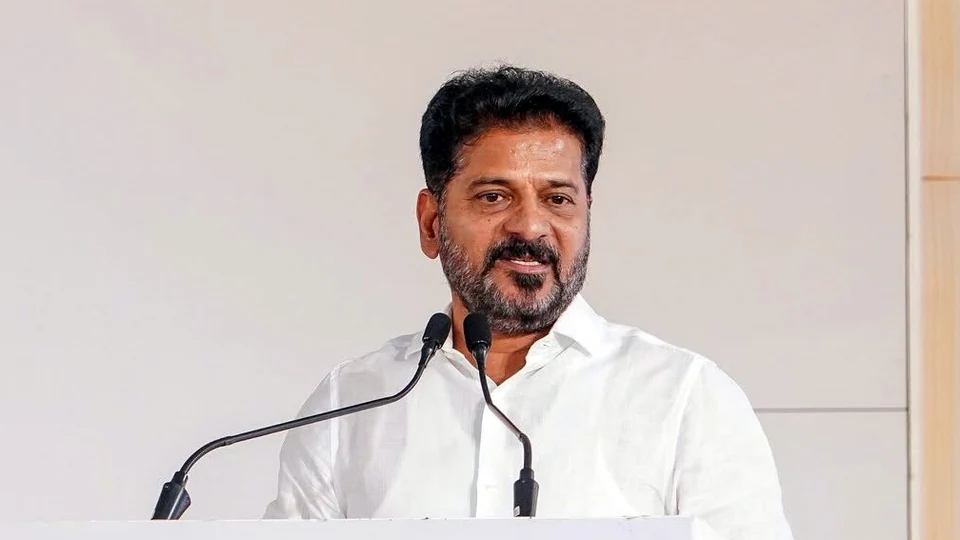
Telangana Chief Minister A Revanth Reddy on Thursday called for Rahul Gandhi, the Leader of the Opposition in the Lok Sabha, to become India’s prime minister, arguing that his leadership was necessary to ensure justice for backward classes and guide the country towards progress.
Speaking at the 174th birth anniversary celebrations of Panduga Sayanna Mudiraj, a figure associated with the struggle for backward-class rights, Reddy said India was at a critical juncture and urged the Nehru family to take greater responsibility for the country’s future. He also appealed to voters to put aside their differences and make a positive choice in the next Lok Sabha elections.
Reddy’s remarks linked national political leadership with the representation and welfare of backward communities. Alongside his appeal for Rahul Gandhi to become prime minister, the Telangana Chief Minister announced steps to examine the Mudiraj community’s demand for inclusion in a different category under the state’s backward-class classification system.
Revanth Reddy Says Rahul Gandhi Should Become Prime Minister
Addressing the gathering, Reddy argued that Rahul Gandhi should assume the country’s top executive position if backward classes were to receive justice. He said members of the Nehru family had previously had opportunities to become prime minister but had chosen to allow other leaders to hold the office.
“Rahul Gandhi should become prime minister if justice is to be done to the backward classes. They could have become (PM) long ago had they wanted it. After Rajiv Gandhi’s death, Congress came to power many times,” Reddy said, according to news agency PTI.
He also described the country as being at a critical point and called on people to consider the country’s future when voting in the next parliamentary elections.
Reddy’s appeal came during an event honouring Panduga Sayanna Mudiraj, whose legacy is associated with resistance to social and economic oppression. By making the statement at a programme focused on backward-class rights, the Chief Minister connected his call for Rahul Gandhi’s leadership with the question of political representation for disadvantaged communities.
He urged people to move beyond their differences and make a constructive choice in the upcoming Lok Sabha elections. His remarks reflected his stated position that leadership at the national level should play a role in addressing the concerns of backward classes.
Telangana Government to Examine Mudiraj Community’s BC-A Status
Alongside his political appeal, Reddy announced that the Telangana government would examine the Mudiraj community’s demand for inclusion in the BC-A category under the state’s backward-class classification system.
The Mudiraj community is currently classified under the BC-D category in Telangana. Reddy said a cabinet sub-committee would be formed to study the demand, with the matter scheduled to be taken up at the next cabinet meeting.
He said officials and legal experts would be consulted before the government reached a decision. The proposed review is intended to examine the community’s request and the implications of changing its existing classification.
The announcement is significant for the community because backward-class categorisation is connected to the administration of reservation benefits. Any proposed change would require consideration of the relevant evidence, legal provisions and the potential impact on other communities covered by the state’s classification system.
Reddy also asked Backward Classes Welfare Minister Ponnam Prabhakar to engage with other backward communities, including Gangaputras, who are already classified under BC-A. The aim, he said, was to address concerns relating to the distribution of reservation benefits.
The Chief Minister’s remarks indicated that the government intended to consult affected communities before deciding how to proceed. However, no final decision on changing the Mudiraj community’s classification was announced at the event.
Why the BC-A Classification Issue Matters
Backward-class categories form part of the framework through which reservation benefits are administered in Telangana. Communities classified under different categories may raise demands concerning their representation and access to benefits, making changes to classifications a matter requiring careful consideration.
In the Mudiraj community’s case, the government has said it will examine the demand through a cabinet sub-committee and consult officials and legal experts. The process is expected to consider the request alongside concerns raised by other backward communities.
Reddy’s direction to the Backward Classes Welfare Minister to engage with Gangaputras and other communities highlights the need to consider how any proposed change could affect the broader distribution of benefits.
The announcement does not itself change the Mudiraj community’s existing classification. The community remains in the BC-D category unless the government completes the required examination and takes a formal decision.
The next cabinet meeting is expected to provide an opportunity for the issue to be considered further, although the supplied report does not specify a final timeline for a decision.
Revanth Reddy Highlights Telangana’s Caste Survey
During his address, Reddy also referred to the caste survey conducted by his government, saying its findings had enabled different communities to raise their concerns more effectively.
The Chief Minister presented the survey as a source of information that could help communities communicate their needs and make their concerns more visible. His remarks placed the exercise within the wider discussion about backward-class representation and welfare measures in Telangana.
Caste-related data can be relevant to discussions about social representation and public policy. In his address, Reddy emphasised the role of the survey in giving communities a stronger basis from which to articulate their concerns.
His comments also connected the survey with the government’s stated commitment to strengthening political representation for backward-class communities. The announcement of a proposed review of the Mudiraj community’s classification formed part of this broader emphasis on community-specific demands.
However, the report did not provide further details about the survey’s findings or outline specific policy changes arising directly from the data. Reddy’s remarks focused on its role in helping communities raise their issues.
Free Fine-Quality Rice for 3.48 Crore People
Reddy also highlighted the Telangana government’s food distribution programme, contrasting it with a subsidised rice scheme introduced by former undivided Andhra Pradesh Chief Minister N T Rama Rao.
Rama Rao had introduced a programme under which rice was provided at Rs 2 per kilogram. Reddy said his government was supplying fine-quality rice free of cost to 3.48 crore people through the Public Distribution System (PDS).
The PDS is a key channel for distributing essential food commodities to eligible beneficiaries. Reddy’s remarks emphasised the scale of the state’s current rice distribution programme and the government’s stated focus on providing food assistance to a large section of the population.
By comparing the programme with the earlier subsidised rice scheme, the Chief Minister placed the current initiative within a longer history of welfare measures in the region.
He also said his government was continuing policies pursued by former chief ministers N Chandrababu Naidu and Y S Rajasekhara Reddy in undivided Andhra Pradesh, as well as K Chandrasekhar Rao after Telangana was formed.
The statement reflected Reddy’s emphasis on continuity in welfare initiatives across different administrations. His address presented food distribution and backward-class welfare as important parts of the government’s policy approach.
Statues of Panduga Sayanna and Doddi Komuraiah Planned at Tank Bund
Reddy announced plans to install statues of prominent Telangana personalities, including Panduga Sayanna and Doddi Komuraiah, at Tank Bund on the banks of Hussain Sagar Lake.
The proposed installations are intended to recognise figures associated with the region’s social and political history. The announcement was made during the celebrations marking Sayanna’s 174th birth anniversary, an event that focused on his legacy and his association with the struggle for backward-class rights.
Reddy recalled Sayanna as a figure who stood up for marginalised people when feudal landlords encroached on their lands during the Nizam’s rule. According to the Chief Minister, Sayanna challenged the treatment of disadvantaged people in a period when powerful landholders exercised considerable influence.
Reddy said Sayanna was arrested by the Nizam’s police. He added that the queen of Wanaparthy Samsthanam, a feudal estate, paid a substantial amount to secure Sayanna’s release.
The Chief Minister also said Sayanna was killed unjustly. He noted that songs celebrating Sayanna’s contributions continued to be sung during agricultural activities such as sowing, even more than a century after his death.
The continued presence of these songs, as described by Reddy, reflects the place Sayanna occupies in local memory and community traditions. The proposed statue at Tank Bund would provide a public tribute to his legacy alongside that of other prominent Telangana figures.
Who Was Panduga Sayanna Mudiraj?
Panduga Sayanna Mudiraj is remembered in the account presented by Reddy as a figure associated with the struggle for the rights of backward and marginalised communities. His legacy is linked to resistance against feudal power and the protection of people whose lands were allegedly encroached upon by influential landlords during Nizam rule.
During the anniversary event, Reddy highlighted stories of Sayanna’s confrontation with feudal authorities, his arrest by the Nizam’s police and the reported payment made by the queen of Wanaparthy Samsthanam to secure his release.
The Chief Minister’s account also emphasised Sayanna’s lasting presence in local cultural memory. Songs associated with his contributions, Reddy said, continue to be performed during agricultural activities, including sowing.
The anniversary celebrations provided an occasion to recognise this legacy and discuss the concerns of the Mudiraj community today. Reddy’s announcements on the community’s BC-A classification demand and the proposed installation of Sayanna’s statue connected historical remembrance with current questions of representation and recognition.
Political Representation and Backward-Class Welfare in Focus
Reddy’s address brought together several themes: national political leadership, backward-class representation, reservation classification, food distribution and recognition of Telangana’s historical figures.
His call for Rahul Gandhi to become prime minister was framed around the need to secure justice for backward classes. At the state level, the proposed cabinet sub-committee will examine the Mudiraj community’s demand for BC-A status, while the government has highlighted its caste survey and welfare initiatives.
The announcement of statues at Tank Bund adds a cultural dimension to the address, recognising figures whose stories are associated with the region’s social history.
The proposed review of the Mudiraj community’s classification remains subject to further examination and a government decision. Meanwhile, Reddy’s comments on Rahul Gandhi and the next Lok Sabha elections represent his appeal for a particular direction in national leadership.
Together, the announcements show how the Chief Minister used the anniversary event to address both national politics and state-level concerns. The next steps will include the government’s examination of the BC-A demand and any further decisions regarding the proposed statues.
(With inputs from PTI)
For breaking news and live news updates, like us on Facebook or follow us on Twitter and Instagram. Read more on Latest India on thefoxdaily.com.






COMMENTS 0