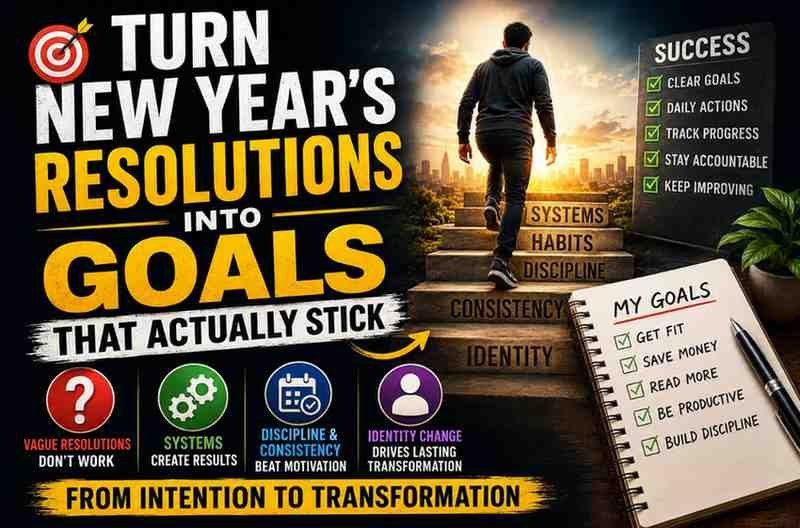
- Why Most New Year’s Resolutions Fail (And What That Reveals)
- Step 1: Define Clear, Actionable Goals (Not Just Wishes)
- Step 2: Prioritize What Truly Matters
- Step 3: Build Discipline, Not Just Motivation
- Step 4: Focus on Systems, Not Outcomes
- Step 5: Break Big Goals Into Small Wins
- Step 6: Eliminate Distractions and Triggers
- Step 7: Track Progress and Stay Accountable
- Step 8: Embrace Failure as Part of the Process
- Step 9: Build Mental Resilience and Consistency
- The Hidden Truth: Identity Drives Behavior
- Real-World Impact: Why This Approach Works
- A Unique Insight: The Problem Isn’t You It’s the Approach
- Prediction: The Future of Goal Setting
- Conclusion: From Intention to Transformation
Every year begins with a promise a fresh start, a better version of yourself, a list of resolutions that feel exciting in January and forgotten by March. Sound familiar? You’re not alone. The truth is, most people don’t fail because they lack motivation they fail because they don’t know how to turn New Year’s resolutions into goals that actually stick.
Every year, as the calendar flips, millions of people quietly promise themselves a fresh start. It could be getting healthier, saving more money, building a Business, or simply becoming more disciplined. These promises what we call New Year’s resolutions often begin with genuine intent. But somewhere between January motivation and real-life distractions, most of them fade away.
The problem isn’t ambition. It’s the lack of structure. A resolution is just an idea unless it’s turned into something measurable, actionable, and consistent. Whether it’s in your personal life, career, or daily habits, lasting change doesn’t happen by chance it happens when intention meets a clear plan and the discipline to follow through.
And the truth is, you don’t have to wait for a new year to make that shift. The real transformation begins the moment you decide to treat your resolutions like goals and start acting on them.
This guide goes beyond generic advice. It breaks down the psychology behind why resolutions fail and more importantly, how to build a system that makes success almost inevitable.
Why Most New Year’s Resolutions Fail (And What That Reveals)
Before fixing the problem, you need to understand it.
Most resolutions fail not because they are unrealistic, but because they are undefined. Saying “I want to get fit” or “I want to save money” sounds good, but it lacks clarity, structure, and accountability.
Core issue: Resolutions are intentions. Goals are systems.
| Resolutions | Goals |
|---|---|
| Vague and emotional | Specific and measurable |
| Short-term motivation | Long-term planning |
| Outcome-focused | Process-focused |
| Easily abandoned | Tracked and adjusted |
Insight: The moment you shift from “what I want” to “how I will do it,” everything changes.
Step 1: Define Clear, Actionable Goals (Not Just Wishes)
If your resolution can’t be measured, it can’t be improved.
Instead of saying “I want to read more,” define it as: “I will read 10 pages every day before bed.”
This transforms an abstract desire into a concrete action.
- Make it specific
- Make it measurable
- Make it time-bound
Example:
- Resolution: “I want to save money”
- Goal: “I will save ₹5,000 every month by reducing non-essential spending”
Why it works: Clarity reduces decision fatigue and increases follow-through.
Step 2: Prioritize What Truly Matters
One of the biggest mistakes people make is setting too many resolutions at once. More goals don’t mean more success they mean divided focus.
Your energy is limited. Your attention is valuable. Use both wisely.
Ask yourself:
- What will actually improve my life the most?
- What am I willing to sacrifice for?
Hard truth: If everything is a priority, nothing is.
This is where discipline begins not in action, but in decision-making.
Step 3: Build Discipline, Not Just Motivation
Motivation feels great until it disappears. Discipline, on the other hand, is what keeps you going when motivation fades.
Think of discipline as a muscle. The more you use it, the stronger it becomes.
For example, resisting impulse shopping once may feel difficult. Doing it repeatedly builds control. Over time, what once felt like effort becomes automatic.
Insight: Small acts of discipline create identity change. You stop trying to be disciplined you become disciplined.
Step 4: Focus on Systems, Not Outcomes
Here’s a mindset shift that changes everything:
Winners don’t focus on goals. They focus on systems.
If your goal is to lose weight, your system might include:
- Daily 30-minute walks
- Eating home-cooked meals 5 days a week
- Tracking calorie intake
The goal is the result. The system is the process that gets you there.
Comparison:
- Goal mindset: “I want to lose 10 kg”
- System mindset: “I follow a routine that naturally leads to weight loss”
Systems remove pressure and replace it with consistency.
Step 5: Break Big Goals Into Small Wins
Big goals can feel overwhelming. That’s why most people quit early.
The solution? Break them down.
Instead of focusing on the final result, focus on daily or weekly progress.
- Write 500 words a day instead of “write a book”
- Save ₹200 daily instead of “build savings”
- Exercise 3 times a week instead of “get fit”
Psychological benefit: Small wins create momentum. Momentum builds confidence. Confidence drives consistency.
Step 6: Eliminate Distractions and Triggers
Willpower alone is unreliable. Your Environment plays a bigger role than you think.
If you want to avoid impulse shopping, don’t browse sales apps unnecessarily. If you want to eat healthy, don’t stock junk food at home.
Golden rule: Make good habits easy and bad habits difficult.
This is not about restriction it’s about smart design.
Step 7: Track Progress and Stay Accountable
What gets measured gets improved.
Tracking your progress keeps you aware and motivated.
- Use a journal or app
- Set weekly check-ins
- Celebrate milestones
Insight: Accountability turns intention into commitment.
Step 8: Embrace Failure as Part of the Process
You will slip. You will miss days. You will feel like quitting.
That’s not failure that’s part of the journey.
The real difference between success and failure is not perfection. It’s persistence.
Reframe:
- Missed one workout? Continue tomorrow.
- Overspent once? Adjust next week.
Light truth: Progress doesn’t disappear because of one bad day but it does if you quit entirely.
Step 9: Build Mental Resilience and Consistency
Consistency beats intensity every single time.
You don’t need extreme effort. You need sustained effort.
This is where mental resilience comes in the ability to keep going even when results are slow.
Example: Walking daily for a year is more effective than intense workouts for a month.
Insight: Repetition is not boring it’s powerful.
The Hidden Truth: Identity Drives Behavior
Here’s a perspective most people miss:
Lasting change doesn’t come from what you do. It comes from WHO you believe you are.
Instead of saying:
- “I want to quit smoking” → Say “I am someone who doesn’t smoke”
- “I want to save money” → Say “I am financially disciplined”
Why it matters: Identity shapes behavior. Behavior reinforces identity.
This creates a powerful feedback loop.
Real-World Impact: Why This Approach Works
Turning resolutions into goals is not just about personal growth it affects every area of life:
- Better financial stability
- Improved physical and mental health
- Stronger relationships
- Higher productivity and career growth
When individuals improve, systems improve families, workplaces, and communities benefit.
A Unique Insight: The Problem Isn’t You It’s the Approach
Most people blame themselves for failing resolutions.
But the real issue is flawed strategy, not lack of willpower.
New perspective: Success is not about trying harder. It’s about designing better systems.
Prediction: The Future of Goal Setting
As awareness grows, goal-setting is evolving:
- More focus on habit-building over outcomes
- Increased use of digital tracking tools
- Greater emphasis on mental health and balance
- Personalized productivity systems
The future belongs to those who understand not just what they want but how to build it consistently.
Conclusion: From Intention to Transformation
New Year’s resolutions are not the problem. The lack of structure is.
When you turn vague intentions into clear goals, build systems around them, and stay consistent, real change becomes possible.
Key takeaways:
- Clarity beats motivation
- Systems beat goals
- Consistency beats intensity
- Identity drives lasting change
Final thought: You don’t need a new year to change your life. You need a better approach. Start small, stay consistent, and LeT your actions shape your future one decision at a time.
For breaking news and live news updates, like us on Facebook or follow us on Twitter and Instagram. Read more on Latest Lifestyle on thefoxdaily.com.

COMMENTS 0