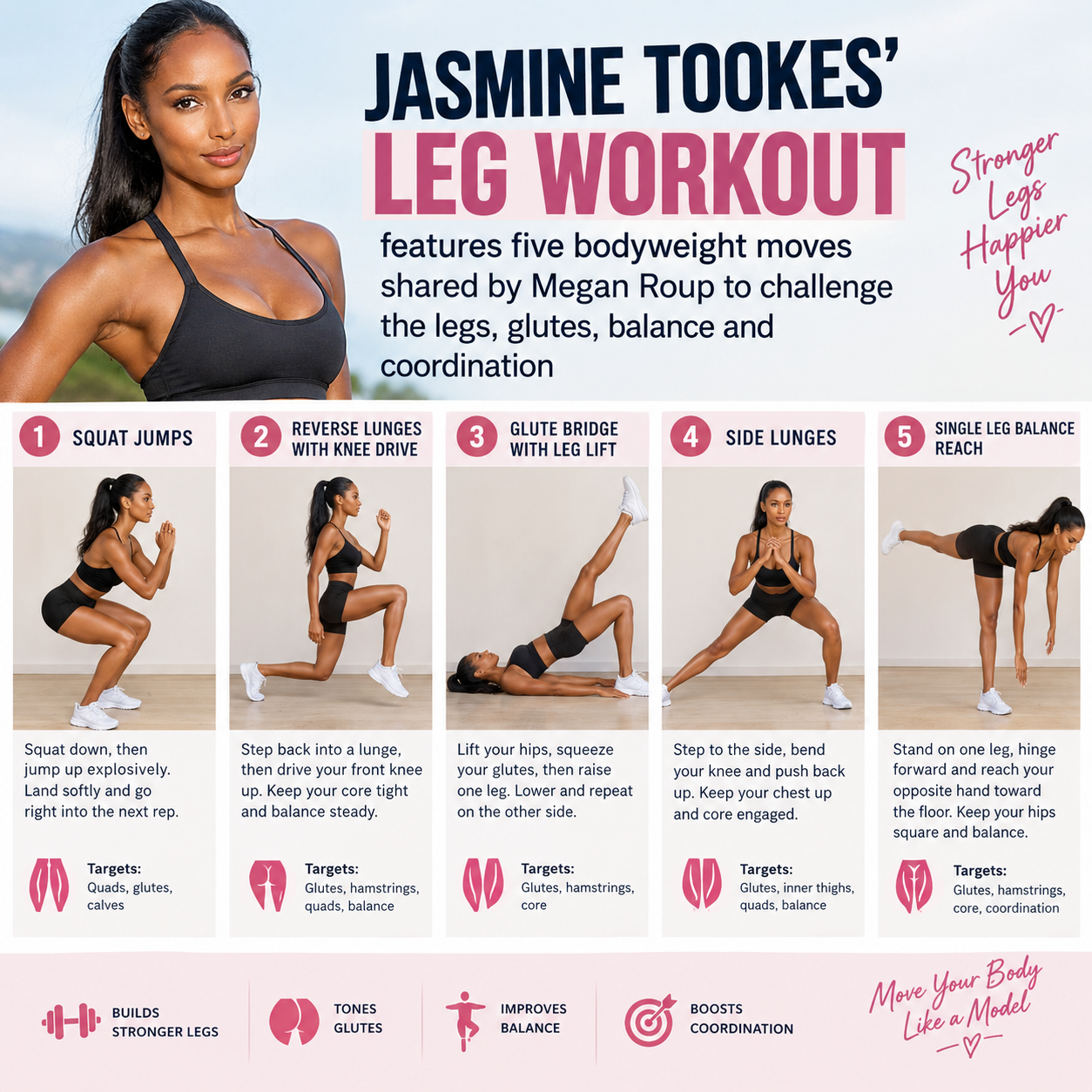
Supermodel Jasmine Tookes brought her signature athletic elegance to the 2026 Victoria’s Secret Fashion Show in Los Angeles, drawing attention for her runway looks and visibly strong legs. A week before the event, celebrity fitness trainer Megan Roup offered a glimpse into the preparation behind the model’s appearance, sharing a five-movement leg circuit on Instagram on October 19.
The routine included curtsy variations, cross taps, backward taps and squats. Rather than focusing exclusively on traditional weighted exercises, it combined controlled lower-body movements that challenge balance, coordination and muscular endurance. These exercises can be adapted for different fitness levels, making the circuit relevant to people looking to strengthen their legs and glutes at home.
However, there is an important distinction between a workout designed to challenge the lower body and a guaranteed method for achieving a particular appearance. The video reveals the exercises used in Tookes’s preparation, but it does not establish that this circuit alone produced her physique. Training history, nutrition, recovery and other factors also influence muscle development and overall appearance.
Jasmine Tookes’ Five-Move Leg Workout: The Complete Routine
According to the workout shared by Megan Roup, the circuit contains five exercises, with eight repetitions of each movement. The sequence emphasizes curtsy-style movements, cross-body coordination and squats.
Here is the complete routine, along with practical guidance on understanding and performing each exercise. The descriptions below explain the movements based on their names; they are not a substitute for the trainer’s original demonstration, particularly where the exact choreography may vary.
1. Around-the-World Curtsy: 8 Repetitions
The around-the-world curtsy combines a curtsy-style leg movement with changes in leg position or direction. A conventional curtsy involves stepping one foot diagonally behind the other and bending the knees in a controlled motion.
The diagonal step challenges balance and asks the muscles around the hips and thighs to control the movement. Depending on how the around-the-world variation is performed, it can also require coordination as the working leg moves through different positions.
How to approach it:
- Stand upright with your feet approximately hip-width apart.
- Step one foot diagonally behind the other, keeping the movement controlled.
- Bend your knees only as far as you can comfortably manage while maintaining balance.
- Return to the starting position before repeating the movement.
Use the trainer’s demonstration to follow the precise around-the-world pattern. Avoid forcing a deep knee bend or allowing the front knee to collapse inward.
2. Cross Taps: 8 Repetitions
Cross taps generally involve moving one foot across the body to tap the floor, then returning to the starting position. The exercise can challenge coordination and balance while requiring the standing leg to stabilize the body.
Its difficulty depends on the exact variation, including the distance of the step and whether the movement is performed at a slow or brisk pace. The aim should be controlled foot placement rather than simply moving as quickly as possible.
How to approach it:
- Begin in a comfortable standing position.
- Move one foot across the body to make a light tap.
- Return to the starting position without twisting the supporting knee unnecessarily.
- Repeat on the other side as directed by the workout demonstration.
People who find balancing difficult can begin with smaller steps. Keeping the torso steady can help make the movement more controlled.
3. Curtsy Cross Knee: 8 Repetitions
The curtsy cross knee appears to combine a curtsy-style step with a cross-body knee movement. Such combinations add a coordination challenge to a familiar lower-body exercise.
A curtsy movement involves stepping diagonally behind the body. Bringing the knee across the body afterward can require the hips and abdominal muscles to help maintain balance. The exact sequence and repetition counting should follow Roup’s original demonstration.
How to approach it:
- Start with your feet comfortably apart and your weight evenly distributed.
- Perform a controlled curtsy-style step.
- Return to standing and bring the knee across the body if that matches the demonstrated variation.
- Complete the movement without rushing or leaning excessively to one side.
Do not force the hips or knee into an uncomfortable position. A smaller, controlled range of motion is preferable to a deeper movement that causes pain or compromises balance.
4. Tap Backs: 8 Repetitions
Tap backs typically involve stepping one foot behind the body and lightly tapping the floor before returning to the starting position. Depending on the variation, the movement can emphasize balance, hip control and coordination.
The exercise may look simple, but repeated backward steps require the body to control its position while the legs alternate between moving and supporting the body’s weight.
How to approach it:
- Stand tall with your feet approximately hip-width apart.
- Move one foot backward and tap the floor lightly.
- Bring the foot back to the starting position.
- Alternate legs as shown in the demonstration.
Keep the step within a comfortable distance. If you struggle to maintain balance, use a wall or stable chair for support rather than extending the leg farther than you can control.
5. Curtsy to Squats: 8 Repetitions
The final exercise combines a curtsy movement with a squat. This pairing brings together a diagonal step and a more conventional lower-body movement.
Squats involve bending at the hips and knees before returning to standing. They recruit several lower-body muscle groups, including the quadriceps and gluteal muscles. Adding a curtsy transition can increase the coordination required to move between positions.
How to approach it:
- Perform the curtsy movement using a comfortable range of motion.
- Return to a stable standing position.
- Move into a squat, keeping your feet planted and your knees aligned with your toes.
- Push through your feet to stand again, then follow the demonstrated sequence.
Keep the squat depth appropriate to your mobility and experience. Beginners can use a shallow squat and gradually increase the range as their technique improves.
How to Structure the Circuit at Home
Roup’s post identifies five exercises and specifies eight repetitions for each. It does not establish a complete training prescription covering the number of rounds, rest periods, workout duration or weekly frequency.
That distinction matters because a list of exercises is not necessarily a full training plan. The total workload depends on how many rounds are completed, how the movements are performed and how much recovery is taken between them.
For someone interested in trying similar movements, a sensible starting point is to learn each exercise individually before combining them into a circuit. Once the movements feel comfortable, they can be performed in sequence with enough rest to maintain good technique.
Consider these practical guidelines:
- Warm up first: Spend a few minutes walking, marching in place or performing gentle bodyweight movements before beginning the circuit.
- Prioritize technique: Controlled movements are more useful than rushing through repetitions with poor balance.
- Adjust the difficulty: Reduce the range of motion or use support when necessary.
- Allow recovery: Rest when your technique begins to deteriorate or your balance becomes difficult to maintain.
- Stop if you feel pain: Muscle effort can be normal, but sharp pain in the knees, hips or back is a reason to stop and reassess the movement.
There is no need to copy a professional model’s training intensity. A circuit should be adapted to the individual’s fitness level, health and experience.
What Muscles Does Jasmine Tookes’ Leg Workout Target?
The circuit’s combination of curtsy variations, cross-body movements, backward taps and squats suggests an emphasis on lower-body control, balance and muscular endurance. The exact demands vary with the exercise technique and the number of repetitions performed.
Quadriceps
The quadriceps are located at the front of the thighs and help straighten the knees. They contribute to movements such as standing up from a squat and controlling the body during a knee bend.
Gluteal Muscles
The gluteal muscles help extend and stabilize the hips. They play a role in standing, stepping and squatting, making them important contributors to many lower-body exercises.
Hamstrings
The hamstrings run along the backs of the thighs and help bend the knees and extend the hips. Their contribution depends on the specific movement and how the body is positioned.
Hip Stabilizers and Core Muscles
Cross-body steps and single-leg movements require the body to remain stable as the feet change position. The muscles around the hips and trunk contribute to this control, particularly when balance becomes more challenging.
However, the presence of these movements does not mean every muscle receives an equal training stimulus. Exercise technique, range of motion and overall workload all influence which muscles are challenged most.
Can This Workout Give You Sculpted Legs in One Week?
The timing of Tookes’s workout has attracted attention because Roup shared the routine approximately a week before the fashion show. But the timing should not be mistaken for evidence that five exercises can transform someone’s legs in seven days.
Muscle development is a longer-term process. Strength and muscular endurance can improve with consistent training, while visible changes in muscle size generally require sustained exercise over time. The extent and speed of those changes vary between individuals.
A short period of exercise can still be useful. It can help someone practise movement patterns, establish a routine or become more familiar with lower-body training. However, a week is not a reliable deadline for achieving a particular body shape.
Several factors influence the appearance of the legs:
- Training history: Someone who exercises regularly may have different strength and muscle development from a beginner.
- Genetics: Natural differences influence body proportions and how muscle develops.
- Nutrition: Adequate energy and protein intake support training and recovery.
- Recovery: Rest and sufficient sleep help the body adapt to exercise.
- Overall activity: Walking, resistance training and other physical activities contribute to a person’s broader fitness routine.
Lighting, posture, clothing and camera angles can also affect how muscle definition appears in photographs and runway footage. Consequently, a model’s visible physique should not be treated as a direct measure of the effectiveness of one workout.
Why a Five-Move Circuit Can Be Useful for Lower-Body Fitness
The appeal of a short circuit lies in its simplicity. Instead of requiring several machines or a long list of exercises, it brings together movements that can generally be practised with body weight and limited space.
Curtsy-style steps introduce diagonal movement, while cross taps and backward taps challenge coordination. Squats provide a familiar movement pattern that can be adjusted according to ability. Together, these exercises offer a way to practise lower-body control without making access to a fully equipped gym a prerequisite.
That does not make the circuit a complete fitness programme. People seeking substantial improvements in strength may benefit from a broader resistance-training routine that progressively challenges the muscles. Depending on their goals and experience, that could include squats, lunges, hip hinges and other exercises performed with suitable resistance.
Progression should be gradual. Once bodyweight exercises become manageable, a person may be able to increase the challenge by adjusting repetitions, movement control or resistance. Adding difficulty is useful only when the underlying technique remains sound.
What Jasmine Tookes Wore at the 2026 Victoria’s Secret Fashion Show
Tookes appeared in two distinctive looks during the Los Angeles show on October 18, 2026. Her first ensemble featured a multicoloured bikini, a sequined magenta cover-up and oversized pink angel wings covered in tinsel. Embellished pumps and blue-beaded hoop earrings completed the look.
For her second appearance, she wore white lingerie beneath a beaded cover-up, accessorised with diamond earrings and a diamond bracelet. The outfits reflected the show’s emphasis on elaborate styling, decorative details and theatrical runway presentation.
Tookes also has a notable history with the event. In 2016, she wore the Bright Night Fantasy Bra, designed by Eddie Borgo and valued at $3 million. In 2025, she attracted attention for opening the show while nine months pregnant, wearing a gold, gem-embellished netted look with a shell-shaped structure on the back.
Her return in 2026 provided another chapter in that runway history, while the trainer’s social media post offered a glimpse into one aspect of her preparation away from the cameras.
How the Victoria’s Secret Fashion Show Has Evolved
First staged in 1995, the Victoria’s Secret Fashion Show became known for combining lingerie presentations with elaborate costumes, prominent models and musical performances. Over the years, the production travelled to several international cities, including London, Paris, Shanghai and Cannes, while New York remained a longstanding home for the event.
The 2026 edition returned to Los Angeles, bringing the runway spectacle to a city associated with the entertainment industry. Executive creative director Adam Selman organised the presentation around seasonal themes, with designs drawing on flowers, snowflakes and metallic effects.
The musical lineup featured Megan Moroney, Tate McRae, KATSEYE and Megan Thee Stallion. Their performances formed part of a production that treated the runway as a combination of fashion presentation and live entertainment.
Within that larger spectacle, workout content offers a different perspective on the preparation behind a model’s appearance. The runway showcases the finished styling, whereas a training clip reveals a small part of the physical work that can accompany a demanding professional schedule.
What Readers Can Learn From Jasmine Tookes’ Workout
The most useful lesson from Roup’s circuit is not that a particular routine can guarantee a model-like physique in a week. It is that lower-body exercise can be organised around simple movements that challenge strength, coordination and balance.
For beginners, the five exercises offer ideas for exploring bodyweight training, provided each movement is adapted to their abilities. For more experienced exercisers, the circuit may serve as a variation within a broader programme rather than a replacement for progressive resistance training.
The routine’s exact workload also matters. Eight repetitions of each exercise describe the movements in the shared circuit, but they do not tell readers how many rounds Tookes completed, how frequently she trained or what other exercises formed part of her preparation. Those details should not be assumed.
Ultimately, Tookes’s runway appearance and the workout shared by her trainer are two connected but distinct stories. The video documents a five-movement leg circuit used during the week before the show; it does not establish that the circuit alone created her physique. For anyone inspired to try similar exercises, consistent training, appropriate recovery and sound technique offer a more realistic foundation for long-term fitness than chasing a rapid visual transformation.
For breaking news and live news updates, like us on Facebook or follow us on Twitter and Instagram. Read more on Latest Lifestyle on thefoxdaily.com.

COMMENTS 0