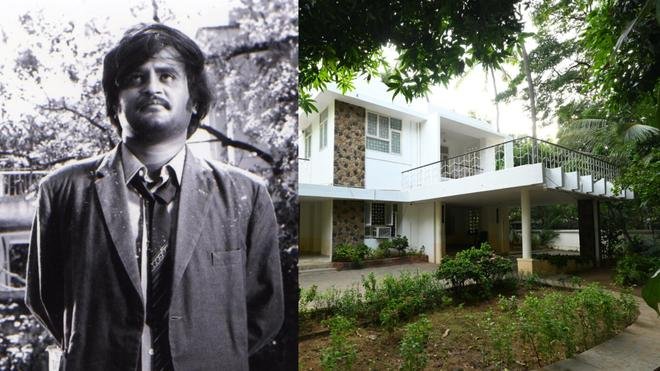
Some stories begin with carefully planned interviews, weeks of research and a clearly defined reporting agenda. Others begin with a gate, a quiet street and a question that refuses to go away.
A search for the Chennai location where Rajinikanth filmed his first movie, Apoorva Raagangal, in 1975 became one such unexpected journey. What began as an attempt to identify a piece of Tamil cinema history eventually opened the door to a much wider lesson about journalism: stories are often waiting in places reporters pass every day.
For generations of Tamil cinema audiences, Apoorva Raagangal occupies a special place in Rajinikanth’s history. The film marked the beginning of an extraordinary acting career, and one of its early images has acquired significance precisely because viewers now know what came next.
The young Rajinikanth pushes open a gate and walks into a house. At the time, he was an emerging actor. In retrospect, the shot looks almost prophetic—a newcomer literally walking into Tamil cinema history.
The Search for Rajinikanth’s First Film Location
The question appeared simple: where exactly was that house?
Finding an old filming location in a city that has changed dramatically over five decades is rarely straightforward. Buildings are renovated, streets acquire new identities, landmarks disappear and memories become less precise with time.
Yet film locations have a peculiar relationship with memory. A place that may be completely ordinary to its residents can become extraordinary to audiences once it appears on screen.
That is especially true when the actor associated with the location later becomes one of Indian cinema’s biggest stars.
The residence in Adyar connected with the opening portions of Apoorva Raagangal therefore represents more than a physical address. It is a small piece of the enormous story of Rajinikanth’s rise.
Apoorva Raagangal: Where Rajinikanth’s Journey Began
Directed by K. Balachander, Apoorva Raagangal was released in 1975. The film is remembered as an important work in Tamil cinema, but its place in popular culture became even more significant because it introduced audiences to Rajinikanth.
Looking back at the film today changes the way those early scenes are perceived.
The performer entering through the gate is no longer simply a newcomer. The audience already knows the decades of stardom that followed: blockbuster films, unforgettable dialogue, distinctive mannerisms and a fan culture unlike that of almost any other Indian actor.
That knowledge gives an ordinary cinematic entrance a strange historical weight.
The gate becomes symbolic because viewers know what lies beyond it—not just the house, but the beginning of one of Indian cinema’s most remarkable careers.
Why Old Film Locations Matter
Film locations are often treated as background details, but they can become cultural landmarks.
A building seen for only a few seconds can acquire meaning because audiences associate it with a character, a song, a memorable scene or an actor’s breakthrough.
In Chennai, where Tamil cinema has been deeply intertwined with the city’s streets and neighbourhoods, these locations form an unofficial cinematic map.
Studios and purpose-built sets are only part of that history. Homes, roads, restaurants, beaches, parks and public buildings have all appeared in films, often without their everyday significance being recorded.
As cities change, these locations can become difficult to identify. That makes journalistic searches for them more than exercises in nostalgia. They can also serve as informal documentation of how a city and its cinema evolved together.
The Unexpected Discovery Along the Way
The most revealing part of this story, however, was not necessarily the destination.
While pursuing the Rajinikanth location, the reporter encountered other details and characters that had little obvious connection to the original assignment. This is where the idea behind the story becomes especially interesting.
Journalism does not always work in a straight line.
A reporter can leave home looking for one fact and return with three completely different stories. A conversation with a stranger, an unfamiliar park or a person doing something unusual can create a new reporting trail.
In this case, a secret Chennai park and a Gandhi impersonator became part of that unexpected journey.
The Secret Park Hidden Inside Chennai
Chennai is a city where familiar neighbourhoods can still contain spaces that remain surprisingly unknown to many residents.
Parks are particularly interesting because they exist in the middle of everyday urban life but can remain invisible to people who do not have a reason to enter them.
A casual stroll can therefore reveal a completely different side of a neighbourhood.
The discovery of a relatively hidden green space during a reporting journey illustrates an important feature of city journalism. Reporters do not always need to travel far to find something new. Sometimes the unfamiliar is sitting behind a gate, down a side road or inside a place that residents themselves have never visited.
Such spaces also provide clues about the character of a city. Chennai is often discussed through its traffic, beaches, temples, cinema, food and rapidly changing urban landscape. Quiet green spaces offer another perspective—one based on pause rather than movement.
Then Came the Gandhi Impersonator
The appearance of a Mahatma Gandhi impersonator added another unexpected layer to the journey.
At first glance, the connection between Rajinikanth, a Chennai park and someone dressed as Gandhi may seem nonexistent. But that is precisely what makes the episode a useful lesson in storytelling.
Journalism often begins with an apparent coincidence.
A person encountered by chance may have a story that does not fit the original assignment. A reporter’s job is not necessarily to force that discovery into the original narrative, but to recognize when it deserves attention of its own.
Impersonators are particularly interesting figures because they exist between performance and everyday life. Their appearance may initially attract attention because they resemble a historical figure, but the more important story is usually the person behind the costume: why they chose the role, how they perform it and what Gandhi represents to them.
What a Gandhi Impersonator Reveals About Public Memory
The enduring visibility of Gandhi in public life is partly sustained through such acts of representation.
Images of Gandhi are instantly recognizable: the round spectacles, bald head, simple clothing and walking stick have become visual shorthand for a historical personality.
An impersonator takes that familiar image and turns it into a living performance.
That creates an interesting relationship between history and popular culture. People who encounter an impersonator may immediately recognize the reference even without knowing anything about the person’s actual work.
In that sense, impersonation becomes a form of public storytelling.
It also raises questions about how historical figures survive in contemporary memory. They are remembered not only through textbooks and monuments but also through performances, photographs, films, school events and public appearances.
What Connects Rajinikanth and Gandhi?
On the surface, very little connects a superstar actor with a historical leader and a hidden urban park.
But there is an underlying connection: all three are about places becoming meaningful because of the stories attached to them.
The house in Adyar is an ordinary residence that acquired cinematic significance through a young actor’s appearance.
The park becomes noteworthy because it exists as an unexpected piece of the city waiting to be discovered.
The Gandhi impersonator turns a familiar historical image into a live encounter.
Each example demonstrates how context changes the way we see ordinary things.
Why the Rajinikanth Gate Still Matters 50 Years Later
Cinema can freeze a moment in a city’s history.
When audiences watch a film made decades ago, they also see buildings, roads, clothing, vehicles and neighbourhoods that may no longer look the same. A filming location therefore becomes an accidental historical document.
The opening appearance of Rajinikanth in Apoorva Raagangal is especially powerful because his future was unknowable at the time.
There was no guarantee that the newcomer walking through that gate would become a cultural phenomenon.
That is what gives retrospective viewing its special quality. The audience knows the ending even though the people inside the original moment did not.
From Unknown Actor to Superstar
Rajinikanth’s career after Apoorva Raagangal developed through a combination of supporting roles, increasingly prominent characters and eventually leading roles that transformed his public image.
His journey also demonstrates how stardom is constructed over time.
The gestures and mannerisms that audiences later associated with “Rajinikanth” were not necessarily fully formed in his first appearance. They developed through years of performance, experimentation and increasingly strong connections with audiences.
That makes returning to the earliest footage particularly fascinating.
Viewers can observe the beginnings of a screen personality before it became a fully established cultural identity.
Why Journalists Should Sometimes Stop Following the Plan
The deeper lesson of this Chennai journey concerns reporting itself.
A carefully constructed pitch can provide direction, but an obsession with the original plan can sometimes cause journalists to overlook better stories.
Walking, observing and talking to people create opportunities that cannot always be predicted in advance.
A reporter may notice a strange sign, overhear a conversation, discover an old photograph or meet someone whose life connects unexpectedly with the subject being investigated.
These moments require curiosity.
The best reporters are not only good at finding answers. They are also good at noticing better questions.
The Value of Serendipity in Journalism
Serendipity does not mean abandoning preparation.
Good journalism still requires verification, context and careful reporting. An unexpected discovery becomes a meaningful story only when the reporter investigates it properly.
The difference is that serendipitous reporting allows the evidence encountered during the journey to influence the direction of the story.
This is particularly valuable in local journalism, where seemingly ordinary people and places can reveal larger truths about a city.
A hidden park may lead to a story about urban planning. A Gandhi impersonator may lead to questions about public memory. An old film location may reveal how neighbourhoods have changed.
The possibilities are often much bigger than the original assignment.
Chennai as a City of Hidden Stories
Chennai is particularly suited to this kind of reporting because its modern identity contains several overlapping histories.
It is simultaneously a major metropolitan city, a centre of Tamil cinema, a coastal city, a cultural hub and a place where old neighbourhoods coexist with rapid development.
Every street can therefore contain multiple timelines.
A house may have appeared in a famous film. A park may have existed quietly for decades. A person encountered on a morning walk may have spent years preserving an unusual tradition.
The challenge is not necessarily finding something extraordinary. It is recognizing the extraordinary significance of something ordinary.
A Lesson for Readers, Too
The story is not only a lesson for journalists.
It also suggests that people can experience their own cities differently by becoming more observant.
The next time someone walks through a familiar neighbourhood, there may be a building they have never noticed, a forgotten plaque, an old cinema connection or a person with an unexpected story.
Digital maps can tell us where things are. They cannot always tell us why a place matters.
That explanation still requires people, memories and curiosity.
Conclusion: The Stories Waiting Behind the Next Gate
The search for the location where Rajinikanth appeared in his first film began as a straightforward piece of cinematic detective work. But the journey became a reminder that stories rarely stay obediently inside the boundaries assigned to them.
A gate connected to Apoorva Raagangal, a quiet park in Chennai and a Gandhi impersonator may seem like unrelated discoveries. Yet together they illustrate something fundamental about journalism and cities: meaning is often hiding in plain sight.
Rajinikanth’s walk through that gate in 1975 lasted only moments on screen. Decades later, the image has acquired an importance nobody could have predicted when the cameras were rolling.
That may be the most beautiful lesson of all.
Stories do not always announce themselves. Sometimes, they wait behind a gate, along an unfamiliar path or in the person who happens to cross a reporter’s route.
For breaking news and live news updates, like us on Facebook or follow us on Twitter and Instagram. Read more on Latest Lifestyle on thefoxdaily.com.






COMMENTS 0