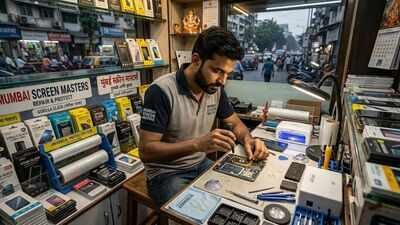
A simple conversation can sometimes reveal unexpected business opportunities. That is what reportedly happened when a man named Pratham asked his household cook how he managed his family’s finances. During the conversation, the cook mentioned that his son also ran a business selling tempered glass screen protectors for smartphones.
Pratham initially assumed the young man operated a small mobile repair shop. However, he later learnt that the business involved using a specialised cutting machine to prepare screen protectors for different smartphone models and supplying them to nearby mobile retailers.
Pratham shared the experience on X, explaining how the relatively small setup reportedly generates a monthly profit of Rs 50,000–60,000. The story attracted attention online because it highlighted a business model built around a common product, a modest initial investment and relationships with local shops.
How a Rs 70,000 Machine Became the Centre of the Business
According to Pratham’s account, the young entrepreneur invested approximately Rs 70,000 in a screen protector cutting machine. The equipment allows him to prepare protectors according to the dimensions and specifications of different smartphone models.
Pratham said he became curious after learning about the setup and asked his cook to bring his son over so he could understand how the business worked. During their conversation, he learnt that the machine could reportedly cut a screen protector in around 30 seconds.
This process can help a small operator serve mobile shops without having to maintain large inventories of pre-cut protectors for every phone model. Retailers can obtain products suited to the devices their customers use, including models for which ready-made stock may be difficult to find.
However, cutting a screen protector to size is different from manufacturing tempered glass from raw materials. The account describes a cutting-based operation and does not establish that the young entrepreneur produces glass from scratch.
Screen Protector Costs Rs 8–10 and Sells for Rs 25–30
One of the most discussed details in Pratham’s post was the reported difference between the production cost and selling price of each screen protector.
- Reported machine investment: Approximately Rs 70,000.
- Reported cost per screen protector: Rs 8–10.
- Reported selling price to retailers: Rs 25–30 per piece.
- Reported monthly profit: Rs 50,000–60,000.
- Reported cutting time: Around 30 seconds per piece.
Based on these figures, the difference between the stated production cost and selling price is approximately Rs 15–22 per unit. This is the gross difference before other business expenses and should not automatically be treated as net profit.
Actual earnings would depend on the number of protectors sold, wastage, packaging, electricity, transportation, machine maintenance, retailer payments and other operating costs. The figures were shared by Pratham on social media and have not been independently verified.
How Supplying Local Mobile Shops Can Create Repeat Business
The business model described in the post focuses on supplying nearby mobile shops rather than relying entirely on individual customers. This business-to-business approach can help an entrepreneur build relationships with retailers who need screen protectors regularly.
Smartphone users frequently purchase screen guards to protect their displays from scratches and everyday wear. Since different devices have different screen dimensions and designs, retailers need products that fit a range of models.
A cutting machine can help an operator prepare protectors based on digital templates. Instead of stocking large quantities of every possible size, a small business may be able to respond to demand as it arises.
Nevertheless, success depends on more than the equipment itself. Product quality, accurate cutting, competitive prices, dependable delivery and maintaining relationships with retailers can all affect whether customers continue placing orders.
Why the Story Resonated With Social Media Users
Pratham’s post attracted attention because it challenged the assumption that a profitable business must require a large shop, a substantial workforce or a major financial investment.
For many readers, the account illustrated how identifying a specific local need can provide a starting point for Entrepreneurship. A business that supplies a frequently used mobile accessory may appear ordinary, but it can potentially serve a consistent market when managed effectively.
Users responding to the post praised the idea of understanding a product’s economics, serving repeat customers and building a business around a practical need. Others pointed out that the reported earnings should be considered cautiously because the details had not been independently verified.
The discussion also highlights an important distinction between revenue, gross margins and net profit. A product may sell for considerably more than its direct production cost, but the amount left after all expenses depends on the scale and efficiency of the operation.
What Aspiring Entrepreneurs Can Learn From the Business Model
The account offers several practical lessons for people considering a small business. First, researching local demand is important. Before investing in equipment, entrepreneurs need to understand which retailers might buy their products, how frequently they would place orders and what prices they are willing to pay.
Second, the initial cost of machinery is only one part of the investment. Working capital, maintenance, consumables, transportation and compliance requirements can also affect profitability.
Third, entrepreneurs should calculate their expected earnings using realistic sales estimates rather than assuming that a machine’s advertised production speed translates directly into profit. The ability to cut a protector quickly does not guarantee that enough customers will buy the finished products.
Finally, product standards and applicable regulations should be checked before starting operations. Businesses involved in smartphone screen protectors need to verify the requirements relevant to their specific products and activities, including any applicable testing or certification obligations.
Is a Smartphone Screen Protector Business Guaranteed to Earn Rs 60,000 a Month?
No. The reported monthly profit is specific to the account shared by Pratham and should not be treated as a guaranteed income opportunity. Anyone considering a similar business would need to independently assess demand, competition, costs, product quality and regulatory requirements in their area.
The reported Rs 70,000 machine investment may appear manageable compared with some larger business setups, but the investment makes sense only if the entrepreneur can generate enough regular sales to cover operating expenses and recover the initial cost.
It is also important to distinguish between cutting screen protectors and manufacturing tempered glass. The exact equipment and production process determine what a business can legally and technically produce.
Conclusion
Pratham’s conversation with his household cook reportedly led him to discover a small smartphone screen protector business that uses a machine costing around Rs 70,000. According to his post, the cook’s son supplies nearby mobile shops, with each protector costing Rs 8–10 to prepare and selling for Rs 25–30.
The reported monthly profit of Rs 50,000–60,000 has not been independently verified, but the story has sparked discussion about local business opportunities and practical entrepreneurship. Its broader lesson is that a viable business often begins with understanding a specific customer need, calculating the costs carefully and building reliable relationships with buyers.
For breaking news and live news updates, like us on Facebook or follow us on Twitter and Instagram. Read more on Latest Lifestyle on thefoxdaily.com.






COMMENTS 0