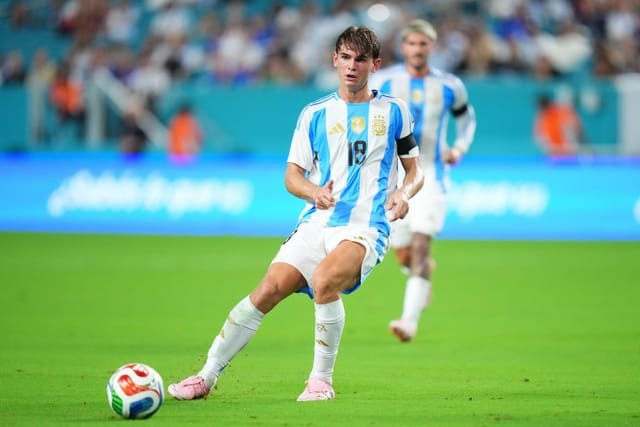
The 2026 FIFA World Cup is set to be the biggest in history and it could also be the tournament that crowns football’s next superstars. Move over, veterans. The under-23 brigade is coming.
The World Cup as a Career Launchpad
Every four years, the FIFA World Cup does something no club competition can replicate: it turns unknown footballers into global icons overnight. One breathtaking run, one perfectly timed goal, one fearless display against a footballing giant and a player’s career trajectory changes forever.
Consider James Rodríguez, who was a promising midfielder before 2014. After that golden boot-winning tournament in Brazil, he became one of the most sought-after players on the planet. Enzo Fernández went from promising youngster to a £106.8 million transfer in the wake of Argentina’s 2022 triumph. Denis Cheryshev, largely unknown outside Russia, became a household name with four goals in 2018. The World Cup manufactures legends at a speed no other competition can match.
Now, as the 2026 tournament kicks off across the United States, Canada, and Mexico — the first-ever 48-team edition a new generation of footballers under the age of 23 is primed to seize their moment. These are the five names you absolutely need to know before a single ball is kicked.
The 2026 World Cup Context: Why Young Players Have More Opportunity Than Ever
The expansion to 48 teams doesn’t just mean more matches — it means more diversity of opposition, which creates fertile ground for young attackers and dynamic midfielders to rack up statistics against less defensively rigid sides. Group stages now include a third game that can be more experimental, giving coaches the freedom to field bold, youthful line-ups with less tactical risk.
Simultaneously, the current era of club football dominated by data-driven recruitment, loan systems, and early professional debuts means that today’s 18-to-22-year-olds are more tactically developed and physically ready than any generation that came before them. These are not raw teenagers being thrown into the deep end. They are polished, battle-hardened competitors who just happen to be very young.
| # | Player | Nationality | Club | Age | Position |
|---|---|---|---|---|---|
| 1 | Lamine Yamal | Spain | FC Barcelona | 18 | Right Winger |
| 2 | Lennart Karl | Germany | Bayern Munich | 19 | Attacking Mid / Wide |
| 3 | Yan Diomande | Ivory Coast | RB Leipzig | 19 | Winger |
| 4 | Nico Paz | Argentina | Como / Real Madrid | 20 | Attacking Midfielder |
| 5 | Kenan Yildiz | Turkey | Juventus | 21 | Forward / Winger |
#5 Kenan Yildiz (Turkey): The Bosphorus Boy Ready to Conquer the World
Here is a remarkable piece of footballing trivia: Kenan Yildiz was not yet born the last time Turkey played at a FIFA World Cup. Turkey’s previous appearance came at the 2002 edition, where they finished an extraordinary third. More than two decades later, this 21-year-old Juventus forward is expected to carry the weight of an entire football-mad nation’s aspirations.
Playing alongside fellow prodigy Arda Güler, Yildiz gives Turkey a front line that most teams in the competition would envy. He is pacy, technically refined, and possesses the kind of direct dribbling ability that makes him nearly impossible to contain in one-on-one situations. At Juventus, he has operated in some of Italy’s most tactically demanding environments and emerged not just competent but genuinely influential.
What makes Yildiz especially intriguing heading into this tournament is the transfer speculation surrounding him. Several elite European clubs have been linked with his signature, and a standout World Cup performance which, historically, inflates valuations by anywhere from 40 to 150 percent — could trigger a bidding war this summer. His World Cup story is not just about football; it is a commercial and sporting inflection point rolled into one.
The unique angle competitors are missing: Yildiz represents something beyond individual talent he is the symbol of a new Turkish footballing identity, built on dual-heritage players raised through elite European academies who are now choosing to represent Turkey at international level. His success could trigger a wave of similar decisions from other dual-nationality talents. The World Cup stage is his audition for a generation.
#4 Nico Paz (Argentina): The Heir to Messi’s Throne Steps Forward
In Argentina, being labelled the “next Lionel Messi” is either the greatest honour in football or the cruellest curse imaginable — depending on who you ask. Yet the tag has found a genuinely worthy recipient in Nico Paz, the 20-year-old creative midfielder who has just completed a breakthrough Serie A season with Como that stopped Italian football in its tracks.
Twelve goals and seven assists from an attacking midfielder in his breakout campaign is not luck. It is evidence of a player whose footballing intelligence, close control, and vision have already outgrown what most players achieve in their mid-twenties. Paz plays football the way great novelists write — he sees a sentence ahead of everyone else.
His situation ahead of the tournament is uniquely fascinating. Real Madrid hold a buyback option, and Como the charming Lake Como-based club punching spectacularly above their financial weight are unlikely to prevent a return to the Bernabéu if Los Blancos choose to act. This World Cup could be both his debut on the global stage and, effectively, his public job interview at one of the world’s biggest clubs.
For Argentina, Paz’s versatility is a tactical gift. Manager Lionel Scaloni has never been afraid to build his systems around intelligent movement over brute physicality, and Paz embodies that philosophy perfectly. Post-Messi Argentina was always going to be a transition project. Paz suggests that transition may be shorter and smoother than anyone dared hope.
Prediction: If Argentina reach the knockout stages in form, Nico Paz will finish this tournament with at least five goal contributions and a world-record-breaking transfer announcement within weeks of the final whistle.
#3 Yan Diomande (Ivory Coast): Africa’s Breakout Star and Europe’s Most Wanted Teenager
Of all five players on this list, Yan Diomande is the name most likely to catch casual football fans completely off guard — and that element of surprise may be precisely his greatest weapon heading into the 2026 World Cup.
The Ivory Coast teenager has been turning heads all season at RB Leipzig, a club renowned for developing and showcasing raw talent within one of European football’s most demanding pressing systems. Thriving in that environment requires not just physical tools but exceptional footballing intelligence — the ability to read space, press with purpose, and transition from defence to attack at speed. Diomande has done all of this, and then some.
What has accelerated the buzz around him most recently was a performance against France in a pre-tournament friendly a match in which he was reportedly in red-hot form, making one of international football’s most defensively organised sides look vulnerable. That sort of display against top-tier opposition is not a coincidence; it is a statement.
The transfer market has responded accordingly. Liverpool, navigating the enormous challenge of replacing Mohamed Salah’s output, are reportedly monitoring him closely. Paris Saint-Germain perennially in search of the next big attacking talent are also said to be tracking his progress as they consider an upgrade on Bradley Barcola. The price tag is likely to be eye-watering if he delivers at this World Cup.
Ivory Coast’s group stage — featuring Germany, Curaçao, and Ecuador hands Diomande a genuinely mixed set of challenges. The Ecuador and Curaçao fixtures represent opportunities to build confidence and accumulate statistics; the Germany match is his chance to announce himself to the world on a giant screen. He will not want to waste it.
#2 Lennart Karl (Germany): Bayern’s Secret Weapon in Nagelsmann’s New Order
Germany and the World Cup have a special relationship with young talent. Michael Ballack, Philipp Lahm, Thomas Müller, Toni Kroos nearly every generation of German football has produced a teenager or early-twentysomething who catches fire on the world stage. In 2026, that torch appears to have been passed to Lennart Karl, the teenage Bayern Munich attacker.
What makes Karl particularly valuable to Julian Nagelsmann an
Germany, playing a home-continent tournament in North America with enormous footballing infrastructure and fan support, will arrive with genuine ambitions for a deep run. If Karl can deliver the kind of youthful energy that complements the composure of senior figures in the squad, he could end this tournament not just as a breakout star but as the cornerstone of Germany’s next great era.
The historical pattern is compelling. Germany’s young players at major tournaments tend to arrive as prospects and leave as established internationals. Kroos was 20 at the 2010 World Cup. Müller was 20 at the same tournament and won the golden boot. The template exists. Karl simply needs to follow it.
#1 Lamine Yamal (Spain): The Teenager Who Has Already Rewritten the Record Books
There is remarkable, and then there is Lamine Yamal. The Barcelona winger occupies a category so singular that conventional footballing language barely does him justice. He is 18 years old. He has already won the European Championship. He is already spoken of in the same breath as Messi, Ronaldo, and Neymar not as aspiration, but as reasonable comparison.
His EURO 2024 campaign was not a fairy tale of a young player getting lucky in a winning team. It was a masterclass. Yamal was arguably Spain’s most important attacking player throughout the tournament, delivering at moments of maximum pressure with a composure that experienced internationals spend careers trying to develop. That he was 16 at the time made it not just impressive but genuinely historical.
The 2026 World Cup represents the next chapter in what is shaping up to be one of the most remarkable careers in football history. Should Spain go deep into the tournament and they are among the genuine contenders Yamal could achieve something only Kylian Mbappé and Pelé have managed before him: lifting the World Cup as a teenager. The company he would be joining should tell you everything about the altitude of expectation surrounding him.
For defenders tasked with stopping him, the challenge is almost unfair. He is quick, unpredictable, technically superior, and perhaps most dangerously entirely unburdened by fear. He does not play like someone with everything to lose. He plays like someone who has nothing but upside in front of him. Because at 18, that is essentially true.
The insight competitors are missing: Yamal’s impact on Spanish football extends well beyond the pitch. He is the face of a new cultural identity for La Roja diverse, youthful, and globally resonant. His commercial profile is already approaching figures that dwarf most veteran internationals, and a strong World Cup would position him as not just football’s next superstar but one of the most marketable athletes on Earth. The football story and the cultural story are inseparable.
Why These Five Players Could Define the Next Decade of Football
Taken together, these five players represent something larger than five strong individual performances at a single tournament. They are the vanguard of a generational shift a moment when the names who have dominated football conversations for the past fifteen years begin to step aside, and new ones take their place in the collective imagination of billions of fans.
The 2026 World Cup is uniquely positioned to accelerate that shift. The expanded format means more matches, more exposure, and more opportunity for exceptional talent to cut through the noise. The North American host cities New York, Los Angeles, Dallas, Toronto, Mexico City bring enormous media infrastructure and global broadcast reach. Every great performance will be amplified a hundred times over.
History tells us that the breakout star of almost every World Cup comes as a partial surprise. In 2002, it was a then-unknown Ronaldo delivering on the biggest stage. In 2014, it was Rodríguez enchanting the world. In 2018, it was Mbappé. The 2022 edition gave us Fernández. The pattern is consistent: the World Cup creates stars the casual fan didn’t see coming.
This time, though, we have the rare privilege of knowing some of the names in advance and the extraordinary talent of Yamal, Karl, Diomande, Paz, and Yildiz suggests the 2026 tournament could produce not one breakout star, but five.
Conclusion: Watch These Names You Won’t Forget Them
The 2026 FIFA World Cup will be remembered for many things: the expanded format, the tri-nation hosting, the records that will inevitably be broken. But if history is any guide, it will most vividly be remembered for the young players who stepped into the global spotlight and refused to leave it.
Lamine Yamal has the talent to become the defining footballer of his generation. Nico Paz carries the impossible weight of Argentina’s post-Messi future and makes it look effortless. Yan Diomande is Africa’s next great export, and the transfer vultures are already circling. Lennart Karl is the latest in Germany’s proud tradition of teenage tournament revelation. And Kenan Yildiz is proof that Turkey’s long absence from the World Cup stage has done nothing to dim the ambition burning in the country’s footballing heart.
The next generation of football does not arrive politely. It arrives with pace, skill, audacity and no respect whatsoever for established reputations. That is precisely what makes it so thrilling to watch.
The 2026 FIFA World Cup starts now. You have been warned.
For breaking news and live news updates, like us on Facebook or follow us on Twitter and Instagram. Read more on Latest Sports on thefoxdaily.com.






COMMENTS 0