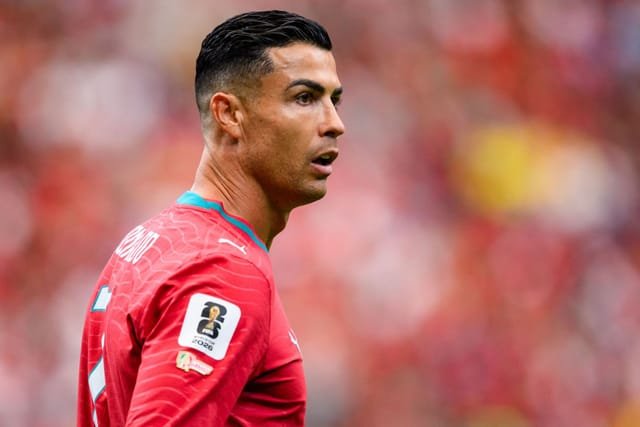
Portugal’s FIFA World Cup 2026 campaign has become a focal point for tactical debate and emotional controversy after former France international and 1998 World Cup winner Emmanuel Petit made a striking claim about the team’s internal dynamics. According to Petit, Cristiano Ronaldo’s presence may actually be creating a structural and psychological imbalance within the squad.
The discussion comes at a time when Portugal are already under scrutiny following a 1-1 draw against DR Congo, where Ronaldo struggled to make an impact and the team failed to assert full attacking control.
What Emmanuel Petit Said About Portugal and Ronaldo
Speaking on the “How To Win The World Cup” podcast on talkSPORT, Petit questioned whether Portugal’s players actively support Ronaldo in the same way Argentina’s squad supports Lionel Messi.
“Argentina.. the players they play for Messi. Do the Portuguese players play for Cristiano Ronaldo? I don’t think so.”
He emphasized that the issue is not solely Ronaldo’s individual performance, but rather how the entire system functions around him—or fails to.
Petit suggested that Portugal’s tactical identity lacks the emotional unity seen in Argentina’s setup under Messi, where players consciously tailor their movements and passing decisions to maximize their captain’s effectiveness.
Why This Claim Has Sparked Major Debate
At the heart of Petit’s argument is a sensitive question in modern Football: does Portugal’s squad fully buy into Ronaldo-centric football, or is there silent resistance within the team structure?
This debate has intensified due to Ronaldo’s age and role evolution. At 41, he remains a guaranteed starter, but his influence is increasingly dependent on service rather than individual creation.
Key reasons the debate is gaining traction include:
- Reduced attacking output from Ronaldo in recent matches
- Perceived lack of coordinated service from midfielders
- Tactical mismatch between modern pressing systems and static finishing roles
- Comparisons with Argentina’s Messi-centric but highly synchronized system
Ronaldo’s Performance vs DR Congo: The Catalyst
The controversy stems largely from Portugal’s underwhelming performance against DR Congo, where Ronaldo struggled to influence the game.
Statistically, the forward registered:
- Zero shots on target
- Three total attempts
- Limited involvement in build-up play
These numbers have fueled arguments that Portugal’s attacking structure is not functioning cohesively around its main striker.
The Messi vs Ronaldo System Debate Reignited
Petit’s comparison to Lionel Messi is not new in football discourse, but it remains highly relevant in tactical analysis.
Argentina’s success in recent years has often been attributed not only to Messi’s brilliance but also to the team’s deliberate structural adaptation around him. Players consistently adjust positioning, passing lanes, and attacking timing to suit his movement.
In contrast, Petit suggests Portugal’s setup lacks this level of synchronized intent.
This leads to a key tactical question:
Is Portugal building a system for Ronaldo—or simply fitting him into a system that no longer aligns with his playing style?
Roberto Martínez Under Tactical Pressure
Portugal manager Roberto Martínez now finds himself at the center of this debate. His challenge is not just tactical but psychological: maintaining squad harmony while balancing a generational superstar with emerging talents.
Petit’s criticism indirectly highlights a managerial dilemma:
- How to integrate Ronaldo without disrupting team fluidity
- How to ensure midfielders maintain creative freedom
- How to balance experience with pressing intensity
This balancing act becomes even more complex in high-stakes tournament football, where cohesion often outweighs individual brilliance.
Are Portugal’s Players Really Not Playing for Ronaldo?
Petit’s claim raises a controversial but important analytical point. While there is no public evidence of internal conflict, on-field patterns can sometimes suggest misalignment in attacking intent.
Observers have pointed to moments where passes were not directed toward Ronaldo in advanced positions, instead recycling possession or choosing alternative attacking routes.
However, this can also be interpreted through a tactical lens rather than emotional disconnect:
- Midfielders may prioritize safer ball retention options
- Opposition defensive setups may limit direct service routes
- Modern systems often emphasize positional rotation over focal strikers
In reality, the truth likely lies somewhere between tactical structure and perception bias.
Portugal’s Current Group Situation
Portugal’s draw against DR Congo has left them in a challenging position in Group K, sitting on one point and trailing early leaders Colombia.
This increases pressure on upcoming fixtures, where performance efficiency—not just results—will be closely analyzed.
Diogo Dalot Responds: Unity Inside the Squad
Amid rising criticism, Portugal defender Diogo Dalot defended Ronaldo and dismissed suggestions of internal friction.
“Our opinion of him hasn’t changed, he will always be ready to help and represent his nation.”
Dalot’s comments highlight an important counter-narrative: despite external criticism, the squad publicly maintains unity and respect for their captain.
Why This Debate Matters for Portugal’s World Cup Chances
This controversy is not just about Cristiano Ronaldo—it reflects a broader issue that can define Portugal’s tournament trajectory.
Teams that succeed in the World Cup often share one defining trait: collective clarity of purpose.
If Portugal’s attacking identity becomes divided between legacy reliance and modern fluidity, it could impact their ability to compete against more synchronized teams.
Key Tactical Questions Going Forward
As Portugal prepare for their next matches, several critical questions remain unanswered:
- Can Ronaldo still be the focal point in a high-tempo system?
- Should Portugal adapt formation to better support him?
- Is a transition toward a younger attacking structure inevitable?
- How will Martínez balance short-term results with long-term evolution?
Conclusion: A Team at a Tactical Crossroads
Emmanuel Petit’s comments have amplified an already sensitive discussion surrounding Portugal’s identity at the FIFA World Cup 2026. While Cristiano Ronaldo remains one of the most influential figures in football history, the modern game increasingly demands collective synchronization over individual dependency.
Whether Portugal’s struggles are due to tactical misalignment or perceived lack of cohesion remains open to interpretation. What is clear, however, is that Roberto Martínez faces one of the most complex managerial challenges of the tournament.
As Portugal move deeper into the group stage, their ability to unify around a clear attacking identity—whether centered on Ronaldo or not—may ultimately determine how far they go in this World Cup.
For breaking news and live news updates, like us on Facebook or follow us on Twitter and Instagram. Read more on Latest Sports on thefoxdaily.com.




COMMENTS 0