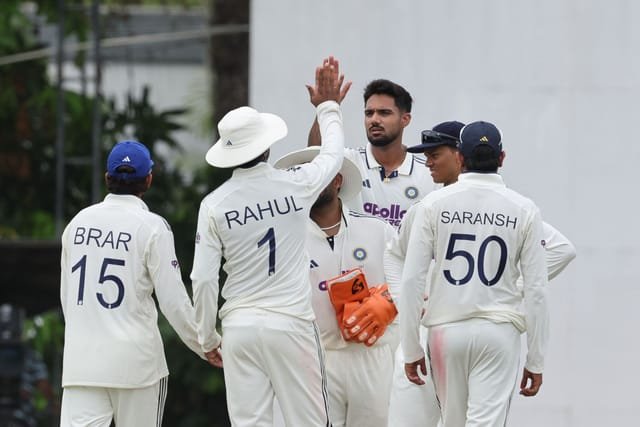
Gurnoor Brar has emerged as an intriguing fast-bowling prospect for India, and former international cricketer Aakash Chopra believes the young seamer should continue receiving opportunities across formats rather than being preserved exclusively for Test cricket.
The discussion comes after India’s recently completed two-match Test series against Sri Lanka. India secured a 1-0 series victory, but Brar did not make the playing XI in either match. Mohammed Siraj and Prasidh Krishna were preferred as India’s specialist seam-bowling options.
Brar’s absence has nevertheless sparked an important question about how India should manage a developing fast bowler. One possible approach would be to protect him from the demands of white-ball cricket and reserve him primarily for Tests. Chopra agreed that the idea has merit, but he also explained why restricting Brar could create another problem.
Why Aakash Chopra questioned a Test-only role for Gurnoor Brar
Chopra acknowledged that keeping Brar primarily for Test cricket could theoretically help India preserve a fast bowler for the longest format. However, he pointed out that India’s Test schedule does not provide continuous opportunities.
According to Chopra, the gap between Test assignments makes it difficult to develop a young player if he is restricted to the format. India had only recently completed their Sri Lanka series in August, while subsequent Test opportunities were expected to arrive in November and then around the end of January.
That irregular schedule creates a practical issue. A bowler who only plays Tests may spend long periods without competitive international cricket. For a relatively inexperienced player, those gaps can affect rhythm, match awareness and the ability to adjust to changing conditions.
Chopra’s argument therefore goes beyond simply deciding which format is best suited to Brar. It focuses on how India can make sure the bowler is sufficiently prepared when an important Test or global tournament arrives.
Gurnoor Brar could become important for India’s 2027 World Cup plans
The biggest reason for giving Brar regular opportunities is India’s preparation for the ODI World Cup 2027. The tournament is scheduled to be played in South Africa, Zimbabwe and Namibia, where conditions could offer pace and bounce to quality fast bowlers.
For India, developing a bowler capable of extracting additional movement and bounce could become strategically valuable. Brar is still at an early stage of his international career, meaning the team does not yet have a large sample size showing how he responds to different opponents, pitches and match situations.
Chopra believes those questions need to be answered before the World Cup rather than during it.
That means India’s selectors could use upcoming ODIs and T20Is as part of Brar’s development pathway. The objective would not necessarily be to play him in every match, but to expose him to enough situations to understand his strengths, limitations and response under pressure.
Brar’s international record shows why more exposure matters
Brar has already gained some experience in India’s ODI setup, although his international career remains in its early stages.
| Format | Matches | Wickets | Other recorded figure |
|---|---|---|---|
| Tests | 0 | 0 | Yet to debut |
| ODIs | 6 | 11 | Economy rate: 6.96 |
| T20Is | 0 | 0 | Yet to debut |
| First-class | 20 | 67 | Bowling average: 25.00 |
| List A | 15 | 23 | Economy rate: 6.67 |
| T20s | 9 | 10 | Economy rate: 10.81 |
These numbers underline the difference between Brar’s domestic experience and his international exposure. He has already taken 67 wickets in first-class cricket, demonstrating a substantial body of red-ball experience, while his List A record also provides evidence of useful limited-overs experience.
However, international cricket presents a different level of challenge. Six ODIs are enough to provide an initial impression, but not enough to establish how a bowler consistently performs against different batting line-ups and in different environments.
Why ODI cricket may be particularly important for Brar
Among the three formats, ODI cricket could offer India an especially useful development platform for Brar before the 2027 World Cup.
Test cricket tests a fast bowler’s ability to maintain discipline over long spells and create pressure through repeated deliveries. T20 cricket demands a different skill set, with bowlers expected to execute plans quickly against aggressive batting.
ODI cricket sits somewhere between those extremes. A bowler must manage longer spells than in T20s while also adapting to changing phases of an innings. New-ball movement, middle-over control and death-over execution can all become relevant.
For a bowler expected to potentially contribute at a World Cup, exposure to those situations can be extremely valuable.
It would also allow India’s coaching staff to determine where Brar is most effective. If he proves particularly dangerous with the new ball, India can build plans around that strength. If his effectiveness comes from hitting hard lengths during middle overs, his role can be adjusted accordingly.
Aakash Chopra’s workload-management argument
Chopra’s broader point was that workload management should not automatically mean removing a player from competition.
Fast bowlers face significant physical demands because of the repeated high-intensity actions involved in bowling. Managing those demands is essential, particularly for a developing player. But Chopra argued that simply keeping a player on the sidelines is only one part of workload management.
There is another side to the equation: building physical capacity through controlled participation.
A young fast bowler needs to gradually develop the stamina required to bowl repeated spells. Match exposure can help players become accustomed to the physical and mental demands of international cricket, provided their workload is carefully monitored.
That makes Chopra’s suggested approach more nuanced than simply saying Brar should play every available game.
Resting Gurnoor Brar versus regularly playing him
| Approach | Potential benefit | Potential concern |
|---|---|---|
| Reserve him mainly for Tests | Could protect him for red-ball cricket | Long gaps between international matches |
| Play him across formats | Builds experience and adaptability | Requires careful workload monitoring |
| Use him selectively | Balances development and recovery | Needs careful scheduling and planning |
The third option may ultimately be the most practical. India does not necessarily need to choose between constant cricket and complete rest. Selective participation can allow Brar to gain experience while avoiding unnecessary physical strain.
For example, the management could rotate him through ODI and T20I assignments while monitoring the number of overs he bowls. During congested periods, he could be rested from certain games without being removed from the team’s broader white-ball plans.
Why the 2027 World Cup changes the calculation
The timing of India’s preparation is important. The 2027 World Cup is not an immediate tournament, which gives the management valuable time to assess emerging players.
That time should ideally be used for experimentation.
India can afford to test different combinations in bilateral cricket, determine which bowlers complement one another and identify backups for major tournaments. Brar’s current stage of development makes him an obvious candidate for such assessment.
The benefit of doing this early is that India would not have to enter the World Cup relying on assumptions. If Brar succeeds, his role can be strengthened. If he struggles in particular conditions, the team can identify the reasons and work on them well before the tournament.
This is particularly important for fast bowlers because their effectiveness can change considerably depending on pitch conditions, ball movement, workload and confidence.
Brar’s Gujarat Titans connection adds another development avenue
Brar’s association with the Gujarat Titans also provides him with exposure to a franchise environment where he can continue developing his limited-overs skills.
Franchise cricket can expose players to different tactical approaches, experienced teammates and high-pressure situations. For an emerging bowler, those experiences can complement international cricket.
However, franchise cricket cannot completely replace international exposure. The pressure, tactical demands and quality of opposition are different, which is why Chopra’s suggestion of giving Brar opportunities for India remains significant.
What India should consider before selecting Brar regularly
There are several factors India’s selectors and team management would need to balance.
- Physical workload: The number of overs and consecutive matches should be monitored carefully.
- Format requirements: Brar’s role should be clearly defined in ODIs, T20Is and Tests.
- Conditions: Opportunities should ideally include different types of pitches and overseas environments.
- Skill development: The coaching staff can identify areas such as new-ball movement, control and variations.
- Match pressure: Competitive opportunities can reveal how he responds when the opposition is strong or the game is closely contested.
This approach would give India a clearer picture of whether Brar can become a dependable option for major tournaments.
Could Gurnoor Brar eventually become a Test specialist?
It is still too early to make that determination because Brar has yet to play a Test for India.
His first-class record suggests that he has substantial experience in the longer format, with 67 wickets from 20 matches at an average of 25.00. Those numbers make him an interesting red-ball prospect.
However, becoming a Test specialist should be the result of demonstrated performance and team requirements rather than a decision made purely to protect him from white-ball cricket.
If Brar establishes himself as an effective ODI and T20I bowler while maintaining the skills required for Tests, India would have greater flexibility. Conversely, if his workload eventually requires a stronger focus on one format, the management can make that decision based on evidence.
The bigger selection question for India
Brar’s situation highlights a broader challenge facing India: how to develop fast bowlers without rushing them or keeping them away from meaningful cricket for too long.
There is no universal workload-management formula. A bowler’s age, physical condition, bowling action, match schedule and role all matter. The ideal strategy is therefore likely to change from player to player.
For Brar, the current priority appears to be building an international sample size. Six ODIs and no T20I or Test appearances leave several unanswered questions.
Those questions can only be answered through controlled opportunities.
Final verdict: Brar needs opportunities, not simply protection
Aakash Chopra’s argument offers a balanced way of looking at Gurnoor Brar’s future. Reserving the fast bowler exclusively for Tests may sound attractive from a workload perspective, but India’s irregular Test calendar could leave a young player without enough competitive exposure.
With the 2027 ODI World Cup approaching in conditions where pace and bounce could become important factors, India have a strong reason to evaluate Brar in the white-ball setup as well.
The best route may therefore be selective all-format exposure rather than constant cricket or prolonged rest. India can manage his overs, rotate him when necessary and still provide enough opportunities for him to understand international conditions.
Brar’s next stage is ultimately about proving that his domestic record and early ODI performances can translate into consistent international impact. If India get that development process right, they could enter the 2027 World Cup with another genuine pace option ready for the challenge.
For breaking news and live news updates, like us on Facebook or follow us on Twitter and Instagram. Read more on Latest Cricket on thefoxdaily.com.






COMMENTS 0