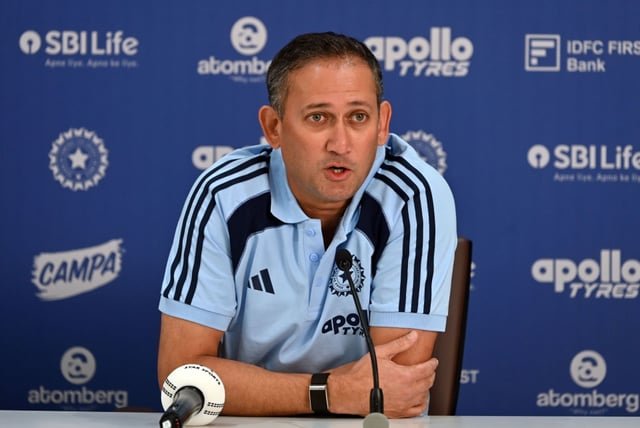
Ajit Agarkar‘s time as chairman of the Indian men’s senior selection committee is reportedly coming to an end after a series of disagreements involving major decisions around the national team. According to a report by PTI cited in the supplied source, Agarkar has not sought an extension and is yet to formally leave the position.
The former India all-rounder took charge of the selection committee in 2023 and has overseen several important phases of Indian cricket. His tenure included India’s gold medal-winning campaign at the 2023 Asian Games as well as preparations for major international tournaments.
However, recent developments involving Rohit Sharma, the Board of Control for Cricket in India (BCCI), and India head of cricket at the Centre of Excellence VVS Laxman reportedly created significant differences within the cricketing administration.
The exact reasons behind Agarkar’s reported decision have not been formally confirmed by the BCCI. The claims about disagreements and his state of mind come from reports and unnamed sources cited by PTI and should therefore be treated as reported developments rather than independently established facts.
Rohit Sharma Saga Reportedly Played a Major Role
One of the most significant issues reportedly involved the selection committee’s position on Rohit Sharma and his future with the Indian ODI team.
According to the report, the selection committee had decided to move on from Rohit ahead of the upcoming World Cup plans. The decision was reportedly communicated to the veteran batter through Pragyan Ojha, who had previously been Rohit’s teammate for both Mumbai Indians and India.
Rohit was reportedly unhappy with the decision and subsequently brought the matter to the attention of senior BCCI officials. The board then issued a public statement backing the experienced cricketer.
The report claims that the development left Agarkar disappointed because he was reportedly not aware that the BCCI would issue such a statement. A senior BCCI official cited by PTI suggested that the episode contributed significantly to Agarkar’s decision not to continue.
The reported disagreement was not simply about Rohit’s selection. It also raised questions about the authority of the national selection committee when dealing with established players and major decisions involving senior members of the Indian team.
Questions Over the Selection Committee’s Authority
Selection committees are responsible for choosing India’s squads, but decisions involving senior players can also involve the wider cricket administration. According to the PTI report, the Rohit episode highlighted a difference between the selectors’ approach and the BCCI’s position regarding prominent players.
The report quoted an unnamed senior BCCI official as suggesting that decisions concerning the continuation or retirement of India’s biggest cricketing names have historically involved the administration as well as the selection committee.
This reported disagreement appears to have been particularly important because Rohit remains an established figure in Indian cricket and has continued to contribute in ODI cricket after returning during India’s Australia tour in 2025.
While Rohit’s performances have included important contributions, the supplied report also notes that his consistency has varied. He has reportedly experienced difficult starts to some series before producing stronger performances later in the campaign.
Agarkar’s Reported Concerns About Rohit and the 2027 World Cup
Another issue highlighted in the report was Agarkar’s reported assessment of Rohit’s prospects for the 2027 ODI World Cup.
While the BCCI was reportedly satisfied with Rohit’s overall contribution, Agarkar is said to have had doubts about whether the veteran batter would be able to make the desired impact at the 2027 tournament.
Such discussions are part of the normal process of building an international squad several years ahead of a major tournament. The 2027 ODI World Cup is still in the future, meaning selectors have to balance current performances with long-term planning and the development of younger players.
However, the disagreement reportedly became more significant because of the wider question of who should ultimately make decisions regarding the future of established players.
Why the Asian Games 2026 Selection Also Created Tension
Another reported source of disagreement involved India’s participation in the 2026 Asian Games.
During Agarkar’s tenure, India had used a second-string squad for the 2023 Asian Games and went on to win the gold medal. For the 2026 edition, however, the BCCI reportedly wanted a stronger squad despite the Asian Games taking place around the same period as India’s scheduled three-match home ODI series against the West Indies.
According to the PTI report, Agarkar questioned the need to use several high-profile players for the Asian Games campaign.
The issue highlights a broader scheduling challenge for Indian cricket. With international bilateral series, multi-sport events and major tournaments often taking place close together, selectors and administrators have to determine how players should be distributed across different assignments.
The decision can affect player workload, availability and preparation for more important international competitions. Different members of the cricket administration may therefore have different priorities when creating the schedule and selecting squads.
Reported Fallout Between Ajit Agarkar and VVS Laxman
The PTI report also points to a reported deterioration in the relationship between Agarkar and VVS Laxman, who has been involved with India’s cricketing setup through the Centre of Excellence.
Agarkar and Laxman were teammates during their playing careers, but their reported differences were said to extend to policy matters involving injured players and the scheduling of India A matches.
The report suggests that disagreements over these issues contributed to growing mistrust between the two former India players.
The Centre of Excellence has an important role in India’s player-development and rehabilitation structure, particularly when senior players are recovering from injuries. Decisions surrounding medical updates, rehabilitation and player availability can therefore involve several stakeholders rather than the selection committee alone.
Centre of Excellence Injury List Became Another Point of Friction
According to the report, the relationship between Agarkar and Laxman became more strained after an extensive list of injured Indian players was published in the media.
The report claims that Laxman was unhappy because the Centre of Excellence received criticism over matters that he believed were not entirely within his control.
The publication of injury-related information involving prominent players can attract significant public attention, particularly when several members of the Indian squad are unavailable simultaneously. It can also create questions about rehabilitation timelines and communication between the medical, coaching and selection departments.
In this case, the report indicates that the episode contributed to an already difficult relationship between Agarkar and Laxman.
Agarkar Reportedly Skipped a Review Meeting
The situation reportedly reached another stage when Agarkar decided not to attend a review meeting.
According to the PTI report, this was viewed as a sign that the relationship between the concerned officials had deteriorated significantly. The report subsequently described Agarkar’s departure as increasingly likely.
However, the supplied report does not provide an official BCCI announcement confirming the exact circumstances of the meeting or Agarkar’s final departure date.
Until the board makes a formal announcement, details concerning internal disagreements should therefore be treated as reported information rather than confirmed official findings.
Agarkar’s Record During His Time as Chief Selector
Agarkar’s tenure has covered an important period for Indian cricket, with the national team competing across multiple formats and major international competitions.
One notable achievement during his tenure was India’s gold medal at the 2023 Asian Games. The selection committee opted for a second-string squad for that competition, with several senior players unavailable due to India’s wider international commitments.
The 2026 Asian Games presented a different selection challenge. With the BCCI reportedly pushing for a stronger squad, the selectors had to balance the demands of the multi-sport event with India’s bilateral commitments.
These contrasting approaches help explain why squad selection and player workload became important administrative issues during Agarkar’s time in charge.
India’s 2026 Asian Games Campaign
India are scheduled to begin their Asian Games 2026 campaign with a quarter-final match on September 28.
The tournament represents another important assignment for Indian cricket, particularly because the BCCI has reportedly chosen to prioritize a stronger squad compared with the approach taken during the previous edition.
The scheduling overlap with the home ODI series against the West Indies has made player selection more complicated. The selectors and team management must consider the demands of international cricket alongside the requirements of the Asian Games.
The final composition of India’s squad and how individual players are managed will therefore remain an important part of the tournament build-up.
What Happens to India’s Selection Committee Next?
If Agarkar formally steps down or does not receive an extension, the BCCI will need to determine who should lead the next selection committee.
The chief selector has a central role in India’s cricket structure, including squad selection, player combinations, long-term planning and communication with team management. Any change at the top of the selection panel can therefore influence how the team approaches upcoming international assignments.
India’s preparations for the 2027 ODI World Cup will make the next selection phase particularly significant. The selectors will have to assess experienced players, emerging talent, injuries and the team’s requirements across different formats.
However, until the BCCI officially confirms Agarkar’s status, the timing and structure of any change remain uncertain.
Rohit Sharma’s Future Remains a Key Talking Point
The situation involving Rohit Sharma is likely to remain an important part of India’s ODI planning. His experience and previous performances make him a significant figure, while the selectors must also consider the team’s long-term requirements ahead of the 2027 World Cup.
The disagreement reported around Rohit’s future demonstrates how complicated such decisions can become when the views of selectors, administrators and senior players differ.
For India, the challenge is to maintain clarity in selection while ensuring that decisions about experienced players are aligned with the team’s long-term objectives.
Final Verdict
Ajit Agarkar’s reported decision not to seek an extension as India’s chief selector comes amid reports of disagreements involving Rohit Sharma, the BCCI and VVS Laxman. The Rohit selection episode and differences over the Asian Games squad are among the issues highlighted in the PTI report.
The report also points to a deterioration in relations between Agarkar and Laxman over matters involving injured players, India A scheduling and the Centre of Excellence.
Agarkar has not yet formally exited the role according to the supplied report, and the BCCI has not been cited as officially confirming all the reported reasons for his departure. Therefore, the details surrounding his future should be viewed in that context.
With India’s Asian Games campaign beginning on September 28 and preparations for the 2027 ODI World Cup continuing, any change in the selection committee could become an important development in the team’s long-term planning.
For breaking news and live news updates, like us on Facebook or follow us on Twitter and Instagram. Read more on Latest Cricket on thefoxdaily.com.






COMMENTS 0