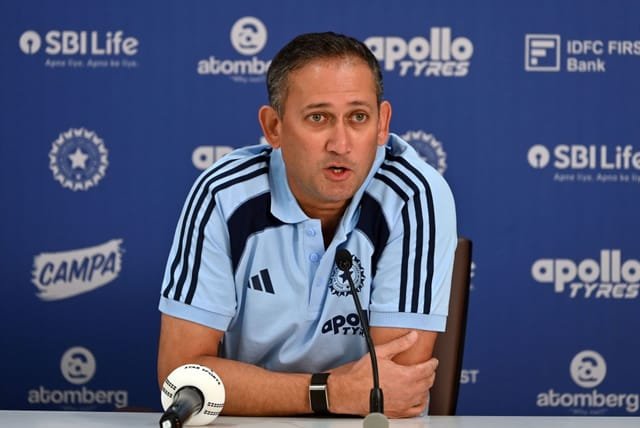
Ajit Agarkar extension talks are expected to become an important BCCI discussion as the chairman of India’s senior men’s selection committee approaches the end of his current contract. With the 2027 ODI World Cup approaching, the decision could have a major impact on the direction of Indian cricket.
Agarkar’s current contract is reportedly set to expire on October 4, and the Board of Control for Cricket in India (BCCI) is expected to hold discussions with him regarding a possible extension. While his future has not yet been officially confirmed, reports suggest that both sides are positively considering continuing the arrangement.
Former India and Royal Challengers Bengaluru batter Wasim Jaffer has now offered his assessment of Agarkar’s tenure. Jaffer believes the chief selector has generally performed well, particularly when it comes to India’s results in white-ball cricket.
At the same time, Jaffer pointed out one area where India’s dominance has not been as strong: Test cricket in home conditions. His comments provide a balanced assessment of Agarkar’s time in charge rather than treating the selector’s record as either completely successful or unsuccessful.
Wasim Jaffer backs Ajit Agarkar for an extension
Jaffer believes Agarkar deserves credit for the results India have achieved during his tenure. According to the former batter, the national team’s performances in white-ball cricket have been particularly impressive.
India’s success across limited-overs cricket has become one of the strongest arguments in favor of continuing with the current selection leadership. Jaffer compared the team’s level of dominance to the Australian side of the early 2000s, a period widely associated with sustained success across international cricket.
Jaffer also acknowledged that India have trophies to show for their performances. That gives Agarkar and the selection committee a tangible measure of success when the BCCI evaluates the chief selector’s tenure.
However, Jaffer did not suggest that everything has gone perfectly. He highlighted India’s reduced dominance in Test cricket, particularly on home soil, as an area that deserves attention.
Jaffer’s assessment is not entirely one-sided
The former India batter’s comments are significant because they recognize both sides of the argument surrounding an Ajit Agarkar extension.
On one hand, India’s white-ball results have provided a strong foundation for the case to retain Agarkar. On the other, the team’s recent Test performances have shown that even a successful period can contain weaknesses.
Jaffer also stressed that no international team can dominate indefinitely. Cricket naturally goes through cycles, with teams experiencing periods of exceptional success followed by tougher stretches.
That perspective is relevant when evaluating a selector because selection decisions are only one part of a team’s results. Performances are also influenced by player form, injuries, opposition strength, conditions and the broader transition between generations.
Why the 2027 World Cup makes Agarkar’s future important
The timing of the decision is particularly interesting because the 2027 ODI World Cup is on the horizon. India will need to build a squad capable of competing in another major global tournament, making continuity in the selection committee potentially valuable.
A chief selector plays an important role in identifying players, managing transitions and creating depth across different positions. The decisions made in the period before a World Cup can influence the composition of the final squad.
If Agarkar receives an extension, he would potentially have greater continuity while India prepare for the tournament. That could allow the selection committee to maintain a longer-term plan instead of introducing a new chairman during an important stage of the World Cup cycle.
However, continuity alone does not guarantee success. The BCCI will still need to assess whether Agarkar’s approach matches the team’s requirements and whether the selection committee has addressed the weaknesses exposed during recent Test campaigns.
BCCI expected to discuss Agarkar’s contract renewal
Reports indicate that the BCCI is preparing to discuss the future of the chief selector with Agarkar. According to a report cited by Sportstar, discussions between Agarkar and BCCI office-bearers were expected to take place over the following couple of days.
The report suggested that both sides were positively looking at the possibility of an extension, although some issues would need to be resolved before a final decision.
This means Agarkar’s continuation should not yet be treated as officially confirmed. The discussions still need to take place, and the BCCI would ultimately have to formalize any extension.
The reported negotiations are nevertheless an indication that Agarkar remains under serious consideration for the position.
What the BCCI needs to consider
The BCCI’s decision is likely to involve more than simply looking at India’s recent win-loss record. The selection committee’s ability to plan for the future will also be important.
India have to balance immediate results with the development of a squad that can remain competitive across formats. That includes identifying emerging players, maintaining experienced leadership and ensuring adequate backup options in key positions.
The 2027 World Cup adds another layer to the process because selectors will have to make difficult decisions about the balance between established names and younger players.
Agarkar missed BCCI’s recent review meeting
Another detail surrounding Agarkar’s future is his absence from the BCCI’s high-profile review meeting in Mumbai earlier this month.
BCCI secretary Devajit Saikia explained that Agarkar was out of town and therefore could not attend the meeting. He was also unable to join the discussion online.
Agarkar’s absence naturally attracted attention because the meeting was considered an important review of Indian cricket. However, his absence by itself does not establish anything about his future as chief selector.
The explanation provided by the BCCI was that he was away from the city, meaning there is no confirmed indication from this incident that his position is under threat.
With contract discussions reportedly approaching, the focus is now shifting from the meeting itself to the broader question of whether the BCCI wants Agarkar to continue.
India’s white-ball success strengthens Agarkar’s case
The strongest argument for retaining Agarkar is arguably India’s performance in white-ball cricket during his tenure.
Jaffer specifically pointed to the team’s overall standard in limited-overs cricket, while acknowledging exceptions on tours of Ireland and England after the World Cup.
That assessment suggests the selection committee has been able to support a team that has remained highly competitive in the shorter formats. More importantly, Jaffer’s reference to trophies indicates that India’s success has translated into major achievements rather than simply strong bilateral results.
For a chief selector, this matters because the quality of selection is ultimately judged by how well the chosen squads perform in major competitions as well as regular international series.
India’s white-ball success therefore provides Agarkar with a strong argument when the BCCI evaluates his overall contribution.
Test cricket remains an area of concern
While Jaffer praised India’s white-ball performances, he also highlighted a decline in dominance in home Test cricket.
India have traditionally been extremely difficult to beat in home conditions, making any reduction in that advantage particularly noticeable. Jaffer’s comments acknowledge that this part of India’s record has not matched the team’s earlier standards.
However, he also put the situation into perspective by noting that no team can continue winning indefinitely.
This is an important distinction. A period of weaker Test results does not automatically mean that the selection committee has failed. It does, however, raise questions about squad balance, player development and the team’s ability to adapt when established strengths are challenged.
For Agarkar, an extension could therefore come with the expectation that the selection setup continues to refresh India’s Test squad while maintaining the team’s strength in white-ball cricket.
Agarkar remains involved in domestic cricket scouting
Agarkar was recently present at the Duleep Trophy 2026 final in Chennai, where East Zone faced South Zone.
The final ended in a draw, but East Zone were declared champions because they had secured the first-innings lead. Agarkar’s presence at the domestic tournament was another reminder of the selector’s role in monitoring players outside the international setup.
Domestic competitions such as the Duleep Trophy can provide selectors with an opportunity to watch players who are competing for future national selection. With India constantly needing to build depth, performances in domestic cricket remain an important part of the selection process.
For a chief selector preparing for a major tournament cycle, keeping track of emerging talent can be just as important as monitoring established international players.
What an Agarkar extension could mean for India
If the BCCI decides to extend Agarkar’s contract, the biggest benefit could be continuity.
The selection committee would have a clearer opportunity to develop a long-term plan for the 2027 World Cup while also dealing with India’s immediate international commitments. Continuity could make it easier to assess players over an extended period instead of making decisions based on short-term form.
An extension would also place greater responsibility on Agarkar to address the areas where India have struggled. Maintaining white-ball success would remain important, but improving the team’s Test depth and competitiveness would also be a key objective.
Another advantage could be familiarity. Agarkar already understands the current group of players and the selection environment. A new chairman would need time to establish his own assessment of the squad and identify future options.
Why a new chief selector could also change the approach
On the other hand, the BCCI could decide that a change is necessary if it believes a fresh perspective would benefit the national team.
A new chief selector could bring different ideas about player development, squad balance and succession planning. Such a change could be particularly relevant if the board believes India’s Test performances require a significant shift in approach.
However, changing the chairman of selectors close to a major World Cup cycle also carries risks. A new selection chief would have to quickly understand the existing squad and make important decisions about the future.
That makes the BCCI’s choice a question of balancing continuity against the potential benefits of a fresh approach.
Ajit Agarkar extension: What happens next?
The immediate next step is expected to be discussions between Agarkar and BCCI officials. Until those talks are completed and the board makes a formal announcement, his future should be regarded as undecided.
Reports suggesting that both sides are positively considering an extension provide an indication of the current mood, but they do not amount to an official confirmation.
Jaffer’s comments could strengthen the argument for continuity because they come from a former India player who has assessed both the successes and shortcomings of the current period.
Ultimately, the BCCI will have to decide whether Agarkar’s record, particularly India’s white-ball achievements, outweighs the concerns surrounding the team’s recent Test performances.
Final Verdict
Ajit Agarkar extension talks could become one of the BCCI’s important decisions ahead of the 2027 World Cup. Wasim Jaffer has backed Agarkar’s overall performance, particularly India’s impressive white-ball results and the trophies achieved during his tenure.
At the same time, Jaffer has acknowledged that India’s dominance in home Test cricket has declined, giving the BCCI an important area to consider while reviewing the chief selector’s record.
Reports suggest that Agarkar and BCCI officials are expected to discuss a possible extension, with both sides reportedly open to continuing the relationship. His recent presence at the Duleep Trophy final also shows that he remains actively involved in monitoring domestic cricket.
No final decision has been confirmed yet. If Agarkar stays, his biggest challenge will be maintaining India’s white-ball strength while helping build a balanced squad capable of competing strongly at the 2027 World Cup and restoring consistency across Test cricket.
For breaking news and live news updates, like us on Facebook or follow us on Twitter and Instagram. Read more on Latest Cricket on thefoxdaily.com.






COMMENTS 0