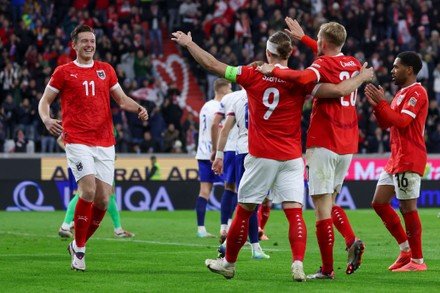
The Austria national football team has not even played its first match at the 2026 FIFA World Cup, yet it is already generating headlines worldwide.
As the squad landed in Los Angeles ahead of its opening Group Stage fixture against Jordan, an enthusiastic fan delivered an unforgettable welcome that quickly spread across social media platforms. The light-hearted interaction offered a glimpse into the growing excitement surrounding Austria’s long-awaited return to the tournament.
However, behind the viral moment lies a much bigger story. For Austria, this World Cup represents the end of a 28-year wait, the culmination of years of rebuilding, and an opportunity to reintroduce itself on football’s grandest stage.
Led by head coach Ralf Rangnick and captain David Alaba, Austria arrives in North America with renewed ambition and realistic hopes of progressing beyond the group stage.
A Viral Welcome Sets the Tone for Austria’s World Cup Journey
Upon arriving in Los Angeles, Austrian players were greeted by cheering supporters eager to catch a glimpse of their national team.
One fan, whose enthusiastic comments quickly went viral online, jokingly asked the players whether any of them were single while complimenting their appearance.
“There are some handsome men out here. Y’all look good. Who’s single out here? I’m single.”
The humorous exchange highlighted one of the defining features of modern sporting events: the power of social media to transform ordinary moments into global talking points.
In previous eras, a team’s arrival would have attracted limited attention outside local news coverage. Today, a brief interaction at an airport can become part of the tournament narrative within minutes.
For Austria, the viral clip has helped introduce a new generation of fans to a team returning to the World Cup after nearly three decades away.
Austria Ends a 28-Year FIFA World Cup Drought
The excitement surrounding Austria’s arrival extends far beyond social media.
The nation is preparing for its first FIFA World Cup appearance since France 1998, ending one of Europe’s longest absences from international football’s biggest competition.
Austria qualified for seven previous World Cups but struggled to establish itself consistently among football’s elite nations.
Its finest moment came in 1954 when the team secured a third-place finish, a result that remains one of the greatest achievements in Austrian sporting history.
Since then, qualification campaigns have often ended in disappointment.
The 2026 tournament, therefore, marks more than just a return—it symbolizes a footballing revival.
| Austria at the FIFA World Cup | Record |
|---|---|
| Total Appearances | 8 (including 2026) |
| Last Appearance Before 2026 | 1998 |
| Best Finish | Third Place (1954) |
| World Cup Absence | 28 Years |
| 2026 Head Coach | Ralf Rangnick |
| Team Captain | David Alaba |
How Ralf Rangnick Transformed Austria
Much of Austria’s recent success can be attributed to head coach Ralf Rangnick.
Widely respected as one of football’s most influential tacticians, Rangnick has built his reputation on high-intensity pressing, tactical discipline, and player development.
His coaching philosophy has shaped some of Europe’s biggest clubs and inspired a generation of managers.
Since taking charge of Austria, Rangnick has successfully modernized the team’s playing style, creating a side capable of competing with stronger opponents through organization, energy, and collective effort.
Under his leadership, Austria has developed a clear identity—something that was often missing during previous qualification cycles.
His message ahead of the tournament has been straightforward: respect every opponent, but fear none.
David Alaba Remains Austria’s Inspirational Leader
While Austria’s squad features exciting young talent, David Alaba remains the team’s most recognizable figure.
The versatile defender and midfielder brings invaluable experience gained from years competing at the highest level of club football.
Beyond his technical ability, Alaba’s leadership has become crucial to Austria’s evolution.
His presence provides calmness in pressure situations and helps bridge the gap between experienced players and emerging stars.
For many younger members of the squad, competing alongside a player of Alaba’s stature offers confidence heading into their first World Cup experience.
Breaking Down Austria’s Group Stage Challenge
Austria has been drawn into a fascinating group featuring defending champions Argentina, tournament debutants Jordan, and experienced African side Algeria.
While Argentina enters as the clear favorite, the battle for second place appears wide open.
Austria’s opening fixture against Jordan could prove decisive.
Historically, teams that begin World Cup campaigns with victories significantly improve their chances of advancing to the knockout rounds.
| Austria’s Group Stage Schedule | Date | Challenge Level |
|---|---|---|
| Austria vs Jordan | June 17, 2026 | Must-Win Match |
| Austria vs Argentina | June 22, 2026 | Highest Difficulty |
| Austria vs Algeria | June 27, 2026 | Potential Decider |
Jordan enters the tournament as a World Cup debutant, while Algeria boasts greater experience but has struggled for consistency in recent international competitions.
If Austria can secure points against Jordan and Algeria, qualification for the knockout stage becomes a realistic objective.
Why Austria Could Be One of the Tournament’s Dark Horses
Every World Cup produces surprise teams that exceed expectations.
Austria has several characteristics commonly associated with successful underdogs.
- A clearly defined tactical identity
- An experienced head coach
- A balanced squad featuring youth and leadership
- Strong team chemistry
- Lower external pressure compared to traditional favorites
Unlike powerhouse nations burdened by expectations, Austria can approach matches with greater freedom.
This psychological advantage often proves valuable in tournament football, where momentum and confidence can rapidly alter outcomes.
Rangnick’s emphasis on collective effort over individual brilliance also makes Austria difficult to predict and prepare for.
The Social Media Era Is Changing the World Cup Experience
The viral airport moment illustrates how the FIFA World Cup has evolved beyond the action on the pitch.
Players today are not just athletes—they are global personalities operating in an environment shaped by instant content, fan engagement, and digital storytelling.
A single interaction can generate millions of views and introduce casual fans to teams they may not have followed previously.
For emerging football nations like Austria, these moments offer valuable visibility and help expand their global profile.
The tournament experience now begins long before kickoff and continues well after the final whistle.
What Would Constitute Success for Austria at the 2026 FIFA World Cup?
Simply qualifying for the tournament represents a major achievement after a 28-year absence.
However, expectations within the squad have grown.
Advancing to the knockout stage appears to be a realistic and attainable objective.
Anything beyond that would rank among the greatest accomplishments in modern Austrian football history.
The key lies in avoiding the temptation to focus solely on the glamour fixture against Argentina.
As Rangnick has emphasized, Austria’s campaign may ultimately be defined by its performances against Jordan and Algeria.
Winning the matches they are expected to compete in could prove more important than attempting to produce a shock result against the defending champions.
Conclusion: Austria’s Return Is About More Than Football
Austria’s arrival at the 2026 FIFA World Cup represents the culmination of years of rebuilding, planning, and persistence.
The viral welcome in Los Angeles may have provided an entertaining introduction, but the team’s real story is only beginning.
After nearly three decades away from football’s biggest stage, Austria has an opportunity to create new memories for a generation of supporters who have never seen their national team compete at a World Cup.
With an experienced coach, an inspirational captain, and a favorable path to the knockout rounds, Austria enters the tournament with genuine optimism.
Whether the journey ends in the group stage or extends deep into the competition, one thing is already clear: Austria is back on the world football map—and fans around the globe are paying attention.
For breaking news and live news updates, like us on Facebook or follow us on Twitter and Instagram. Read more on Latest Sports on thefoxdaily.com.






COMMENTS 0