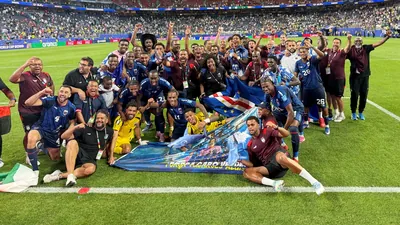
The 2026 FIFA World Cup has already delivered its fair share of drama, but few stories have captured global imagination like the extraordinary rise of Cape Verde. From being tournament outsiders with little global expectation to securing a place in the Round of 32, the island nation has produced one of the most inspiring underdog runs in modern football history.
What makes this achievement even more remarkable is not just the results, but the way they were earned. Cape Verde did not rely on luck or isolated performances. Instead, their success reflects years of planning, smart talent identification, and a footballing identity built on discipline, resilience, and belief.
In a tournament expanded to 48 teams, critics initially questioned whether smaller footballing nations would struggle to compete. Cape Verde has answered that question emphatically—with results, structure, and composure against some of the world’s strongest teams including Spain and Uruguay.
World Cup 2026 Context: Why Cape Verde’s Run Matters
The expansion of the FIFA World Cup to 48 teams was designed to increase global representation and give emerging football nations a bigger stage. However, it also raised concerns about competitive imbalance.
Cape Verde’s performance has become the strongest argument in favor of expansion done right. Instead of being outclassed, they have competed toe-to-toe with elite teams, showing that modern football is no longer just about traditional powerhouses.
- Unbeaten group stage campaign
- Goalless draw against Spain
- 2–2 draw against Uruguay
- Clean sheet against Saudi Arabia
These results are not isolated surprises—they form a consistent pattern of tactical maturity and defensive excellence.
The Match That Changed Everything: Holding Spain to a Goalless Draw
Cape Verde’s turning point came against Spain, one of the tournament favorites. Few expected them to survive the match without a heavy defeat, yet they produced a disciplined defensive masterclass.
At the heart of that performance was veteran goalkeeper Vozinha, whose reflex saves and positioning frustrated Spain’s attacking rhythm. His leadership from the back line helped organize a defense that refused to break under pressure.
This result didn’t just earn them a point—it changed global perception. Suddenly, Cape Verde was no longer seen as a “participation team” but as a legitimate competitor.
Cape Verde vs Spain: Defensive Performance Snapshot
| Category | Performance |
|---|---|
| Opponent | Spain |
| Result | 0-0 Draw |
| Key Performer | Vozinha (Goalkeeper) |
| Defensive Style | Compact low block + quick transitions |
| Impact | First major global recognition of Cape Verde’s potential |
How Cape Verde Built a World Cup-Level Team
The foundation of Cape Verde’s success did not happen overnight. It is the result of a long-term strategy implemented by the football federation (FCF), focusing on diaspora recruitment and structured squad development.
Instead of relying only on domestic talent, Cape Verde actively identified players of Cape Verdean origin across Europe, particularly in countries with strong football academies like the Netherlands, Portugal, and France.
Out of the 26 players in the World Cup squad, 14 were born outside Cape Verde. This hybrid model allowed the team to combine technical European training with strong national identity and cohesion.
Why the Diaspora Strategy Worked
The success of Cape Verde’s recruitment model is based on three key advantages:
- Technical development: Players trained in top European academies bring superior tactical awareness.
- Physical intensity: Exposure to high-level leagues improves endurance and game speed.
- Cultural motivation: Representing ancestral roots strengthens emotional commitment.
This combination has created a squad greater than the sum of its parts.
The Role of Coach Bubista: Stability Over Chaos
Another critical factor in Cape Verde’s rise is the leadership of head coach Bubista, who has been in charge since 2020. In international football, coaching instability is common, especially for smaller nations. Cape Verde took a different approach.
Instead of frequent managerial changes, the federation trusted Bubista to build a long-term identity. This stability allowed him to develop a clear tactical system focused on defensive organization, quick counterattacks, and collective discipline.
The results began to show at the 2023 Africa Cup of Nations, where Cape Verde shocked Ghana, held Egypt, and reached the quarter-finals. That tournament became the blueprint for their World Cup success.
AFCON to World Cup: The Evolution Timeline
| Year | Milestone |
|---|---|
| 2013 | First AFCON qualification appearance |
| 2020 | Bubista appointed head coach |
| 2023 | AFCON quarter-final run |
| 2026 | Unbeaten FIFA World Cup group stage |
Breaking Down Cape Verde’s Tactical Identity
Cape Verde’s success is not accidental—it is tactical. Their gameplay revolves around structured defending, compact midfield lines, and quick vertical transitions.
Against stronger opponents, they rarely dominate possession. Instead, they focus on controlling space and forcing errors under pressure.
This style has proven especially effective against technically superior teams like Spain, where patience and discipline outweighed possession statistics.
Key Tactical Strengths
- Deep defensive block with minimal spacing errors
- Fast counterattacks using wide channels
- Strong aerial presence in defensive situations
- Goalkeeper-led organization and communication
The Uruguay Test: Proving It Was Not Luck
If the Spain match was a statement, the 2–2 draw against Uruguay confirmed Cape Verde’s legitimacy. Uruguay, known for physical and aggressive football, posed a different kind of challenge.
Cape Verde adapted by increasing midfield aggression and improving transitional defense. Matching a South American heavyweight in both intensity and tactical discipline proved that their earlier success was no coincidence.
Why Cape Verde’s Story Matters for Global Football
The rise of Cape Verde carries implications far beyond one tournament. It represents a shift in global football dynamics where structure, scouting, and planning can rival financial power.
For decades, football success was concentrated among a small group of nations. Cape Verde is part of a growing list of teams challenging that hierarchy, alongside stories like Iceland’s Euro 2016 run and Morocco’s 2022 World Cup semi-final journey.
Comparison: Cape Verde vs Other Modern Underdogs
| Team | Breakthrough Moment | Key Strength |
|---|---|---|
| Iceland | Euro 2016 quarter-finals | Set-piece efficiency |
| Morocco | 2022 World Cup semi-finals | Defensive organization + transitions |
| Cape Verde | 2026 World Cup Round of 32 | Diaspora talent + tactical discipline |
The Next Challenge: Argentina Awaits
Cape Verde’s dream run now faces its biggest test yet—defending champions Argentina. Led by Lionel Messi, Argentina represents the highest level of footballing excellence and tournament experience.
For Cape Verde, this match is less about expectation and more about legacy. Even if their journey ends here, their impact on the 2026 World Cup will remain one of the defining narratives of the tournament.
Conclusion: A Story Bigger Than Football
Cape Verde’s journey is more than a sporting achievement. It is a story of belief, planning, and identity. A nation of just over half a million people has shown that success on the world stage is not defined by size, but by structure and vision.
Whether they progress further or exit against Argentina, Cape Verde have already achieved something far greater—changing how the world views underdogs in modern football.
The 2026 FIFA World Cup will have many champions in statistics, but Cape Verde may ultimately be remembered as its most inspiring story.
For breaking news and live news updates, like us on Facebook or follow us on Twitter and Instagram. Read more on Latest Sports on thefoxdaily.com.






COMMENTS 0