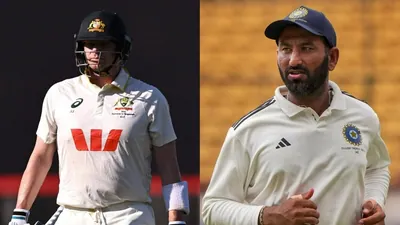
Cheteshwar Pujara has offered fresh insight into one of the most controversial episodes from the 2017 Border-Gavaskar Trophy between India and Australia. Nearly a decade after the Bengaluru Test, the former India batter has explained what he believes was happening behind the scenes when Australia made several crucial DRS decisions.
The 2017 series remains one of the most memorable India-Australia contests in recent Test history. India eventually won the four-match series 2-1, but the cricket was overshadowed at times by heated exchanges, intense sledging and the infamous Steve Smith brain fade incident.
Speaking to Aakash Chopra, Pujara claimed that Australia had access to a live television feed inside their dressing room. According to him, this allowed the Australian players to look at replays before deciding whether to use the Decision Review System.
Pujara’s comments add another layer to an incident that had already created significant controversy during the Bengaluru Test. While the events on the field were visible to millions of viewers, his latest recollection focuses attention on what may have been happening away from the playing area.
What Happened in the Bengaluru Test?
The controversy took place during the second Test of the 2017 Border-Gavaskar Trophy in Bengaluru. Australia were chasing 188 in the fourth innings when captain Steve Smith became the centre of attention after being given out LBW by India fast bowler Umesh Yadav.
Smith was faced with a decision over whether to review the umpire’s call. Instead of immediately discussing the decision with non-striker Peter Handscomb, he looked towards the Australian dressing room.
The incident quickly caught the attention of the Indian players. Virat Kohli and his teammates objected to what they believed was an attempt to seek assistance from the dressing room before making the DRS decision.
The on-field officials intervened, and the time allowed for the review eventually expired. Smith later described his actions as a “brain fade”, a phrase that became permanently associated with the controversy.
However, Pujara’s latest comments suggest the Indian team had concerns beyond that single moment. He claimed Australia had been using a live feed in their dressing room to help with DRS calls throughout the series.
Pujara’s Claim About Australia’s Live Feed
According to Pujara, the Indian players noticed that Australia’s DRS decisions appeared remarkably accurate. He said the Australian team seemed to know whether a review was worth taking before making the call.
The former India batter explained that dressing-room television feeds are normally delayed. In his recollection, however, Australia had access to a live feed that could show replays almost immediately.
Pujara alleged that Australian players would look towards the dressing room discreetly and use what they saw to influence their DRS decisions.
That claim is significant because DRS is designed to allow players to challenge an umpire’s decision based on information available to the teams within the established review process. Using an unauthorized or unusually fast source of replay information could provide a potential advantage.
Pujara described the practice as unfair and suggested that Australia had found a loophole that could help them make better review decisions.
His comments were made years after the series, meaning they represent his recollection of events rather than a new official finding about the 2017 Test. The original controversy, however, remains well documented as one of the defining moments of the series.
Why the DRS Controversy Became So Big
The importance of the incident went beyond one review. India and Australia were playing a fiercely contested series, and the Bengaluru Test had already become a battle of nerves.
DRS decisions can dramatically change a Test match. A successful review can remove a batter or overturn an important decision, while an unsuccessful review can leave a team without another opportunity.
Because of this, any additional information available to a team could potentially influence its decision-making.
The controversy also involved Australia’s captain, making the incident even more prominent. Smith was not simply an ordinary batter in the situation; he was responsible for leading the visiting side through a difficult series in India.
Virat Kohli’s reaction further intensified the situation. The Indian captain strongly objected to Smith’s decision to look towards the dressing room, turning an already unusual moment into a major talking point.
Australia’s Determination to Win in India
Pujara also provided broader context about Australia’s approach during the 2017 series. He said the Australian side arrived in India determined to win a Test series on Indian soil.
At the time, beating India at home was considered one of the toughest challenges in Test cricket. Australia had the players and preparation to compete, and they pushed India harder than many visiting teams had managed in previous years.
Pujara acknowledged that Australia deserved credit for arriving prepared and putting India under genuine pressure. He pointed out that they were the first team since England in 2012 to seriously threaten India’s strong home record.
That competitive pressure helped create the atmosphere in which the Bengaluru controversy occurred. The series was not simply about technical cricket; emotions were running high on both sides.
Pujara Admits He Also Took Part in Sledging
One of the more interesting parts of Pujara’s recollection was his admission that he also sledged during the series.
The normally calm image of Pujara is one reason this admission stands out. He explained that when an opponent sledges heavily, players can reach a point where they decide they will no longer hold back.
According to Pujara, players sometimes became conscious of whether the television camera or stump microphone was picking up their words. However, he also acknowledged that the situation could cross the line from competitive banter into personal comments.
For Pujara, the ultimate purpose of sledging was to help create pressure and eventually take a wicket. Yet he admitted that players can sometimes say things they later regret.
This gives a useful insight into the intensity of India vs Australia cricket during that period. The rivalry was competitive, but the players were also aware that emotions could become personal.
2017 Border-Gavaskar Trophy: The Bigger Picture
The DRS controversy cannot be separated from the overall importance of the 2017 Border-Gavaskar Trophy. India entered the series as a dominant home side, while Australia were determined to challenge them in conditions traditionally difficult for visiting teams.
Australia won the opening Test in Pune, putting India under immediate pressure. India responded strongly in Bengaluru before winning the third Test in Ranchi and drawing the final match in Dharamsala.
The eventual 2-1 result showed how closely contested the series became.
| Key aspect | 2017 Border-Gavaskar Trophy |
|---|---|
| Series result | India won 2-1 |
| Major controversy | Steve Smith’s DRS “brain fade” incident |
| Second Test venue | Bengaluru |
| India captain | Virat Kohli |
| Australia captain | Steve Smith |
| Important Indian batter discussing the episode | Cheteshwar Pujara |
Why Pujara’s Revelation Matters Today
Pujara’s comments are significant because he was directly involved in the series and was part of the Indian team that experienced the controversy from inside the dressing room and on the field.
His account also highlights how much tactical information can matter in modern Test cricket. DRS has become an important part of the game, and teams spend considerable time analysing patterns, reviewing dismissals and deciding when a challenge is worthwhile.
The allegation about a live feed, therefore, is not merely a story about technology. It raises a broader question about competitive advantage and the boundaries teams should observe when using available match information.
At the same time, Pujara’s account should be treated as his recollection of the events. It should not automatically be interpreted as proof of wrongdoing unless supported by an official finding or independent evidence.
Steve Smith’s ‘Brain Fade’ Remains a Defining Moment
Even though several years have passed, the phrase Steve Smith brain fade remains closely linked with the Bengaluru Test. Smith’s decision to look towards the Australian dressing room became one of the most discussed moments of the entire series.
The episode was particularly unusual because DRS decisions are generally expected to be made by players on the field. The involvement of the dressing room created immediate questions about where teams should draw the line when seeking information.
Smith later acknowledged that he had made a mistake. However, the incident continued to influence the narrative around the series because it occurred during a period of extremely high tension between the two teams.
India vs Australia Rivalry Produced More Than Cricket
The 2017 series is remembered not only for the scoreline but also for the psychological battle between the two teams. India were trying to maintain their dominance at home, while Australia were determined to prove that they could compete in difficult conditions.
The rivalry produced aggressive cricket, tactical battles and frequent verbal exchanges. Pujara’s admission about sledging shows that the intensity affected players on both sides.
Yet the series also demonstrated why India-Australia contests have become among the most closely followed rivalries in Test cricket. The smallest decisions could have major consequences, and every controversial moment attracted enormous attention.
What Pujara’s Comments Tell Us About That Era
Pujara’s recollection provides a player’s perspective on a series that has often been discussed primarily through the most visible controversies. His comments suggest that the tension was not limited to the moments broadcast on television.
The former India batter also acknowledged that both teams were operating under enormous competitive pressure. Australia’s desire to win in India, India’s determination to protect their home record and the personalities involved all contributed to the intensity.
That context is important when looking back at the 2017 Border-Gavaskar Trophy. The series was fiercely competitive, but it also demonstrated how quickly tactical battles and on-field emotions can become major stories in international cricket.
Final Verdict
Cheteshwar Pujara’s latest comments have reopened discussion around the 2017 India vs Australia DRS controversy, particularly the circumstances surrounding Steve Smith’s infamous “brain fade” moment in Bengaluru.
His claim that Australia had access to a live dressing-room feed adds a new perspective to an incident that was already controversial. Pujara also admitted that the series featured intense sledging and moments when players became overly personal.
Ultimately, India won the series 2-1, but the 2017 Border-Gavaskar Trophy remains memorable for much more than its result. The DRS controversy, fierce rivalry and psychological battles ensured that the series became one of the most talked-about chapters in modern India-Australia Test cricket.
For breaking news and live news updates, like us on Facebook or follow us on Twitter and Instagram. Read more on Latest Cricket on thefoxdaily.com.


COMMENTS 0