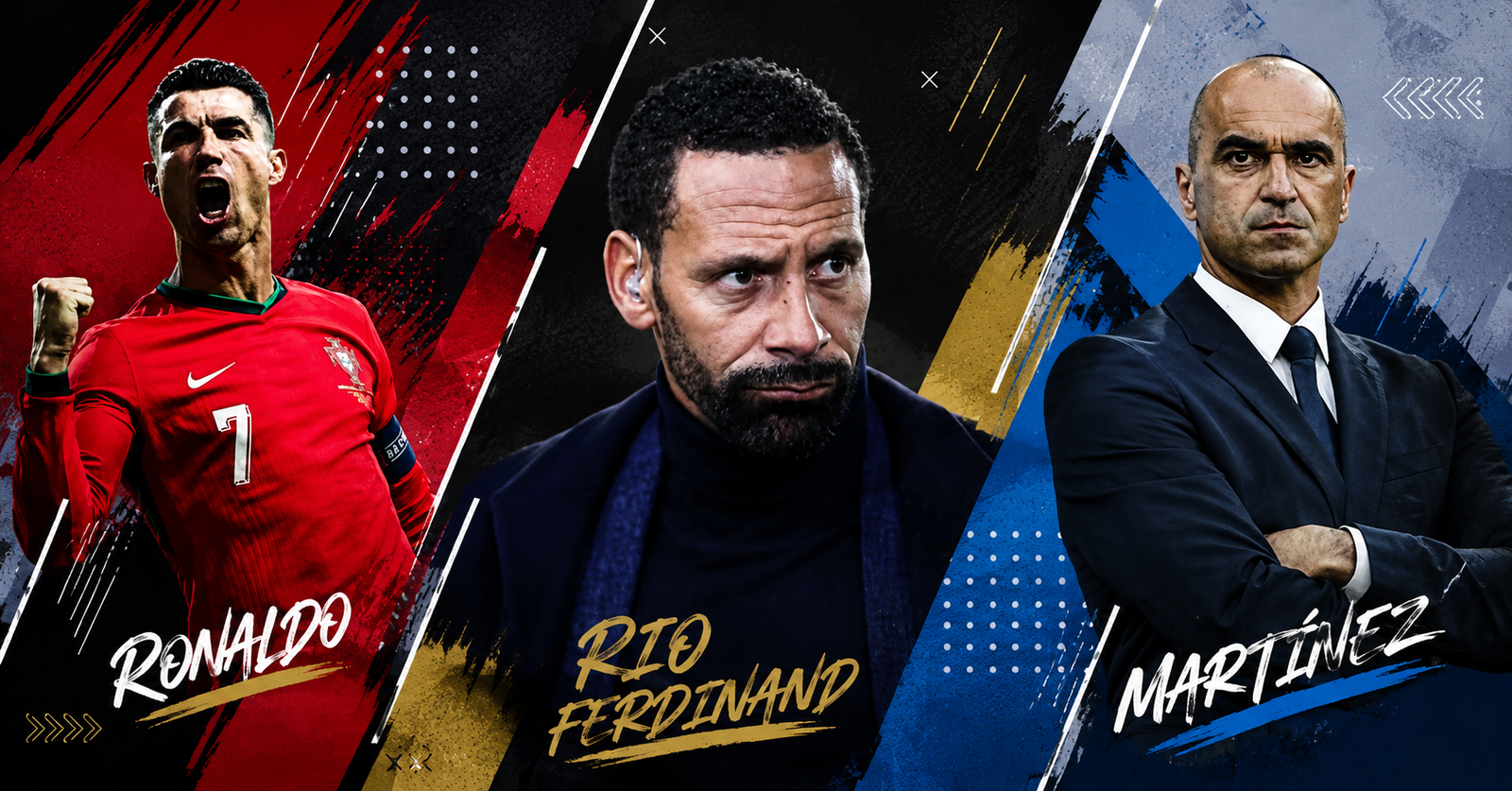
As Portugal prepares for what many believe could be its strongest FIFA World Cup campaign in decades, a major debate has emerged around one of football’s greatest icons. Cristiano Ronaldo, now 41 years old and still a central figure for his national team, remains one of the biggest talking points heading into the tournament.
The discussion intensified after former Manchester United defender Rio Ferdinand suggested that Portugal manager Roberto Martinez should consider deploying Ronaldo in a different role. Rather than starting every match, Ferdinand believes the legendary forward could become an even more devastating weapon by coming off the bench during key moments.
The proposal is bold, controversial, and perhaps reflective of a larger question facing elite teams around the world: how should national sides manage aging superstars whose influence remains enormous despite the physical realities of time?
Why Rio Ferdinand Wants Ronaldo to Become a Super-Sub
Ferdinand’s argument is not based on Ronaldo’s lack of quality. In fact, it stems from the opposite belief.
Even at 41, Ronaldo remains one of football’s most clinical finishers. His movement inside the penalty area, aerial dominance, positioning, and ability to deliver in decisive moments continue to make him one of the most dangerous attackers in international football.
However, Ferdinand believes Portugal could gain a tactical advantage by introducing Ronaldo later in matches, particularly against elite opponents.
When defenders become fatigued after seventy minutes of intense football, a fresh Ronaldo entering the field could create problems that exhausted backlines struggle to solve.
Rather than reducing his importance, such a role could potentially increase his effectiveness.
The Numbers Show Ronaldo Remains a Major Force
Despite ongoing discussions about age and squad evolution, Ronaldo’s production under Roberto Martinez remains impressive.
| Category | Record Under Roberto Martinez |
|---|---|
| Appearances | 32 |
| Starts | 32 |
| Goals | 25 |
| Assists | 4 |
These statistics demonstrate why Martinez has continued to trust Ronaldo as a starter. Few international forwards can match that level of productivity.
Yet modern football increasingly prioritizes tactical flexibility, leading many analysts to question whether Portugal’s strongest lineup always requires Ronaldo from the opening whistle.
The Challenge Facing Roberto Martinez
Managing Cristiano Ronaldo may be one of the most complex responsibilities in international football.
Martinez is not simply coaching a player. He is managing a global icon, Portugal’s all-time leading scorer, and one of the most influential athletes in sports history.
That reality requires careful communication and strategic planning.
Ferdinand believes the key lies in transparency. A manager must clearly explain that any adjustment in Ronaldo’s role is designed to benefit both the player and the team.
Successfully handling that conversation could become one of the defining moments of Portugal’s World Cup campaign.
Why the Super-Sub Strategy Has Worked Before
Football history offers several examples of elite players thriving in reduced but highly impactful roles.
As athletes age, preserving energy for decisive moments often becomes more valuable than maximizing playing time.
A fresh attacking player entering the match during the final stages can:
- Exploit tired defenders.
- Create immediate attacking momentum.
- Provide leadership during pressure situations.
- Offer a different tactical dimension.
- Increase efficiency in front of goal.
Given Ronaldo’s extraordinary goal-scoring instincts, many believe he could excel in such circumstances.
Portugal’s Attack Has Evolved Beyond a One-Man Team
One major difference between Portugal’s current squad and previous generations is the abundance of attacking talent available.
While Ronaldo remains a central figure, the team now possesses multiple players capable of deciding matches independently.
| Player | Primary Strength |
|---|---|
| Cristiano Ronaldo | Finishing and leadership |
| Bruno Fernandes | Creativity and passing |
| Bernardo Silva | Technical control |
| Rafael Leao | Explosive pace |
| Joao Felix | Movement and versatility |
| Goncalo Ramos | Penalty-box presence |
This depth provides Martinez with options that previous Portuguese managers simply did not possess.
Can Ronaldo Accept a Reduced Role?
The biggest obstacle to Ferdinand’s proposal may not be tactical—it may be psychological.
Throughout his career, Ronaldo has built his success on relentless competitiveness and unwavering belief in his own abilities. Those qualities helped him become football’s all-time leading international goalscorer and one of the sport’s most decorated players.
Accepting a rotational role requires a different mindset.
However, it is worth noting that elite athletes often adapt when convinced that changes improve the team’s chances of winning major trophies.
If Martinez successfully frames the decision as a pathway to World Cup glory, the idea may become more realistic than many expect.
Ronaldo’s Ultimate Goal Remains Unfinished
Despite winning virtually every major trophy available at club level, one achievement continues to elude Cristiano Ronaldo: lifting the FIFA World Cup.
His international résumé already includes:
- UEFA European Championship winner.
- UEFA Nations League winner.
- Portugal’s all-time leading scorer.
- Most-capped men’s international footballer.
- Highest goalscorer in men’s international football history.
Adding a World Cup title would complete one of the most remarkable careers sports has ever witnessed.
Portugal’s Path at FIFA World Cup 2026
Portugal enters the tournament as one of the strongest contenders for the title.
| Opponent | Date | Competition Stage |
|---|---|---|
| DR Congo | June 17, 2026 | Group Stage |
| Uzbekistan | June 23, 2026 | Group Stage |
| Colombia | June 27, 2026 | Group Stage |
On paper, Portugal possesses the quality to advance comfortably. However, knockout football introduces entirely different challenges, making squad management increasingly important as the tournament progresses.
Cristiano Ronaldo’s Own Perspective on the World Cup
Interestingly, Ronaldo’s recent comments suggest a pragmatic mindset.
Rather than discussing trophies or records, he emphasized the importance of focusing on each match individually and building momentum gradually.
This measured approach reflects the experience of a player who understands how unpredictable major tournaments can be.
His emphasis on starting strongly aligns closely with the philosophy adopted by many successful World Cup-winning teams.
Comparing Portugal’s Current Squad to Previous Generations
| Era | Biggest Strength | Main Limitation |
|---|---|---|
| 2006 | Defensive organization | Squad depth |
| 2010 | Ronaldo’s emergence | Creativity |
| 2018 | Experience | Attacking depth |
| 2022 | Technical quality | Tactical consistency |
| 2026 | Balance and depth | Managing star roles |
Many analysts believe the 2026 squad is among the most complete Portugal has ever assembled.
The challenge now lies in maximizing those resources effectively.
A Unique Angle: Could Ronaldo Become Portugal’s Ultimate Tournament Weapon?
One perspective often overlooked is that a super-sub role could actually enhance Ronaldo’s World Cup legacy rather than diminish it.
Imagine a scenario where he scores decisive goals in knockout matches after entering from the bench. Such contributions would likely be remembered far more vividly than routine group-stage starts.
Football history tends to celebrate impact rather than minutes played.
If Portugal were to win the World Cup with Ronaldo delivering crucial moments throughout the tournament, few supporters would care whether he started every match.
Prediction: Portugal’s Success Will Depend on Flexibility
The strongest teams at FIFA World Cup 2026 will likely be those willing to adapt throughout the competition.
Portugal possesses enough talent to challenge any nation in the tournament. Whether Ronaldo starts every game, rotates occasionally, or embraces a different role altogether, the ultimate objective remains unchanged.
Winning football’s biggest prize requires collective success rather than individual recognition.
How Martinez balances loyalty to a legend with the demands of modern tournament football may ultimately determine how far Portugal goes.
Conclusion
Rio Ferdinand’s suggestion has sparked an important conversation about Cristiano Ronaldo’s role at FIFA World Cup 2026. While the Portuguese captain remains one of the game’s most dangerous finishers, tactical realities and squad depth have created legitimate arguments for a more flexible approach.
Roberto Martinez now faces a delicate but potentially decisive challenge. Managing Ronaldo’s role effectively could unlock the full potential of an exceptionally talented Portugal squad.
Whether as a starter, a super-sub, or a combination of both, one thing remains certain: Cristiano Ronaldo will continue to be one of the defining figures of FIFA World Cup 2026. And if Portugal finally lifts the trophy, the exact role he played may matter far less than the outcome itself.
For breaking news and live news updates, like us on Facebook or follow us on Twitter and Instagram. Read more on Latest Sports on thefoxdaily.com.






COMMENTS 0