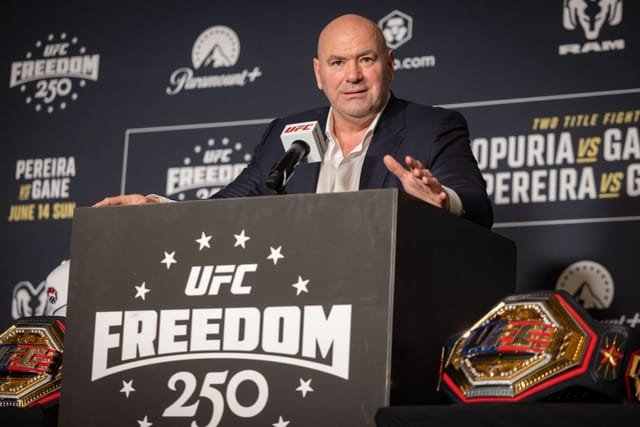
UFC Freedom 250 was designed to be unforgettable—and by almost every measure, it succeeded.
Held on the South Lawn of the White House as part of the America 250 celebrations, the event combined elite mixed martial arts competition with a level of production rarely seen in combat sports. Thousands of military personnel, government officials, celebrities, and invited guests witnessed a historic night that blurred the lines between sports, entertainment, and national celebration.
Yet just hours after the final fight concluded, UFC CEO Dana White delivered a surprising reality check: despite the event’s enormous cultural impact, it was simply too expensive to repeat.
According to White, UFC Freedom 250 was a “one-of-one” experience that will never happen again.
Why UFC Freedom 250 Was Unlike Any Event in MMA History
For decades, the UFC has built its reputation on pushing the boundaries of live sports entertainment.
From hosting events on Fight Island during the global pandemic to transforming Las Vegas’ Sphere into an immersive fight experience, the promotion has consistently looked for ways to redefine what a combat sports event can be.
However, staging a pay-per-view card at the White House represented an entirely new level of ambition.
The event featured:
- Fighter walkouts originating from the White House grounds
- A custom-built outdoor arena structure
- Advanced lighting and sound systems
- Enhanced security protocols
- Special accommodations for government officials and military personnel
- Unique broadcast and production requirements
The result was a visually stunning showcase that many fans described as one of the most memorable nights in UFC history.
The $60 Million Price Tag Behind the Spectacle
Memorable experiences come at a cost.
TKO Group Holdings President and COO Mark Shapiro previously revealed that UFC Freedom 250 carried a production budget exceeding $60 million.
Even with major sponsorship agreements and premium commercial partnerships, the event was expected to generate a financial loss estimated at approximately $30 million.
Those figures highlight the enormous logistical complexity involved in hosting a live sporting event at one of the world’s most secure and recognizable locations.
Unlike traditional arenas that already possess the necessary infrastructure, the White House grounds required extensive temporary construction, technology installation, and operational planning.
Dana White Explains Why the Event Will Not Return
During the UFC Freedom 250 post-fight press conference, White acknowledged the significance of the event while making it clear that fans should not expect a sequel.
“This was an amazing experience, a one-of-one. That will never happen again.”
When asked whether the promotion could revisit the concept in the future, White pointed directly to the financial realities involved.
“I can’t afford it. There’s no way we can do this again. I will never do the Sphere again, and we will never do this again.”
His comments reinforced an important truth about modern sports entertainment: not every successful event is designed to become a recurring property.
Sometimes, exclusivity is part of the appeal.
Why UFC Freedom 250 Was Meant to Be a One-Time Event
The White House card was closely tied to the America 250 celebrations commemorating the 250th anniversary of the United States.
Its significance extended beyond mixed martial arts.
The event served as a cultural moment that blended patriotism, sports, and entertainment in a way unlikely to be replicated under different circumstances.
Recreating the same experience in future years would diminish the unique context that made it special.
Scarcity often increases the long-term value of major sporting events. By keeping UFC Freedom 250 as a standalone experience, the promotion ensures it remains a landmark moment in its history.
Comparing UFC Freedom 250 to the Sphere Event
Dana White compared the White House event to UFC’s groundbreaking show at the Sphere in Las Vegas.
That event also featured an unprecedented production budget and immersive technology designed to create a one-of-a-kind fan experience.
White previously indicated that the Sphere card would not be repeated due to its enormous cost.
Despite their differences, both events shared several characteristics.
| Category | UFC at Sphere | UFC Freedom 250 |
|---|---|---|
| Venue Type | Immersive entertainment arena | White House South Lawn |
| Primary Objective | Revolutionize event presentation | Create a historic national celebration |
| Production Cost | Extremely high | More than $60 million |
| Long-Term Viability | Limited | One-time event |
| Fan Experience | Technology-driven | Cultural and symbolic |
These projects reflect White’s broader philosophy: prioritize innovation, even if profitability takes a temporary back seat.
The Business Strategy Behind High-Cost UFC Events
Although UFC Freedom 250 is expected to lose money directly, its broader business impact may be more difficult to measure.
Major sporting organizations increasingly invest in landmark events that generate long-term brand value rather than immediate financial returns.
Benefits can include:
- Increased global media attention
- Higher brand visibility
- Growth in international audiences
- Enhanced sponsorship opportunities
- Greater social media engagement
- Stronger relationships with strategic partners
For the UFC, creating unforgettable moments strengthens its position as a leader in combat sports entertainment.
The promotion understands that cultural relevance often translates into future commercial success.
What UFC Freedom 250 Means for the Future of Live Sports
The event reflects a growing trend across the sports industry.
Fans no longer expect only competition—they want experiences.
Organizations are increasingly competing on presentation, storytelling, and atmosphere as much as the product itself.
From Formula 1’s expansion into entertainment-driven race weekends to the NFL’s large-scale international games, sports properties are investing heavily in creating must-watch spectacles.
UFC Freedom 250 may have pushed that concept further than any previous MMA event.
However, White’s comments suggest there are practical limits to how far promotions can go.
Innovation remains essential, but financial sustainability still matters.
Will the UFC Continue Creating Unique Events?
While White ruled out another White House card, he made it clear that the UFC will continue exploring new ways to enhance the fan experience.
“I am always looking to go to great arenas with good technology and give fans the best experience we possibly can.”
That mindset has become a defining feature of the UFC’s growth strategy.
Rather than repeating past successes, the organization consistently searches for new ideas that capture global attention.
The next groundbreaking concept may not involve a historic government building or a futuristic venue, but fans can expect the UFC to keep pushing boundaries.
Conclusion
UFC Freedom 250 will be remembered as one of the most ambitious events in combat sports history.
Its setting, production value, and cultural significance created a spectacle unlike anything fans had seen before.
Yet Dana White’s candid admission that the event was financially unsustainable highlights the delicate balance between innovation and profitability.
At more than $60 million in production costs, the White House card was never designed to become an annual tradition.
Instead, it stands as a reminder that some sporting moments derive their value precisely because they happen only once.
For the UFC, the challenge now is not recreating UFC Freedom 250—it is finding the next unforgettable experience that captures the imagination of fans around the world.
For breaking news and live news updates, like us on Facebook or follow us on Twitter and Instagram. Read more on Latest Sports on thefoxdaily.com.






COMMENTS 0