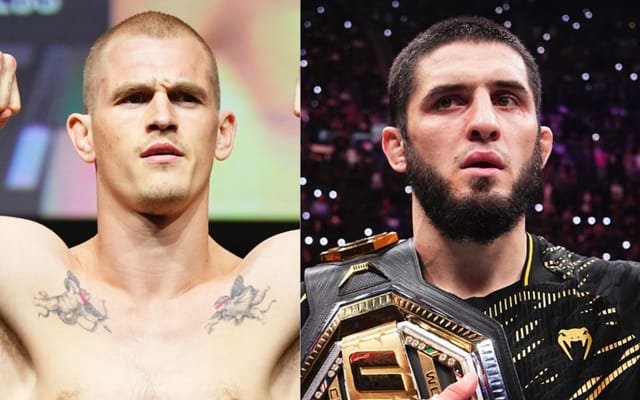
Ian Machado Garry vs Islam Makhachev is shaping up as one of the most intriguing stylistic matchups on the UFC 330 card, with former UFC title challenger Demian Maia backing Garry’s ability to compete with one of the most accomplished grapplers in mixed martial arts.
Garry is scheduled to challenge Makhachev for the welterweight title in the main event of UFC 330 at Xfinity Mobile Arena in Philadelphia. The matchup brings together two fighters whose greatest strengths are built around very different forms of control.
Makhachev has established himself as an elite submission wrestler and positional grappler, while Garry has developed a reputation for using his length, movement and striking intelligence to manage distance and dictate where exchanges take place.
That contrast explains why the fight has generated so much discussion. For Makhachev, the objective could be to close distance, force grappling exchanges and turn small positional mistakes into takedowns or submissions. For Garry, keeping the fight at his preferred range could be the foundation of his championship opportunity.
Maia, who has worked with Garry as a grappling coach, believes the Irishman understands that equation. His confidence does not come from underestimating Makhachev. Instead, Maia believes Garry possesses the specific tools required to exploit the areas where the champion can be challenged.
Why Demian Maia believes Garry can become champion
Maia’s assessment is significant because he understands both sides of the equation.
The Brazilian is a former UFC title challenger and one of the most respected grapplers in MMA history. His career was built around elite Brazilian jiu-jitsu, positional control and submissions, making his evaluation of Makhachev’s grappling particularly relevant.
Maia emphasized that Makhachev creates problems for virtually every opponent because of the number of ways he can transition between striking, takedowns and ground attacks.
But Maia also identified Garry’s biggest potential advantage: his ability to strike while controlling distance.
That distinction is crucial.
Beating an elite grappler does not necessarily require becoming a better grappler than the grappler. A striker can instead attempt to prevent the grappling exchanges from developing in the first place.
For Garry, that means maintaining enough distance to make Makhachev’s entries difficult while punishing him whenever he has to cross the space between them.
Makhachev’s grappling is the central problem
Any analysis of Ian Machado Garry vs Islam Makhachev has to begin with the champion’s wrestling and submission game.
Makhachev has built his reputation around the ability to take opponents down and control them once the fight reaches the mat. His game is not based solely on one takedown technique. He can change levels, chain attempts together and transition between positions when an opponent successfully defends the first attack.
That makes defending him especially demanding.
A fighter might successfully stop an initial takedown but still find himself dealing with a second attempt, a body lock, a trip or a transition to another position.
Maia highlighted precisely this danger when discussing the matchup. According to him, Makhachev can capitalize on small technical errors involving an opponent’s elbows, legs or hips.
That is one of the most important aspects of the fight.
Against an average grappler, a slightly misplaced hip might create a minor positional problem. Against Makhachev, the same mistake can become a takedown, back control or submission opportunity.
Why Garry’s distance control could be decisive
Garry’s path to victory begins with managing space.
The Irishman has physical and stylistic characteristics that can make him difficult to close down. His striking game relies heavily on maintaining range, using movement and making opponents work to enter his preferred striking distance.
That can be particularly useful against a fighter whose offensive wrestling becomes more dangerous once he gets close enough to establish meaningful contact.
However, distance control is not simply about moving backward.
A fighter who constantly retreats can eventually find himself against the cage, where his available movement becomes restricted. Garry therefore needs to control the geography of the fight rather than merely avoid contact.
That could mean using lateral movement, timely attacks and intelligent positioning to keep the center of the Octagon available.
The more space Garry can preserve, the more opportunities he should have to make Makhachev enter through strikes rather than allowing the champion to establish his preferred grappling positions immediately.
The biggest danger for Garry: giving Makhachev a mistake
One of the most interesting elements of Maia’s assessment is that he did not suggest Garry simply needs to outfight Makhachev.
Instead, Maia focused on preventing mistakes.
That is a different way of looking at the matchup.
Makhachev does not necessarily need a spectacular opening to take control. A poorly positioned leg, an exposed arm or an incorrect hip angle can give an elite grappler enough information to attack.
For Garry, defensive discipline therefore becomes almost as important as offensive creativity.
A successful striking sequence is valuable, but if Garry finishes that sequence in a vulnerable position, the exchange could immediately change direction.
This creates a tactical balancing act. Garry needs to attack often enough to discourage Makhachev from walking forward freely, but he cannot become so aggressive that his own positioning becomes vulnerable.
Garry’s intelligence could matter as much as his striking
Maia also described Garry as a smart fighter, an assessment that could prove especially important over five championship rounds.
Championship-level MMA is often a game of adjustments. Fighters have to identify what their opponent is trying to accomplish and modify their approach without abandoning their own strengths.
Garry will likely need to make several decisions repeatedly:
- When to attack Makhachev’s entries.
- When to move rather than exchange.
- When to defend a takedown attempt aggressively.
- When to return to the center of the Octagon.
- How much energy to spend defending prolonged grappling exchanges.
Those decisions become increasingly important as the fight progresses.
A fighter can have an excellent game plan entering a championship bout, but the ability to adjust when the opponent starts solving that plan is often what separates contenders from champions.
Tom Aspinall sees the fight differently
Not everyone shares Maia’s confidence in Garry’s ability to overcome Makhachev.
UFC heavyweight champion Tom Aspinall has offered a more cautious prediction. He believes Makhachev is more likely to win a decision because he expects the champion to have greater opportunities to control the fight.
Aspinall’s argument centers on control rather than a prediction of an early finish.
His view is that Makhachev’s ability to dictate where the fight takes place gives him a reliable route to victory over five rounds. At the same time, Aspinall acknowledged that Garry absolutely has a chance to win.
That creates an important contrast between the two assessments.
Maia is emphasizing Garry’s tools and ability to prevent Makhachev from imposing his grappling game. Aspinall is placing greater emphasis on the champion’s ability to force those grappling exchanges and accumulate control time.
Why the championship rounds could matter
UFC 330’s main event is scheduled as a championship fight, meaning the fighters have five rounds to establish superiority.
That changes the tactical equation compared with a three-round contest.
A fighter who wins the early rounds may still face a major challenge if the opponent adjusts later. Conversely, a fighter who starts slowly has more time to recover and change tactics.
Aspinall specifically considered whether championship-round conditioning could influence the fight.
He noted that Garry has not shown obvious signs of fading late in fights, meaning he does not expect fatigue to automatically become a weakness for the Irishman.
That could be important if the fight becomes increasingly technical in the fourth and fifth rounds.
However, grappling fatigue is different from ordinary striking fatigue. Repeated takedown defense, scrambling and getting back to the feet can consume significant energy even when a fighter appears physically fresh.
Garry will therefore need to manage his energy carefully if Makhachev forces him into extended grappling sequences.
The five-round strategy could favor both fighters
| Key area | Potential Garry advantage | Potential Makhachev advantage |
|---|---|---|
| Striking | Distance control, movement and long-range attacks | Ability to use striking to create grappling opportunities |
| Grappling | Improved defensive preparation under Maia | Elite takedowns, positional control and submissions |
| Fight location | Open space and the center of the Octagon | Cage pressure and grounded exchanges |
| Cardio | Has shown an ability to maintain output late | Five-round experience and controlled pace |
| Risk management | Can win by avoiding unnecessary grappling exchanges | Can capitalize on even small technical mistakes |
What Garry must avoid against Makhachev
The most obvious mistake would be allowing the champion to establish prolonged control without forcing him to pay a price for entering.
Garry does not necessarily need to chase a knockout. His objective should be to make Makhachev’s route to the takedown as difficult and expensive as possible.
That means every defensive exchange matters.
If Garry can consistently return to his feet after takedown attempts, he can reset the fight and regain access to his striking. If Makhachev repeatedly gets Garry down and keeps him there, however, the challenger could find himself spending too much of the fight trying to escape rather than creating offense.
Another danger is overcommitting to strikes.
Long attacks can be effective against an opponent at range, but they can also provide opportunities for level changes if the attack leaves the hips exposed.
Garry’s striking success will therefore depend not only on accuracy but on how safely he exits each exchange.
What Makhachev needs to do to neutralize Garry
From Makhachev’s perspective, the objective should be to reduce the amount of open space available to Garry.
The more the champion can pressure the challenger toward the cage, the less room Garry has to use lateral movement and long-range striking.
Once Garry’s movement becomes predictable, Makhachev can look for opportunities to connect his striking pressure to wrestling attacks.
This is where the champion’s patience could become a major advantage.
Makhachev does not need to force a takedown on the first opportunity. He can spend time learning Garry’s reactions and waiting for an opening.
That approach would fit Maia’s warning that Makhachev is capable of exploiting small mistakes.
Could Garry’s striking force Makhachev to change his approach?
The matchup becomes particularly interesting if Garry can consistently make Makhachev uncomfortable while entering.
If the champion begins taking clean shots whenever he attempts to close distance, he may need to alter his entries or become more selective with his pressure.
That would create a different fight.
Instead of Makhachev freely deciding when to grapple, Garry could potentially force him to hesitate. Even a small amount of hesitation can be valuable for a striker because it gives him more time to establish range and choose his attacks.
The reverse is also true.
If Makhachev successfully gets inside early and repeatedly takes Garry down, the challenger may become increasingly cautious with his striking. That could allow the champion to control the pace and remove one of Garry’s biggest weapons.
Maia’s involvement adds an intriguing layer
Maia’s role as Garry’s grappling coach makes his comments particularly interesting.
The former UFC contender understands what it takes to survive against high-level grapplers and how small technical details can determine whether a fighter stays standing or ends up underneath an opponent.
His preparation with Garry is therefore likely focused on more than simply teaching basic takedown defense.
The goal would be to prepare Garry for the sequence after the initial takedown attempt: how to defend the second attack, how to protect his limbs, how to maintain safe hip positioning and how to return to his feet without giving Makhachev a submission opportunity.
That is a much more demanding task than simply stopping a single takedown.
Why this is one of the most fascinating UFC 330 matchups
The fight represents a classic MMA question: can elite distance striking overcome elite positional grappling?
There is no universal answer because the outcome depends on execution.
A world-class striker can neutralize a grappler if he consistently maintains distance, but one successful takedown can dramatically alter a round. Similarly, an elite grappler can dominate an opponent on the ground, but repeated failed entries can expose him to dangerous counterstrikes.
That makes the first few exchanges particularly important.
They could reveal whether Garry can maintain his preferred range and whether Makhachev can comfortably close the distance.
What Demian Maia’s prediction really tells us
Maia’s statement should not be interpreted as a guarantee that Garry will defeat Makhachev.
Instead, it highlights the existence of a credible pathway for the challenger.
Maia recognizes Makhachev’s grappling advantage but believes Garry’s striking and distance management can create the conditions necessary for an upset.
That is a more nuanced prediction than simply picking one fighter.
It identifies the specific battle that will probably determine the contest: whether Makhachev can consistently convert his pressure into grappling control before Garry can make him pay at range.
Garry vs. Makhachev: the key tactical battle
The clearest way to understand this matchup is to view it as a fight over space.
Garry wants space because space gives his striking game room to operate.
Makhachev wants to remove that space because close-range exchanges create opportunities for takedowns and control.
That makes cage positioning particularly important.
If Garry spends too much time near the fence, his movement options become limited. If Makhachev spends too much time chasing Garry without securing meaningful contact, he risks allowing the challenger to score from range.
The fighter who controls where the exchanges happen may ultimately control the fight itself.
What to watch at UFC 330
- Garry’s first defensive reactions: His ability to read Makhachev’s entries will provide an early indication of how effective his preparation has been.
- Makhachev’s striking pressure: The champion may use punches and kicks to disguise or create his wrestling attempts.
- Cage positioning: Garry’s ability to stay off the fence could be one of the most important factors in the fight.
- Scrambles: Even if Makhachev gets takedowns, Garry’s ability to escape quickly could determine how much control the champion actually gains.
- Championship-round pace: The fourth and fifth rounds could reveal which fighter has managed energy most effectively.
Conclusion: Garry has a path, but Makhachev’s control remains the major obstacle
Ian Machado Garry vs Islam Makhachev offers a compelling clash between elite distance striking and championship-level grappling. Demian Maia believes Garry has the intelligence, striking ability and distance control necessary to become champion, while Tom Aspinall expects Makhachev’s ability to control the fight to give him the edge.
The disagreement between those assessments captures the central question surrounding UFC 330.
Garry does not need to prove that he is a better grappler than Makhachev. He needs to prevent Makhachev from turning the fight into the kind of grappling contest where the champion is most comfortable.
Makhachev, meanwhile, will likely attempt to compress the distance, pressure Garry toward the cage and capitalize on technical mistakes.
The five-round format adds another layer of uncertainty. Garry has shown the ability to maintain his conditioning late, but repeated grappling exchanges can test a fighter in ways that ordinary striking exchanges do not.
Ultimately, the fight may come down to a deceptively simple question: Can Garry keep the fight where his strengths are greatest, or can Makhachev force him into his world?
If Maia’s assessment is correct, Garry has the tools to become champion. But against Makhachev, possessing the tools is only the beginning. The real challenge will be executing the perfect game plan for five rounds without giving one of MMA’s most dangerous grapplers the mistake he needs.
For breaking news and live news updates, like us on Facebook or follow us on Twitter and Instagram. Read more on Latest MMA on thefoxdaily.com.






COMMENTS 0