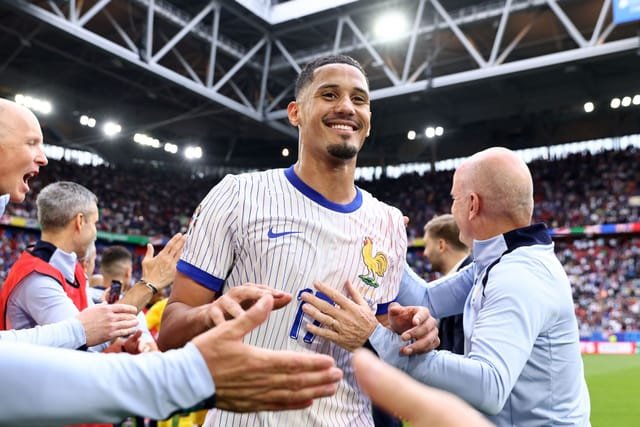
Didier Deschamps has confirmed that all 26 France players will be available for their Northern Ireland friendly on June 8, dismissing concerns about William Saliba’s recurring back problem and explaining Ousmane Dembele’s recent absences as precautionary management rather than injury concern.
IntrThe Fitness Cloud That Gathered Over France’s Preparation
In the final stretch of World Cup preparation, every fitness bulletin carries amplified weight. For France, a squad built around individual brilliance at almost every position, the questions that emerged around William Saliba and Ousmane Dembele in the days preceding the Northern Ireland friendly had the potential to cast a shadow over what should be a period of confidence-building.
Saliba had been dealing with a recurring back problem that, according to reports, would eventually require surgery for a long-term solution. The detail that surgery would be necessary after the tournament ended in the United States introduced the uncomfortable question of how compromised he might be throughout the competition. A central defender managing a back issue in the knockout rounds of a World Cup is a different proposition from the same player at full fitness, and France need him at full capacity.
Dembele, meanwhile, had not featured since the UEFA Champions League final victory against Arsenal. His absence from the bench and from the pitch against Ivory Coast in France’s 2-1 defeat raised questions about whether his availability for the tournament itself would be affected.
Deschamps has addressed both situations directly, and his message is clear: France are going into this World Cup with their squad intact.
The Saliba Update: Management, Not Crisis
“All 26 players will be available for tomorrow’s match. He is being looked after by the medical staff, and we are also managing him based on how he feels. But it’s something he’s had for several weeks, and it hasn’t prevented him from playing every match with Arsenal, including that final for 120 minutes.”
Didier Deschamps, Telefoot (via GOAL)
Deschamps is making a specific and important point with the Arsenal final reference. Saliba played 90 minutes of normal time and 30 minutes of extra time in the UCL final against PSG. Arsenal lost 4-2 on penalties in what was clearly a physically and emotionally exhausting occasion. The fact that Saliba completed 120 minutes of a Champions League final while managing a back issue that “hasn’t prevented him from playing every match” is a significant piece of evidence that the condition is being successfully managed rather than threatening his ability to perform.
The phrase “managed based on how he feels” reflects the reality of professional sport at this level. Elite players routinely carry manageable physical concerns through the final stages of seasons and into major tournaments. The key variable is not whether a condition exists but whether it is being appropriately monitored and whether the player’s match availability and performance are being affected. By Deschamps’s account, neither is currently compromised.
The surgery revelation is the piece of information that generated the most concern in the original reports, and it remains the most uncertain element of Saliba’s situation. Surgery for a long-term fix being required after the tournament implies a degree of ongoing discomfort that will need to be actively managed throughout France’s campaign, potentially across multiple knockout matches with limited recovery time between them. Deschamps’s confirmation of availability does not eliminate that concern entirely. It simply establishes that it is not preventing selection.
Saliba’s UCL Final Context: What Arsenal Losing to PSG Means for France’s World Cup
The Champions League final context is worth dwelling on for an additional reason beyond the fitness indication it provides. Arsenal lost 4-2 on penalties to PSG. Saliba, as one of Arsenal’s most important defensive figures, played through the full 120 minutes of that defeat before the penalty shootout concluded the occasion.
Saliba and Dembele were, in that final, on opposite sides. Dembele’s PSG claimed the trophy. Saliba’s Arsenal were the runners-up. Both players now reconvene in the France national team setup to represent the same country at a World Cup that begins with a group stage match against Senegal on June 16.
The emotional and psychological dynamic of that reunion is one of the more interesting subplot elements in France’s preparation. Two players who competed against each other in a high-stakes European final are now dependant on each other for national success. The ability of elite professional squads to absorb those dynamics and maintain collective focus is a marker of genuine quality, and Deschamps’s reference to both players by first name in his Telefoot interview suggests the management of that environment is proceeding normally.
The Dembele Situation: Recovery Time, Not Injury Management
“Yes, like other players. Ousmane is one of the players, like Desire Doue, who didn’t play after the final. I felt it was important for him to recover.”
Didier Deschamps, Telefoot (via GOAL)
Deschamps’s explanation of Dembele’s absence is reassuringly simple. This is not injury management. It is recovery scheduling. The manager felt that giving his most intense club-season performers a recuperation window before the World Cup was more valuable than the match minutes they could accumulate in low-stakes friendlies. That is a sound decision from a tournament preparation perspective.
Dembele’s club season was extraordinary. Thirty-five goals, sixteen assists, 53 appearances, a UCL title, and a Ligue 1 championship. He has been operating at peak intensity for an extended period, and arriving at a World Cup mentally and physically fresh is more important for a player of his specific contribution profile than any additional preparation game could achieve. What Dembele needs heading into the tournament is rest, not mileage.
The 2-1 defeat to Ivory Coast in France’s previous friendly, in which Dembele remained on the bench, should not be read as a selection decision about the World Cup. It was a managed workload outcome for a player whose contribution to the tournament will be far more important than his presence in a June friendly. Whether he features against Northern Ireland on June 8 depends on Deschamps’s assessment of his recovery progress, but the indication is that he will be a central figure when the competitive matches begin.
| Player | Situation | Availability Confirmation | Expected Role vs Senegal |
|---|---|---|---|
| William Saliba | Recurring back problem; surgery post-tournament likely | Confirmed available (Deschamps) | Starting centre-back |
| Ousmane Dembele | Post-UCL final recovery; managed absence from friendlies | Confirmed in squad; recovery ongoing | Key attacker |
France’s World Cup Opening: Why Senegal on June 16 Is the Match That Matters
France’s group stage schedule positions Senegal as the first competitive test on June 16. The Northern Ireland friendly on June 8 provides one more preparation window, but the competitive reality begins in under ten days from the time of Deschamps’s press conference.
Senegal represent a genuinely demanding opener. With players like Sadio Mane having established a generation of Senegalese talent capable of competing at the highest level, and having won the Africa Cup of Nations, the opening group stage match is not a comfortable easing-in assignment. France need their best players available and, as importantly, match-sharp.
Saliba’s presence in the defensive line is significant for that match specifically. Senegal’s attacking quality puts a premium on defensive organisation, and Saliba’s ability to read the game, win aerial duels, and initiate attacks from deep positions is central to how France build from the back under Deschamps. A compromised Saliba, even if present, would reduce France’s defensive ceiling in ways that matter in a fixture of this difficulty.
The confirmation that he will be available, managed but available, gives France their best defensive configuration for that opening examination.
Dembele’s World Cup Significance: The Ballon d’Or Winner as France’s X-Factor
Ousmane Dembele arrives at this World Cup as the reigning Ballon d’Or holder, a distinction that brings expectations he will need to meet in the tournament rather than merely the qualification phase. His 35-goal, 16-assist season for PSG established him as the most effective attacker in Europe last year, and the World Cup is where that status will be tested against the best defensive organisations from every football-playing nation.
For France, Dembele’s particular value is the directness he brings in attacking transitions. He is the forward who can take defenders on in one-on-one situations and win those confrontations at an elite rate. In a tournament where defensive compactness is the dominant tactical approach for lesser-ranked teams facing the major nations, the ability to beat defenders individually and create chances from nothing is a premium skill. Dembele has it more completely than almost any player in the world currently.
His rest from the Ivory Coast friendly and possible rest from the Northern Ireland fixture are not signs of a problem. They are signs of a management team that understands what they need from him when the real matches begin and is protecting that asset accordingly.
Conclusion: France Head to the World Cup With Their Biggest Questions Answered
The fitness concerns that surrounded Saliba and Dembele in the lead-up to France’s Northern Ireland friendly have been addressed by Deschamps with the kind of clarity that preparation periods require. Saliba is available, managed carefully, and has demonstrated his ability to perform under his back condition through an entire Champions League campaign including a 120-minute final. Dembele has been resting, not hiding, and will be central to France’s tournament ambitions when the competitive phase begins.
The 2-1 defeat to Ivory Coast was a reminder that friendly results should never be extrapolated directly onto tournament predictions. France, when they are at full strength and full focus, are one of the most complete squads in this World Cup. Deschamps’s squad management in the preparatory period reflects a manager who understands the difference between pre-tournament performance and tournament performance, and is optimising for the latter.
June 16 against Senegal is where France’s World Cup begins in earnest. The confirmation that Saliba and Dembele will be available for that match is the most important piece of pre-tournament news the French camp has produced.
France face Northern Ireland on June 8 before their World Cup opener against Senegal on June 16. Both of their key players will be available. Les Bleus are ready.
For breaking news and live news updates, like us on Facebook or follow us on Twitter and Instagram. Read more on Latest Sports on thefoxdaily.com.



COMMENTS 0