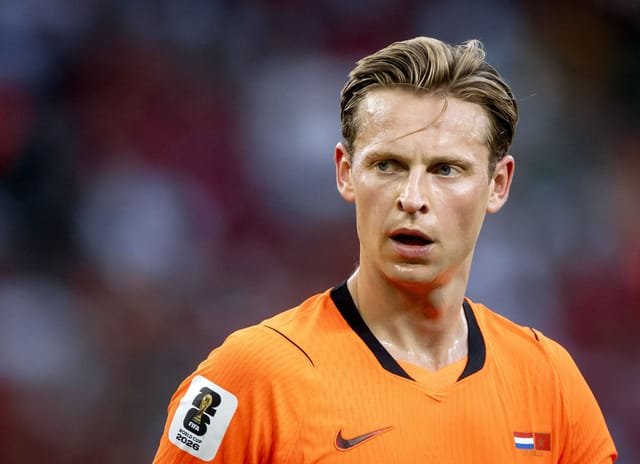
Barcelona‘s preparations for the new season have suffered an early setback after Frenkie de Jong confirmed that he will spend time on the sidelines recovering from a knee injury sustained during the 2026 FIFA World Cup.
The Dutch midfielder, one of Barcelona’s most influential players in recent years, used social media to address growing speculation surrounding his fitness, commitment, and future availability. His statement not only clarified the nature of the injury but also provided insight into the challenges elite footballers face when balancing national team duties with club responsibilities.
While the injury does not currently require surgery, the revelation that it is more serious than initially diagnosed has sparked concern among Barcelona supporters and football observers across Europe.
With a demanding season approaching, De Jong’s recovery timeline could become one of the most important storylines at Camp Nou.
What Happened to Frenkie de Jong at the FIFA World Cup?
De Jong represented the Netherlands throughout the 2026 FIFA World Cup, appearing in every match until the Dutch campaign came to an end in the knockout stages.
Like many players competing in major international tournaments, he continued playing despite experiencing physical discomfort.
According to his explanation, initial medical assessments during the tournament suggested the issue was relatively minor. Medical staff reportedly believed the injury could be managed without significantly increasing the risk of further damage.
As a result, De Jong continued participating for his country during the competition.
Only after returning to Barcelona and undergoing additional examinations did the full extent of the injury become apparent.
Barcelona Medical Assessment Reveals Greater Damage
The situation changed when Barcelona’s medical team conducted more detailed evaluations following the midfielder’s return from international duty.
Further testing revealed damage to the medial collateral ligament (MCL) in his right knee.
Although the club has not publicly established an exact return date, the injury is considered significant enough to keep the midfielder out of action for an extended period.
The development highlights one of the recurring challenges in modern football: injuries that initially appear manageable can sometimes reveal greater complications once comprehensive assessments are performed.
Why the MCL Injury Matters
The medial collateral ligament plays a crucial role in stabilizing the knee joint.
For footballers, particularly midfielders who rely on quick changes of direction, balance, and mobility, the ligament is extremely important.
An MCL injury can impact several key aspects of performance:
- Acceleration and movement.
- Agility during directional changes.
- Defensive duels.
- Ball retention under pressure.
- Overall physical confidence.
Even when surgery is not required, recovery must be managed carefully to avoid setbacks or recurring issues.
Frenkie de Jong Addresses Speculation About His Commitment
Perhaps the most notable aspect of De Jong’s statement was his decision to directly address criticism regarding his commitment to Barcelona.
Over recent years, injuries have occasionally fueled speculation about his availability and long-term fitness.
In response, the Dutch international made it clear that representing Barcelona and the Netherlands remains one of the greatest privileges of his career.
His comments reflected frustration with narratives suggesting anything less than total dedication.
For professional athletes, injuries often create misconceptions because supporters see only the matches missed rather than the recovery work taking place behind the scenes.
De Jong’s statement appeared designed to eliminate those doubts.
The Difficult Decision to Play Through Pain
One of the most interesting revelations from his message involved his decision to continue playing during the World Cup.
Elite athletes frequently face situations where injuries fall into a gray area.
The condition may not prevent participation entirely, but it can still create discomfort and risk.
Players must then weigh several factors:
- The importance of the competition.
- Medical advice.
- Personal responsibility.
- National team commitments.
- Potential long-term consequences.
For many footballers, representing their country at a FIFA World Cup is considered the pinnacle of the sport. That reality often influences difficult decisions regarding fitness and availability.
Barcelona’s Midfield Faces a Significant Challenge
De Jong’s absence creates a major tactical issue for Barcelona.
Over the years, he has developed into one of the team’s most important midfielders due to his unique combination of technical quality, ball progression, and tactical intelligence.
Few players in European football can replicate his ability to:
- Carry the ball through midfield.
- Break opposition pressure.
- Control possession.
- Link defense and attack.
- Maintain tempo during matches.
Replacing those qualities is rarely straightforward.
Even when Barcelona possess talented alternatives, De Jong’s specific profile remains difficult to duplicate.
Why Frenkie de Jong Is So Important to Barcelona
Statistics only tell part of the story when evaluating De Jong’s importance.
His influence often comes through actions that do not appear on traditional score sheets.
| Attribute | Impact on Barcelona |
|---|---|
| Ball Progression | Advances possession through midfield |
| Press Resistance | Helps team escape pressure |
| Tactical Flexibility | Can perform multiple midfield roles |
| Possession Control | Improves rhythm and game management |
| Experience | Provides leadership in key moments |
These qualities explain why Barcelona supporters reacted with concern when details of the injury emerged.
A Recurring Battle With Injuries
One of the reasons this setback has attracted attention is De Jong’s recent injury history.
Although he has remained a highly productive player, physical setbacks have periodically interrupted his momentum.
For footballers, repeated injuries create challenges beyond the physical dimension.
They can affect:
- Match rhythm.
- Confidence.
- Consistency.
- Training continuity.
- Long-term planning.
As players approach their late twenties and early thirties, effective injury management becomes increasingly important.
Barcelona’s medical team will therefore prioritize a complete recovery rather than rushing him back into action.
The Impact on Hansi Flick’s Plans
The timing of the injury presents an additional challenge for Barcelona head coach Hansi Flick.
Preseason periods are critical because they allow managers to implement tactical ideas, build chemistry, and establish preferred lineups.
Missing a player of De Jong’s caliber during that process inevitably complicates planning.
Midfield systems often depend heavily on understanding, positioning, and coordinated movement. Every week without a key player can delay that development.
Flick may now need to accelerate the integration of other midfield options while adjusting tactical structures to compensate for De Jong’s absence.
What This Means for the Netherlands National Team
The implications extend beyond club football.
De Jong remains one of the most important players for the Netherlands national team and has consistently been a central figure in their midfield.
His ability to control possession and dictate tempo makes him particularly valuable in international tournaments.
While there are no immediate major competitions on the horizon, Dutch supporters will closely monitor his recovery progress.
Maintaining the fitness of key players remains essential for any nation hoping to compete at the highest level.
The Modern Football Calendar and Injury Risk
De Jong’s situation also reignites a broader conversation about player workload.
Elite footballers now compete in more matches than ever before.
A typical season may include:
- Domestic league fixtures.
- Cup competitions.
- European tournaments.
- International qualifiers.
- Major international championships.
The cumulative physical demands can increase injury risks, particularly when players receive limited recovery time between competitions.
Many coaches, medical experts, and former players have raised concerns about scheduling pressures in recent years.
Can Barcelona Cope Without De Jong?
The answer depends largely on the duration of his absence and how effectively the squad adapts.
Barcelona possess talented midfield options, but replacing one of the team’s most complete players is never simple.
The club’s success during the opening months of the season may depend on:
- Squad depth.
- Tactical flexibility.
- Emergence of younger players.
- Effective rotation.
- De Jong’s recovery progress.
Should the rehabilitation proceed smoothly, the long-term impact could be minimized. However, prolonged absences always create uncertainty.
Reasons for Optimism
Despite understandable concerns, there are positive aspects to the situation.
The most encouraging development is that surgery is currently unnecessary.
That significantly improves the outlook compared to more severe knee injuries.
Additionally, De Jong has already indicated that he is fully focused on rehabilitation and returning stronger.
His professionalism, experience, and commitment to recovery should provide confidence to both Barcelona and Netherlands supporters.
Modern sports medicine has also improved dramatically, enabling athletes to recover more effectively than ever before.
Conclusion: Frenkie de Jong Faces Another Challenge, but Barcelona Need Him Back at Full Strength
Frenkie de Jong’s injury update has brought clarity to a situation that generated significant speculation following the FIFA World Cup. While the midfielder initially believed he was dealing with a relatively minor issue, subsequent examinations revealed a more serious knee injury that will require careful management.
His decision to publicly explain the circumstances reflects both transparency and a desire to address doubts regarding his commitment to Barcelona. The message reinforced what teammates, coaches, and supporters have long recognized: De Jong remains deeply invested in both his club and national team.
For Barcelona, the immediate challenge will be navigating an important period without one of their most influential midfielders. For De Jong, the focus shifts entirely toward recovery.
If rehabilitation proceeds as expected, the Dutch star should return with the opportunity to once again become a central figure in Barcelona’s ambitions. Until then, supporters will be hoping that patience, proper medical care, and careful recovery management help ensure he returns stronger and fully prepared for the challenges ahead.
For breaking news and live news updates, like us on Facebook or follow us on Twitter and Instagram. Read more on Latest Sports on thefoxdaily.com.






COMMENTS 0