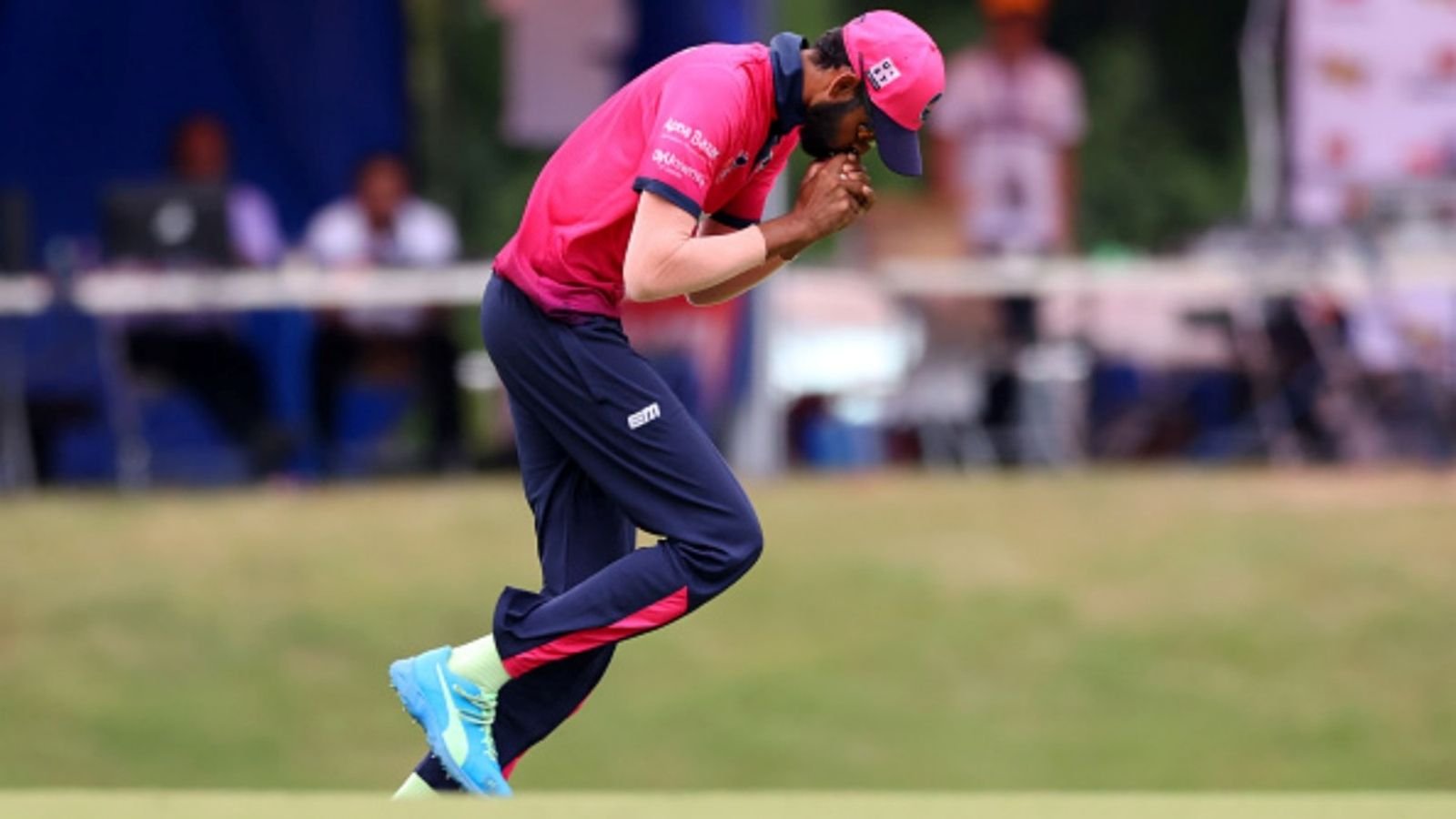
The International Cricket Council banned USA international Bodugum Akhilesh Reddy from all forms of cricket for eight years on August 3, closing out a case that began nine months earlier when the 26-year-old off-spinner was provisionally suspended. Reddy, born in Hyderabad and capped four times for the United States in T20 Internationals, was found guilty of three separate breaches of the ICC Anti-Corruption Code tied to the 2025 edition of the Abu Dhabi T10 League, where he played for the Aspin Stallions under Harbhajan Singh’s captaincy. He will not be eligible to play again until November 22, 2033.
On the surface, this reads like a routine anti-corruption headline, another name added to a growing list. Look closer, though, and Reddy’s case is a near-perfect case study in how the T10 League format has become cricket’s most reliable pipeline for corruption charges, and why players from associate nations like the USA are disproportionately the ones who end up banned rather than the star names who get approached.
What Reddy Was Actually Charged With
The ICC Anti-Corruption Tribunal found Reddy guilty on three counts. The first, under Article 2.1.1, covered attempting to fix or otherwise improperly influence the result, progress or conduct of matches in the 2025 Abu Dhabi T10 League. The second, Article 2.1.4, involved soliciting or persuading another participant to breach that same article, meaning Reddy was not just accused of trying to fix matches himself but of trying to pull someone else into the scheme. The third charge, Article 2.4.7, is arguably the most damning: obstructing the Designated Anti-Corruption Official’s investigation by deleting data and messages from a mobile device that could have been relevant to the inquiry.
That third charge matters more than it might first appear. Deleting evidence during an active ICC investigation is treated as an aggravating factor, not a separate minor offence, and it is a recurring pattern across nearly every major T10 League banning case over the past four years. Investigators consistently report that accused players attempt to wipe phones the moment they sense scrutiny, which only slows down cases without ever actually protecting anyone.
Reddy’s Cricket Career: A Modest Profile for a Major Ban
What makes this case notable is the gap between Reddy’s playing profile and the severity of his punishment. He made his T20I debut against the Cayman Islands and played just four matches for the USA, all in the North America T20 Cup, against Bahamas, Bermuda and Canada. Across those four games he took a single wicket, against Bahamas, while conceding a tidy 5.31 runs per over. In the Abu Dhabi T10 League itself, he played only two matches for Aspin Stallions and picked up one wicket.
In other words, Reddy was not a marquee player being paid to underperform on the pitch himself. His value to a fixing operation would have been almost entirely as an insider, someone with dressing room access and knowledge of team dynamics who could be used to approach or pressure other players, which lines up precisely with the Article 2.1.4 charge against him. This is an important distinction for readers to understand: modern cricket corruption increasingly targets fringe players and support staff who have proximity to information, not just the athletes who can single-handedly swing a result.
The Abu Dhabi T10 League’s Corruption Problem Did Not Start With Reddy
Reddy’s ban is the latest entry in a pattern that stretches back years and makes the Abu Dhabi T10 League arguably the most heavily sanctioned domestic tournament in modern cricket. The 2021 edition alone led to eight separate individuals being charged, including former Bangladesh international Nasir Hossain, two Pune Devils co-owners, a batting coach, a team manager and two domestic players. The punishments handed down from that single tournament season ranged wildly in severity.
| Individual | Role | Tournament | Ban Length |
|---|---|---|---|
| Bodugum Akhilesh Reddy | Player (USA international) | Abu Dhabi T10, 2025 | 8 years |
| Rizwan Javed | UK club cricketer | Abu Dhabi T10, 2021 | 17.5 years |
| Sunny Dhillon | Assistant coach | Abu Dhabi T10, 2021 | 6 years |
| Nasir Hossain | Player (Bangladesh international) | Abu Dhabi T10, 2021 | 2 years |
| Mohammad Naveed | Player (former UAE captain) | T10 League, 2019 | 8 years |
| Shaiman Anwar | Player (UAE) | T10 League, 2019 | 8 years |
Notice the spread. Rizwan Javed’s 17.5-year sentence remains the second-longest in ICC history, behind only a 20-year ban handed to a Zimbabwean cricket official in 2018, largely because Javed refused to cooperate with investigators at all. Nasir Hossain, by contrast, received just two years because he cooperated fully. Reddy’s eight-year ban sits in the middle of that range, roughly matching the punishment given to Naveed and Anwar back in 2019, suggesting the ICC treats “attempted fixing plus evidence destruction” as a fairly standardized tier of offence regardless of which T10 edition it happens in.
Why Associate-Nation Players Keep Showing Up in These Cases
This is the angle most coverage of the Reddy ban has missed entirely. Every major name in the table above, aside from the coaches and officials, represents an associate or lower-profile cricketing nation: the USA, the UAE, Bangladesh’s fringe player pool, and UK club cricket. None of these are central contracted stars from India, Australia or England, and that is not a coincidence.
Players from associate nations typically earn a fraction of what full-member international cricketers make, yet T10 franchise contracts can still represent meaningful supplementary income relative to their usual match fees. That combination, modest earning power plus a genuine financial incentive to say yes, is exactly the profile fixing syndicates look for. It also means these players often have the least institutional support: fewer players’ associations, less anti-corruption education relative to what BCCI or Cricket Australia contracted players receive, and less scrutiny from national boards who may not have the same integrity infrastructure as full-member nations.
USA Cricket, still a relatively young governing body building out its domestic structures, is a clear example. Reddy’s international career consisted of four T20Is against similarly emerging cricket nations. He was, by any measure, a marginal international player who found himself playing in a high-visibility gambling market (the T10 League draws heavy betting interest across South Asia and the Gulf) without the kind of protective structure a central contract at a major board would typically provide.
The Real-World Impact: What This Means for USA Cricket’s Growth Story
USA Cricket has spent the past several years positioning itself as cricket’s next major growth market, buoyed by Major League Cricket, ICC events being hosted on American soil, and growing diaspora investment. A match-fixing ban attached to a USA international, however minor his on-field role, is exactly the kind of story that undercuts that narrative at a sensitive moment. It signals to sponsors, broadcasters and the ICC itself that USA Cricket’s anti-corruption education and player vetting still has real gaps to close, particularly for players who moonlight in overseas franchise leagues during the American off-season.
There is also a broader implication for the T10 format itself. Even accounting for the ICC’s stated commitment to disrupting corruption before it happens, a tournament that has now produced this many separate banning cases across multiple editions raises a fair question about whether the format’s short, high-variance matches (ten overs a side, where a single over can swing a result dramatically) make it inherently more attractive to fixers than longer formats. Shorter matches mean fewer data points determine the outcome, which makes spot-fixing specific deliveries or overs both easier to execute and harder to detect in real time.
What Happens Next
Reddy’s ban runs until November 22, 2033, by which point he will be 33 years old, effectively ending any realistic path back to competitive cricket at the level he once played. His case will likely be cited going forward as a reference point for other associate-nation players who breach the Code while also destroying evidence, sitting comfortably in the same eight-year bracket as the Naveed and Anwar bans from 2019.
For the ICC’s Anti-Corruption Unit, the more pressing task is upstream of any individual ban: continuing to expand education programmes specifically aimed at associate-nation players before they ever set foot in a T10 dressing room, since every case in this pattern points to the same structural vulnerability rather than a one-off lapse in judgment.
Conclusion
Akhilesh Reddy’s eight-year ban is not an isolated incident, it is the latest data point in a well-documented pattern of the Abu Dhabi T10 League producing corruption cases disproportionately involving players from associate and lower-profile cricketing nations. His modest playing record, just one wicket in four T20Is and one wicket in two T10 appearances, makes clear that his alleged value to a fixing operation was as an insider and recruiter rather than a match-winner, a distinction that should worry administrators more than the ban itself. Until USA Cricket and similar emerging boards build out anti-corruption education to match what full-member nations already provide, expect this pattern, marginal international players caught in high-stakes franchise gambling markets, to keep repeating.
For breaking news and live news updates, like us on Facebook or follow us on Twitter and Instagram. Read more on Latest Sports on thefoxdaily.com.






COMMENTS 0