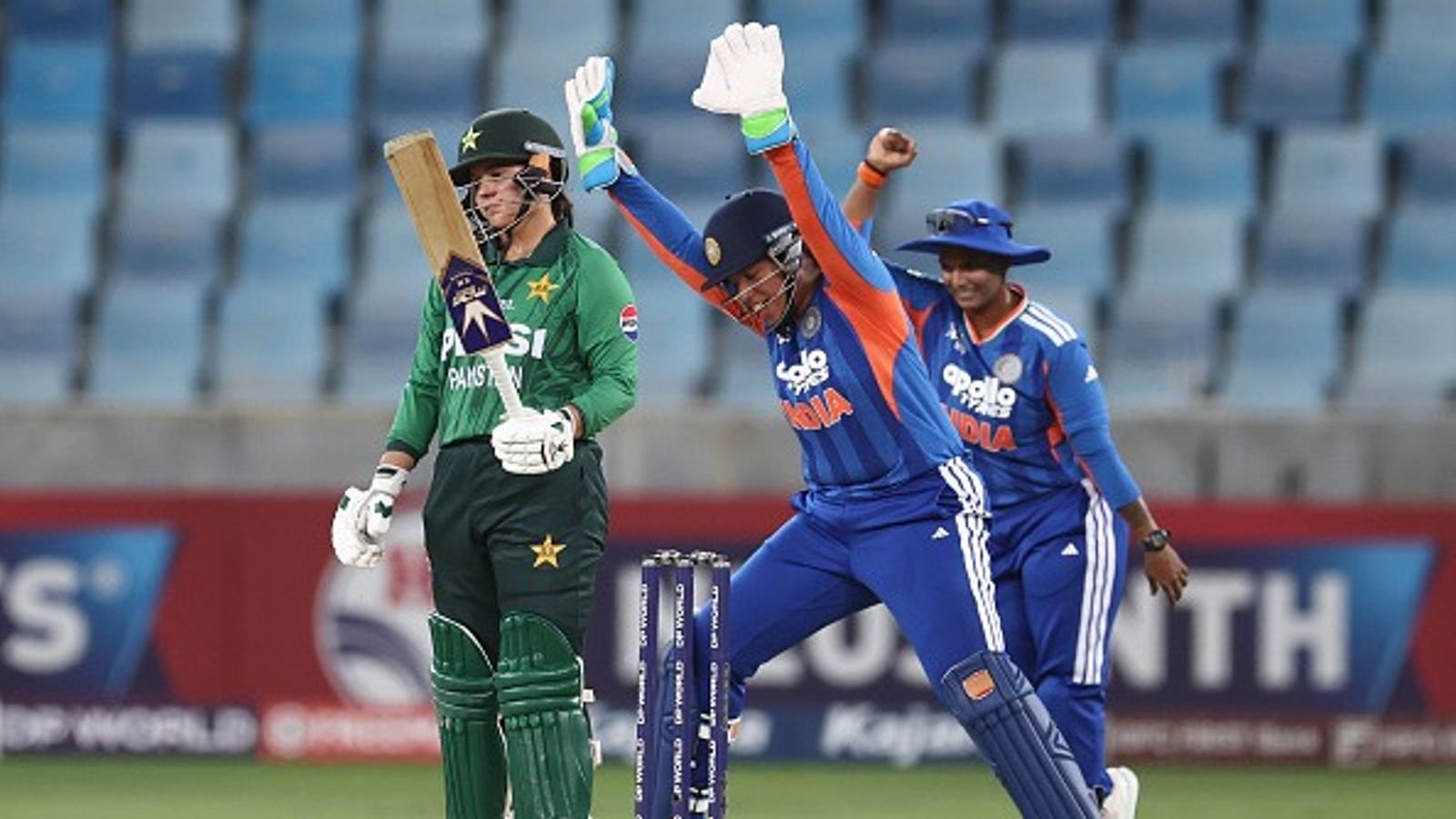
India vs Pakistan Womenâs Asia Cup 2026 once again ended with India on top as Harmanpreet Kaur’s side defeated Pakistan by seven wickets in a remarkably one-sided contest. Pakistan were bowled out for just 55 in 18.1 overs after losing their final 10 wickets for only 28 runs, while India reached the target in 8.4 overs.
The victory extended India’s dominant Women’s Asia Cup record against Pakistan to seven wins in eight meetings. More importantly, the manner of the result underlined the gap between the two sides on the day. India’s spin attack controlled the middle overs, Pakistan’s batting collapsed dramatically, and a short chase was eventually completed despite a brief wobble from the Indian top order.
Shree Charani and Prema Rawat claimed three wickets each, while Deepti Sharma took two wickets for only five runs. Shafali Verma also contributed with the ball by removing Muneeba Ali. Pakistan captain Fatima Sana briefly gave her team hope with an early three-wicket burst, but Harmanpreet Kaur and Deepti Sharma ensured that India never came close to losing control.
India vs Pakistan Women’s Asia Cup 2026: What happened?
Pakistan won the toss and chose to bat first, but their innings quickly became a story of missed opportunities and relentless Indian bowling. The Pakistan openers initially appeared comfortable and moved to 27 without loss, creating the possibility of a competitive total.
That promise disappeared almost immediately. Once India made their first breakthrough, Pakistan lost wickets in rapid succession. The batting side struggled to handle India’s spin options and eventually collapsed for 55.
India then needed only 56 runs to win. Although Pakistan managed to remove three Indian wickets, the target was far too small to create serious pressure. Harmanpreet Kaur remained unbeaten on 18, while Deepti Sharma finished with 12 not out as India crossed the line in only 8.4 overs.
Pakistan’s collapse was the decisive moment
The most important phase of the match was Pakistan’s collapse after their promising start. Reaching 27 without losing a wicket suggested that the team had found a way to negotiate the early pressure. Instead, the innings completely changed direction.
Shafali Verma’s dismissal of Muneeba Ali for 13 opened the door for India’s spin attack. Shree Charani and Prema Rawat then applied sustained pressure, taking three wickets apiece.
Deepti Sharma added another layer of control. Her two wickets came at the cost of only five runs, highlighting just how difficult Pakistan found it to score once India’s spinners established control.
The collapse also exposed the importance of partnerships in T20 cricket. Pakistan had the opportunity to build a platform after reaching 27 without loss, but the loss of wickets prevented the middle and lower order from contributing meaningfully.
Pakistan’s batting card tells the story
| Pakistan batting | Runs | Match impact |
|---|---|---|
| Shawaal Zulfiqar | 14 | Pakistan’s highest scorer |
| Muneeba Ali | 13 | Provided an early contribution before falling to Shafali Verma |
| Other batters | 28 combined | Failed to build partnerships after the opening phase |
| Pakistan total | 55 all out | Lowest total in Pakistan Women’s T20I history |
Shree Charani and Prema Rawat dismantle Pakistan
India’s biggest advantage in the match was their spin bowling. Shree Charani and Prema Rawat were central to Pakistan’s collapse, taking three wickets each and preventing the opposition from rebuilding after the first breakthrough.
Charani finished with figures of 3/7, while Rawat returned 3/9. Those figures demonstrate not only wicket-taking effectiveness but also exceptional control. In a short-format match, conceding very few runs while repeatedly breaking partnerships can completely change the pressure equation.
Deepti Sharma further strengthened the attack with two wickets for five runs. Her economical spell meant Pakistan had almost no opportunity to accelerate during the middle and later stages of the innings.
The performance was a reminder that spin remains one of India’s major strengths in Asian conditions. Instead of relying exclusively on pace, India used variations in speed, trajectory and turn to make scoring difficult.
Why Pakistan’s 55-run total mattered
Pakistan’s total of 55 was not merely a low score; it removed almost all strategic uncertainty from the match. In T20 cricket, a team batting first normally needs enough runs to create pressure through wickets and scoreboard demands. Pakistan had neither advantage.
Once India restricted them to 55, the chase became more about avoiding unnecessary mistakes than overcoming a competitive target.
The low total also placed immense pressure on Pakistan’s bowlers. They needed early wickets because defending such a small score required an extraordinary start. Fatima Sana provided exactly that possibility by producing a three-wicket burst.
However, India’s experienced players did not allow the situation to develop into a genuine crisis.
Fatima Sana’s three wickets provide Pakistan’s only resistance
Pakistan captain Fatima Sana was responsible for the most encouraging phase of Pakistan’s defence. Her three-wicket burst gave the chasing team a brief scare and demonstrated that Pakistan still had the ability to create pressure even after a disastrous batting innings.
The problem was the size of the target. India needed only 56 runs, meaning Pakistan had almost no margin for error. Even a few boundaries or a calm partnership could quickly remove the remaining pressure.
Harmanpreet Kaur and Deepti Sharma provided that stability. Their partnership prevented Pakistan from turning early wickets into a dramatic comeback.
Harmanpreet Kaur anchors India’s chase
Harmanpreet Kaur finished unbeaten on 18, playing an important role in bringing India safely across the finishing line. Her innings was not required to be spectacular because India’s bowlers had already done most of the work.
Her contribution instead reflected the value of experience in a low-scoring chase. When the target is tiny, aggressive batting can sometimes create unnecessary risks. India’s experienced players ensured that Pakistan’s brief spell of momentum did not become a genuine threat.
Deepti Sharma also remained unbeaten on 12, giving India another composed presence during the final stages.
India completed the chase in just 8.4 overs
India reached 56 in 8.4 overs, leaving 68 balls unused. The speed of the chase made the seven-wicket victory even more emphatic.
The result can be understood through three simple numbers: 55, 3 and 68. Pakistan were dismissed for 55, India lost only three wickets, and India still had 68 deliveries remaining when the winning runs were scored.
This combination illustrates how completely the contest was controlled by India. Pakistan’s bowling did produce some resistance, but the enormous difference between the required run rate and the available target meant India could recover quickly from any minor setback.
India’s dominance over Pakistan continues in the Women’s Asia Cup
The latest result took India’s Women’s Asia Cup head-to-head record against Pakistan to seven wins from eight meetings.
That record demonstrates a sustained pattern rather than a single-match advantage. Across different editions and different generations of players, India have repeatedly found ways to perform effectively against Pakistan in the tournament.
The latest victory was particularly convincing because India dominated both innings. They restricted Pakistan with the ball and then completed the chase with minimal difficulty.
| Key match statistic | India | Pakistan |
|---|---|---|
| Runs | 56/3 | 55 all out |
| Overs faced | 8.4 | 18.1 |
| Wickets lost | 3 | 10 |
| Result | Won by 7 wickets | Lost by 7 wickets |
| Head-to-head in Women’s Asia Cup | 7 wins | 1 win |
The tactical difference: India attacked with spin, Pakistan lacked a recovery plan
The match also revealed a significant tactical contrast. India were able to keep changing their bowling options and maintain pressure after every breakthrough. Pakistan, by comparison, struggled to recover once their opening partnership ended.
India’s spin-heavy approach was especially effective because Pakistan were unable to rotate the strike consistently. When boundaries disappeared, the pressure increased with every dot ball. Eventually, Pakistan’s batters had to take greater risks, creating further wicket-taking opportunities.
This is one of the hidden reasons why the collapse became so severe. A batting side does not always collapse because every batter suddenly plays a poor shot. Sometimes a disciplined bowling attack gradually reduces scoring options until the batting team is forced into increasingly difficult decisions.
What India’s performance means for the rest of the tournament
India’s perfect group-stage record gives them significant momentum heading towards the semi-finals. Victories over Pakistan, Thailand and Hong Kong have provided both points and confidence.
More importantly, India have demonstrated that their bowling attack can win matches even before the batting unit has had to produce a major score.
That balance could become extremely valuable in knockout cricket. Tournament matches often produce different conditions and different types of pressure. A team that can win through dominant bowling as well as powerful batting has more ways to survive difficult situations.
Pakistan still have a route to the semi-finals
Despite the heavy defeat, Pakistan’s tournament campaign is not necessarily over. Their strong net run rate gives them a favourable position heading into their final group-stage match against Hong Kong.
That makes the next fixture extremely important. Pakistan will need to put the collapse against India behind them and focus on securing the result required to move into the final four.
The biggest challenge will be psychological as much as tactical. A defeat by seven wickets after being bowled out for 55 can affect confidence, particularly among the batting group. The response in the next match will therefore be a useful measure of the team’s resilience.
Harmanpreet Kaur’s milestone adds another layer
The match was also significant for Harmanpreet Kaur personally. She marked her world-record 150th appearance as a T20I captain, adding another milestone to an already long international career.
Her unbeaten 18 was therefore part of a memorable occasion, combining an individual leadership landmark with a convincing team victory.
For India, having an experienced captain capable of remaining calm in a low-scoring chase is an important advantage. Harmanpreet did not need to force the pace, and her measured approach helped ensure that Pakistan’s brief bowling resistance did not change the outcome.
India vs Pakistan Women’s Asia Cup 2026: The bigger picture
The biggest takeaway from this match is not simply that India won again. It is the manner in which India controlled the contest.
Pakistan started reasonably well but could not convert that platform into runs. India identified the weakness, used spin to attack the middle of the innings and kept the scoring rate under control. Once Pakistan were dismissed for 55, India’s experienced batters ensured that the chase did not become unnecessarily complicated.
This is what separates a dominant tournament team from one that relies on individual brilliance. India did not require one extraordinary batting innings or a single five-wicket bowling performance. Instead, multiple players contributed to a collective performance that removed Pakistan’s chances of recovery.
The unique lesson is that India’s advantage was created through pressure rather than one dramatic moment. Pakistan’s innings slowly became smaller, their options became fewer, and their wickets followed. By the time India began chasing, the match was effectively tilted beyond Pakistan’s reach.
Conclusion: India send a strong message ahead of the semi-finals
India’s seven-wicket victory over Pakistan in the Women’s Asia Cup 2026 was one of their most convincing performances of the tournament so far. Pakistan’s 55 all-out provided the foundation for the result, while Shree Charani, Prema Rawat and Deepti Sharma led an outstanding bowling effort.
Although Fatima Sana’s three wickets briefly created hope during the chase, Harmanpreet Kaur and Deepti Sharma calmly finished the job. India reached the target in just 8.4 overs, with 68 balls remaining.
The victory extended India’s Women’s Asia Cup dominance over Pakistan to seven wins from eight meetings and strengthened their momentum heading into the knockout stage. Pakistan, meanwhile, still have an opportunity to progress but must quickly recover from their batting collapse.
For India, the message is clear: they are not merely winning matches; they are finding multiple ways to dominate them. If the same balance between spin bowling, experience and controlled batting continues, India will enter the semi-finals as one of the tournament’s strongest contenders.
For breaking news and live news updates, like us on Facebook or follow us on Twitter and Instagram. Read more on Latest Cricket on thefoxdaily.com.






COMMENTS 0