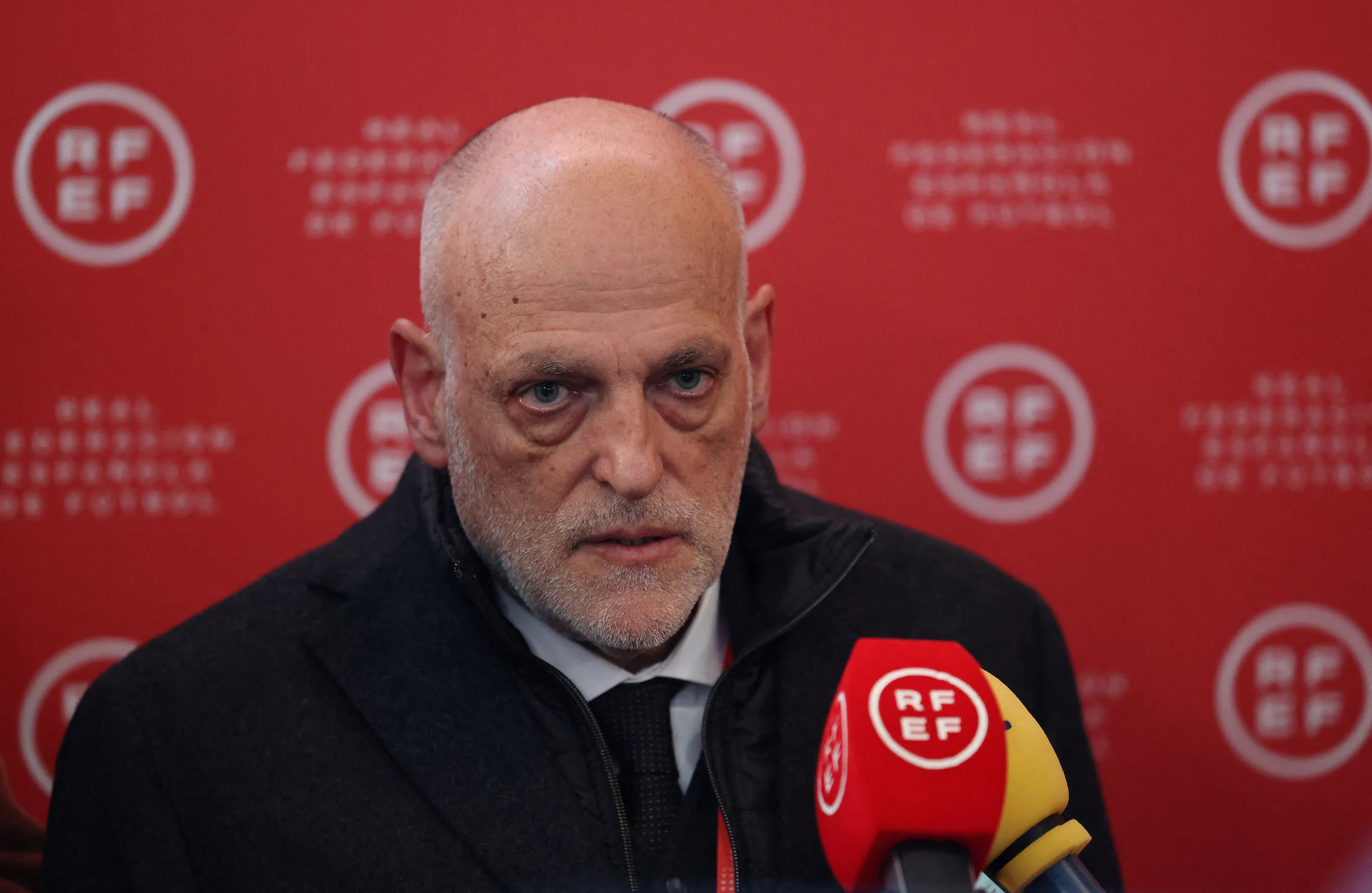
Spain’s National Sports Council (CSD) has referred LaLiga president Javier Tebas to the country’s sports tribunal following controversial comments in which he compared Real Madrid‘s communication strategy to Nazi propaganda. The referral asks the tribunal to determine whether his remarks violated Spanish sports regulations governing dignity and decorum.
The dispute intensified after Tebas made the comparison on social media on Friday, prompting Real Madrid to issue a statement demanding his immediate resignation. Tebas subsequently defended his remarks, emphasizing that he was criticizing the club’s communication methods rather than comparing its ideology or supporters with those of the Nazi Party.
The CSD announced that it had raised the matter with the sports tribunal on Thursday, asking it to assess whether the comments could constitute a serious infraction under Spain’s sports legislation. Potential sanctions for such violations include warnings, fines and suspension.
The case places Tebas, one of European football’s most prominent league executives, under scrutiny over the way he publicly criticizes a major club. It also highlights the continuing tensions between LaLiga’s leadership and Real Madrid, with the dispute extending beyond the original remarks to broader questions about the league’s integrity and the responsibilities of its president.
Why Spain’s Sports Council Referred Javier Tebas to the Tribunal
The CSD’s referral centers on whether Tebas’s comments breached Article 76.4.b of Spain’s Law 10/1990 on Sport. The provision classifies certain public acts that infringe upon sporting dignity or decorum as serious infractions.
Rather than announcing a final finding against Tebas, the council has asked the sports tribunal to examine the remarks and determine whether they fall within the scope of the relevant rule. That distinction is important because a referral initiates or advances a disciplinary assessment; it does not, by itself, establish that a violation occurred.
The controversy arose from Tebas’s comparison of Real Madrid’s communication strategy to Nazi propaganda. The reference prompted an immediate response from the club, which objected to the comparison and called for the league president to resign.
The tribunal’s task is to assess the potential regulatory implications of the remarks. The central issue is whether the statements meet the legal threshold for conduct that violates sporting dignity or decorum, rather than simply whether the comparison was offensive or politically controversial.
What Article 76.4.b means for the case
Article 76.4.b of Law 10/1990 on Sport identifies notorious and public acts that infringe upon sporting dignity or decorum as serious infractions, as described in the CSD’s referral.
The reference to public conduct is relevant because Tebas made his comments on social media. Public statements by senior football officials can attract scrutiny when they concern clubs, competitions or other participants in organized sport.
However, the existence of a potentially applicable disciplinary provision does not automatically mean that a particular statement violates it. The tribunal must assess the circumstances and determine whether the conduct satisfies the requirements of the rule.
The available information does not establish that the tribunal has reached a decision or that Tebas has been found guilty of an infraction. Until an outcome is announced, the case remains an assessment of whether disciplinary action may be justified.
What Javier Tebas Said About Real Madrid’s Communication Strategy
Tebas defended his comments by drawing a distinction between the ideology of the Nazi Party and the communication techniques he attributed to Real Madrid. He said he was not comparing the club or its supporters with the Nazi Party in ideological terms, but was referring to what he characterized as the club’s propaganda methods.
That distinction is central to Tebas’s defense. His position is that the comparison concerned how the club communicates its message, rather than its political beliefs or the identity of its fan base.
Nevertheless, invoking Nazi propaganda in a dispute involving a football club carries substantial historical and political weight. The comparison can provoke strong reactions even when the person making it says the reference is limited to communication methods.
The CSD’s referral means the remarks are now being examined through the framework of Spanish sports discipline. The question is no longer limited to the public disagreement between Tebas and Real Madrid; it also concerns whether the comments fall within the scope of the regulations governing the conduct of people involved in sport.
Tebas maintains his position after the referral
Tebas returned to social media shortly after the CSD made the referral public, reiterating the distinction between ideology and propaganda techniques.
He also argued that criticism of LaLiga’s integrity could itself warrant scrutiny. According to his response, Real Madrid’s questioning of the competition’s integrity could provide grounds for a similar referral.
That argument broadens the dispute. Instead of treating the case solely as a question of whether his original remarks crossed a line, Tebas has presented the controversy as part of a wider conflict over how the league and its leadership are discussed publicly.
His position does not determine whether the tribunal will consider any separate complaint against Real Madrid. The supplied information confirms Tebas’s argument but does not establish that the CSD has opened a parallel proceeding against the club.
Real Madrid Demands Tebas’s Immediate Resignation
Real Madrid responded to Tebas’s comments with a statement calling for his immediate resignation. The demand reflects the seriousness with which the club views the comparison and adds institutional pressure to an already contentious relationship between the club and LaLiga’s leadership.
Real Madrid is one of the most prominent clubs in Spanish and European football, making its disputes with the league particularly consequential for the sport’s public profile. When a disagreement between a league president and a major club becomes public, it can affect perceptions of the relationship between the competition’s organizers and its participants.
However, a demand for resignation is a political and institutional response, not a disciplinary ruling. The CSD’s referral and the club’s statement represent separate developments: one concerns the possible application of sports regulations, while the other expresses Real Madrid’s position on Tebas’s conduct.
Reuters had asked Real Madrid for comment, according to the supplied report. No additional response from the club is established in the available information.
Why the dispute matters beyond the original remarks
The confrontation raises questions about how football officials should communicate criticism of clubs and how disagreements should be handled when they become public.
League presidents regularly operate in a position that requires them to defend competitions, respond to criticism and address disputes involving clubs. At the same time, their public statements can carry more institutional weight than comments made by ordinary supporters because they represent the leadership of the competition.
That creates a difficult balance. Strong public criticism can be part of an executive’s response to a dispute, but controversial comparisons may also create reputational consequences and invite regulatory scrutiny.
In this case, the tribunal’s assessment will determine whether Tebas’s remarks raise a disciplinary issue under the specific provision cited by the CSD. It will not necessarily resolve the wider disagreements between Real Madrid and LaLiga.
Potential Sanctions: What Could Happen to Tebas?
The CSD’s referral identifies possible consequences for serious infractions under the relevant sports regulations, including warnings, fines and potential suspension.
These are possible sanctions, not penalties that have already been imposed. The available report does not establish the amount of any potential fine, the length of a possible suspension or whether the tribunal will ultimately conclude that Tebas breached the law.
The outcome depends on the tribunal’s assessment of the comments and the applicable disciplinary framework. A referral should therefore not be interpreted as a finding of misconduct or an indication that a particular punishment is inevitable.
Three possible directions for the case
1. The tribunal finds no violation. If the tribunal determines that the remarks do not meet the requirements for an infraction under the cited provision, the referral may not result in a sanction under that rule.
2. The tribunal establishes an infraction and imposes a sanction. If the tribunal determines that the comments violated the relevant regulations, potential consequences could include a warning, a fine or suspension, as identified in the supplied report.
3. The assessment develops further before a final outcome. The tribunal may need to examine the statements and their circumstances before reaching a conclusion. The available information does not establish the timetable for a decision or the procedural steps that will follow.
These are possible outcomes rather than predictions. No final ruling is established in the supplied information, and it would be premature to conclude that Tebas will be suspended, fined or forced to leave his position.
LaLiga and Real Madrid’s Wider Conflict Over Competition Integrity
Tebas’s response suggests that the disagreement extends beyond the wording of his comparison. He argued that defending the competition requires him to respond to those who repeatedly discredit it, presenting public criticism as part of his responsibilities as LaLiga president.
He also suggested that Real Madrid’s questioning of LaLiga’s integrity could provide grounds for a similar referral. That statement introduces a reciprocal dimension to the dispute, although the supplied report does not confirm that a separate case against Real Madrid has been initiated.
The distinction between criticizing a league and violating sports regulations is important. Clubs may disagree with decisions, governance arrangements or the way a competition is administered. Whether particular statements trigger disciplinary consequences depends on the applicable rules and the circumstances of the case.
Likewise, a league president may defend the competition and respond to criticism, but that responsibility does not automatically exempt public statements from scrutiny. The CSD’s referral places the focus on whether Tebas’s particular remarks could breach the legal standards governing sporting dignity and decorum.
The case therefore illustrates the tension between forceful public advocacy and the conduct expected of senior officials. It also demonstrates how disputes between clubs and league leadership can move from public statements into formal regulatory processes.
Why the Tribunal’s Decision Could Matter for Spanish Football
The eventual outcome could have implications for how the boundaries of public conduct are interpreted in Spanish sport. A decision addressing Tebas’s comments may help clarify how the cited provision applies to controversial statements by senior football officials.
The precise significance will depend on the tribunal’s reasoning and the scope of any decision. Without a ruling, it is not possible to determine whether the case will establish a broader interpretation of the law or remain limited to the circumstances of Tebas’s remarks.
The dispute also matters for the relationship between football governance and public communication. Social media allows senior officials to respond directly to criticism, but it can also amplify contentious remarks and turn a disagreement into a wider institutional controversy.
For clubs, league executives and supporters, the central question is how to preserve room for legitimate criticism while maintaining standards of conduct in public disputes. The cited legal provision offers a framework for assessing some forms of misconduct, but its application in this case remains for the tribunal to determine.
There is also an important distinction between reputational consequences and formal disciplinary consequences. Even without a sanction, a controversial statement can intensify disagreements and damage relationships. Conversely, a formal referral does not establish that the person involved has committed an infraction.
What Happens Next in the Javier Tebas Case?
The immediate next step is the sports tribunal’s assessment of the CSD’s referral. The council has asked it to determine whether Tebas’s comparison of Real Madrid’s communication strategy to Nazi propaganda may constitute a serious infraction under Article 76.4.b of Spain’s Law 10/1990 on Sport.
The key questions are whether the statements fall within the scope of the provision and whether any disciplinary consequence is warranted. The supplied report does not provide a confirmed decision date or establish what final outcome the tribunal will reach.
Meanwhile, Tebas has maintained that his comparison concerned propaganda techniques rather than ideology. Real Madrid has called for his resignation, while the league president has argued that criticism of LaLiga’s integrity should also be considered in the wider dispute.
Any subsequent developments will need to be assessed separately. A tribunal ruling, a potential disciplinary sanction, a resignation demand and any future complaint involving Real Madrid would represent distinct developments rather than interchangeable outcomes.
Conclusion: A Public Football Dispute Now Faces Regulatory Scrutiny
The referral of Javier Tebas to Spain’s sports tribunal marks a significant escalation in the dispute between the LaLiga president and Real Madrid. The controversy began with Tebas’s comparison of the club’s communication strategy to Nazi propaganda and intensified after Real Madrid demanded his immediate resignation.
The CSD has asked the tribunal to determine whether the comments could violate rules protecting sporting dignity and decorum under Spanish sports law. Potential sanctions include warnings, fines and suspension, but no final finding or punishment is established in the available report.
Tebas continues to distinguish his criticism of the club’s communication techniques from any comparison of its ideology or supporters with the Nazi Party. He has also argued that questions about LaLiga’s integrity should be considered in the wider context of the dispute.
The tribunal’s assessment will determine whether the remarks warrant disciplinary consequences under the cited provision. Until that assessment produces an established outcome, the case remains a regulatory examination of controversial public comments rather than a confirmed finding of misconduct.
For breaking news and live news updates, like us on Facebook or follow us on Twitter and Instagram. Read more on Latest Sports on thefoxdaily.com.






COMMENTS 0