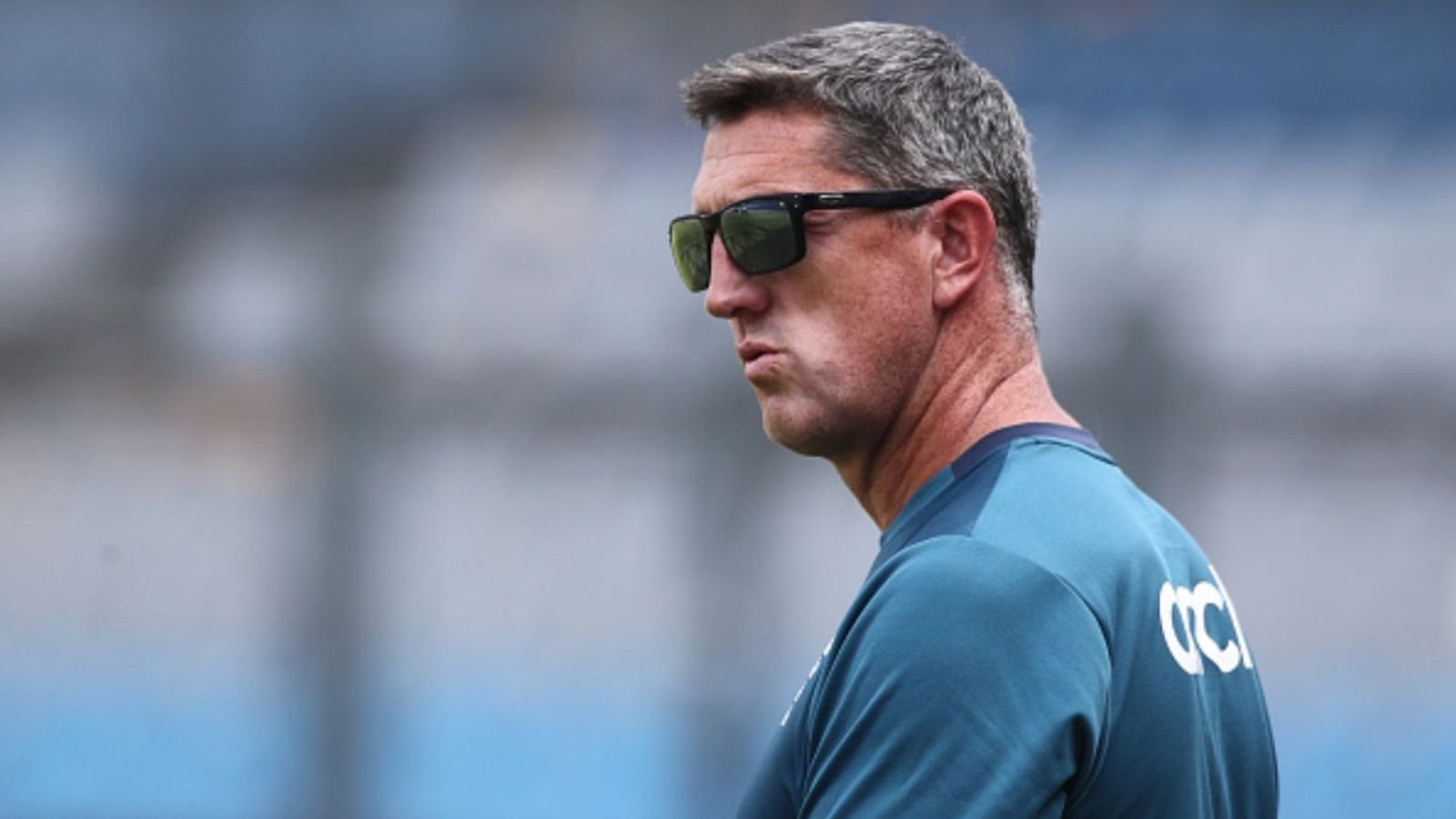
Jon Lewis has revealed that owner involvement in team selection became one of the biggest challenges during his time as UP Warriorz head coach in the Women’s Premier League. The former England cricketer explained that the franchise’s ownership group was closely involved in recruitment and squad-building decisions, sometimes leaving the head coach without complete control over selection matters.
Lewis’ comments provide an insight into one of the less visible challenges of franchise cricket: determining where the authority of the coaching staff ends and the influence of ownership begins. While franchise owners naturally have a major financial and strategic interest in their teams, selection decisions ultimately require a clear understanding of roles if a coaching staff is expected to build a consistent playing combination.
Lewis served as UP Warriorz’s head coach from the inaugural WPL season in 2023 through 2025. He helped the team reach the playoffs during its first campaign, but the franchise struggled to maintain that momentum in the following seasons. His comments have now added another layer to the story of his tenure.
Jon Lewis explains why UP Warriorz selection became difficult
Speaking on the Wisden Women’s Cricket Weekly podcast, Lewis described his experience in the WPL as different from some of his previous coaching roles.
“In the WPL, I have had a different experience where the owners are closer to the team and sometimes to the selection of the team, to the point where, as a head coach, you aren’t always totally in control of the decisions that are being made.”
The key issue was not simply that owners had opinions. Lewis suggested that their involvement could extend into areas traditionally handled by coaching and cricket operations teams.
That distinction matters because a head coach is generally expected to be accountable for performances. If the coach has limited influence over the composition of the squad or the final playing combination, however, accountability can become more complicated.
Lewis said that coaches operating in such an environment need to develop a relationship with the ownership group and convince them that their preferred approach is the best one.
“You have got to try and convince the owner and you have got to be close enough to the owners that your way is the right way of doing it.”
Why owner involvement can create a tricky coaching environment
Franchise cricket is built differently from traditional international cricket. A national coach normally works within an established administrative structure, while a franchise operates as a business as well as a sporting organisation.
Owners invest heavily in players, staff, infrastructure and marketing. They therefore have a legitimate interest in the direction of the team.
The challenge begins when multiple decision-makers have overlapping authority.
Squad construction is not simply about selecting the biggest names. A successful T20 team needs to balance batting depth, bowling variety, overseas-player availability, domestic talent, match-ups and flexibility across different conditions.
A coach may prefer one type of player because of tactical requirements, while an owner or management representative may have a different view based on the player’s profile, market value or long-term potential.
Neither perspective is automatically wrong. The problem occurs when the final decision-making structure is unclear.
UP Warriorz showed early promise under Jon Lewis
Lewis joined UP Warriorz when the WPL was launched in 2023 and was tasked with helping establish a new franchise from the ground up.
The Warriorz made an encouraging start by reaching the playoffs during the inaugural season. That early result suggested that the franchise had developed a competitive foundation despite being a new team in a brand-new league.
However, the subsequent seasons were considerably less successful.
The team finished fourth in the five-team competition in one season before ending another campaign in fifth place. The decline from playoff qualification to struggling near the bottom highlighted the difficulty of maintaining a competitive squad in a rapidly developing league.
Lewis eventually left the franchise in 2025 after completing a three-season stint.
What changed after UP Warriorz’s promising first season?
The contrast between the inaugural campaign and the seasons that followed is one of the most interesting aspects of Lewis’ tenure.
Making the playoffs in the first WPL season gave the Warriorz a strong starting point. But sustaining success requires more than one successful squad.
Player development, recruitment, auction strategy and tactical evolution all become increasingly important as rival franchises learn from one another.
The WPL has also developed quickly, meaning teams have less room for inefficient squad construction. A player who looks like a good signing in isolation may not necessarily fit the tactical structure of the rest of the squad.
This is where a clearly defined cricketing philosophy becomes particularly important.
If the head coach, captain and recruitment team are aligned before major decisions are made, the franchise can construct a squad around specific tactical needs. If those voices disagree, compromises may produce a squad that contains talented individuals but lacks balance.
UP Warriorz’s difficult WPL 2026 campaign
The latest season underlined the franchise’s struggles.
UP Warriorz finished last in the WPL 2026 standings with two wins from eight matches. The campaign was particularly notable because the team was led by Australia’s legendary captain Meg Lanning, one of the most decorated figures in women’s cricket.
Despite having an experienced leader at the helm, the Warriorz could not turn that experience into enough victories to challenge for the playoffs.
The team’s performance demonstrates an important reality of franchise cricket: even an elite captain cannot solve every structural problem on the field.
A successful T20 team needs depth and role clarity throughout its squad. A captain can make tactical adjustments during matches, but many of the factors influencing results are determined before the first ball of the tournament is bowled.
Who owns UP Warriorz?
UP Warriorz are owned by Capri Global Holdings Private Limited, which acquired the Lucknow-based franchise before the WPL began.
Jinisha Sharma represents the ownership group in the franchise’s sporting affairs and oversees aspects of its investments and operations.
The ownership structure is relevant to Lewis’ comments because it highlights the business side of the WPL.
Unlike a national team, a franchise is ultimately backed by private investment. Owners have financial interests in the performance, visibility and long-term value of the team.
That makes involvement from ownership understandable. At the same time, Lewis’ comments raise the question of how much cricketing authority should sit with professional coaches and recruitment specialists.
Abhishek Nayar now leads the UP Warriorz
UP Warriorz currently have Abhishek Nayar as their head coach.
Nayar’s appointment represents another phase in the franchise’s development after Lewis’ departure in 2025.
His challenge is not simply to improve results. The broader objective is to establish a sustainable cricketing structure that can compete consistently in a league where the margins between teams are becoming increasingly important.
The 2026 season showed how difficult that task can be, with the Warriorz winning only two of their eight matches despite having Lanning as captain.
Meg Lanning’s presence highlights the importance of squad construction
Lanning’s leadership experience makes the Warriorz’s 2026 campaign particularly instructive.
She has won major international trophies and spent years leading Australia’s highly successful women’s team. Her presence provides leadership and tactical knowledge that few players can match.
Yet leadership alone cannot compensate for weaknesses across an entire squad.
This is perhaps the clearest lesson from UP Warriorz’s recent struggles: franchise success is usually a product of collective construction rather than one marquee name.
A team needs players who complement one another. It needs backups for key roles, specialists for different conditions and enough flexibility to adapt when injuries or form problems emerge.
That makes the auction and recruitment process arguably as important as match-day tactics.
Owner versus coach: Where should the power sit?
Lewis’ comments raise a wider question that applies to franchise cricket well beyond the WPL: who should have the final say on cricketing decisions?
There is no universal answer, but the most effective model is usually one where responsibilities are clearly established.
Owners can provide the financial framework and long-term vision. A director of cricket or general manager can oversee recruitment and squad strategy. The head coach can then translate that squad into a tactical system, while the captain makes decisions during matches.
Such a structure does not prevent owners from having opinions. Instead, it ensures that opinions are channelled through a defined decision-making process.
That can be especially important in a league such as the WPL, where teams have limited matches and relatively little margin for error.
The hidden risk of unclear authority
The biggest risk is not necessarily disagreement. Healthy disagreement can improve decision-making.
The bigger danger is uncertainty about accountability.
If a franchise performs poorly, the coach may be judged on results even when the coach did not have complete authority over recruitment or selection. Conversely, if owners become too distant from cricketing decisions, they may fail to understand why certain players or combinations are required.
Lewis’ comments suggest that his approach was to work within the structure rather than openly fight against it. His solution was to build enough trust with ownership to persuade them to accept his cricketing vision.
That requires communication skills that go beyond traditional coaching.
UP Warriorz timeline under Jon Lewis
| Year | Development |
|---|---|
| 2023 | Jon Lewis became the head coach of UP Warriorz for the inaugural WPL season. |
| 2023 | Warriorz reached the playoffs in their first WPL campaign. |
| 2024 | The franchise finished fourth in the five-team competition. |
| 2025 | Lewis ended his three-season spell with UP Warriorz. |
| 2026 | UP Warriorz finished fifth with two wins from eight matches under captain Meg Lanning. |
| 2026 | Abhishek Nayar took charge as the team’s head coach. |
What Lewis’ revelation means for the future of UP Warriorz
The comments do not, by themselves, prove that ownership involvement was responsible for the Warriorz’s results. Lewis described it as a challenge from his coaching perspective, but franchise performance depends on numerous factors.
However, the revelation does highlight an area UP Warriorz can potentially address going forward: clearly defining the roles of ownership, cricket operations, coaching staff and leadership.
The franchise has already experienced several changes since the WPL began. The next step should be building continuity around a consistent cricketing philosophy.
That means identifying what kind of players the team wants, determining how those players fit together and ensuring that recruitment decisions are aligned with the tactical plan.
If that structure is established, the coaching staff can be judged more fairly on its ability to turn the available resources into results.
Why this matters for the wider WPL
Lewis’ comments are relevant beyond UP Warriorz.
The WPL remains a relatively young competition, and its franchises are still developing their organisational identities. As the league grows, teams will increasingly need sophisticated cricket operations departments rather than relying solely on headline signings.
The most successful franchises are likely to be those that can combine financial resources with strong cricketing processes.
That includes scouting, analytics, player development, auction planning and coaching continuity.
In other words, the next stage of the WPL’s evolution may be determined as much by what happens inside franchise offices as by what happens on the field.
Conclusion
Jon Lewis’ comments have provided a revealing look at the challenges that can arise when franchise ownership becomes closely involved in team selection and squad construction. The former UP Warriorz coach said he was not always completely in control of decisions and explained that coaches in such situations must build trust with owners and convince them of their cricketing vision.
Lewis’ three-season tenure began with a playoff appearance in the inaugural WPL campaign but was followed by less successful seasons before he departed in 2025. UP Warriorz subsequently endured another difficult campaign in 2026, finishing last with two victories from eight matches under Meg Lanning.
The results alone cannot be attributed to ownership involvement, but the episode highlights an important lesson for the franchise: clear decision-making authority, strong recruitment planning and alignment between ownership and cricket management are essential for long-term success.
As Abhishek Nayar leads the next phase, the Warriorz have an opportunity to turn those lessons into a more stable structure. In a competition where one or two decisions can dramatically change a season, getting that balance right could be the difference between another disappointing campaign and a genuine playoff push.
For breaking news and live news updates, like us on Facebook or follow us on Twitter and Instagram. Read more on Latest Cricket on thefoxdaily.com.

COMMENTS 0