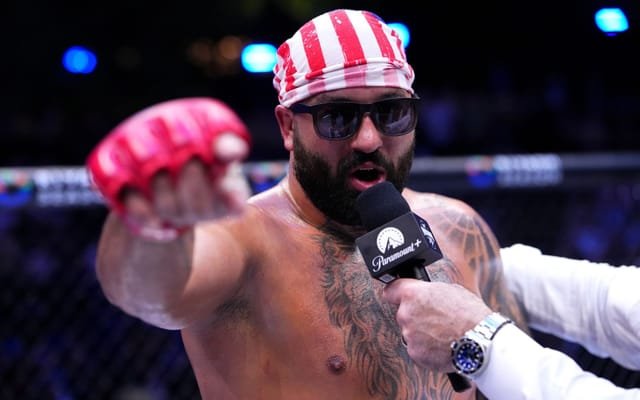
Josh Hokit’s criticism of Tom Aspinall has added another layer to an increasingly complicated UFC heavyweight title picture. Hokit is campaigning for a major fight, with Ciryl Gane appearing to be his preferred target, while simultaneously arguing that Aspinall should no longer hold the championship after being forced out of action by an eye injury.
The controversy centers on Aspinall’s decision to stop during his title fight with Gane after suffering eye pokes to both eyes. Hokit believes Aspinall should have continued, and he used former UFC middleweight champion Michael Bisping as an example of the kind of toughness he believes elite fighters should display.
Hokit’s argument has attracted attention because it goes beyond ordinary fight promotion. He is effectively challenging the way fans and fighters should evaluate injury decisions inside the Octagon. At the same time, his comments serve a second purpose: putting his own name into the heavyweight title conversation.
The bigger question is not simply whether Hokit’s criticism is fair. It is whether toughness should be measured by continuing through an injury or by making the correct decision when an injury affects a fighter’s ability to compete safely.
Why Josh Hokit is targeting Tom Aspinall and Ciryl Gane
Hokit has made it clear that he wants a major opportunity at heavyweight. His recent social media activity has focused on securing a fight against either Ciryl Gane or Alex Pereira, with Gane seemingly representing his preferred route toward the top of the division.
Calling for a fight is nothing unusual in MMA. Heavyweights frequently use social media to create momentum around potential matchups, especially when the division’s championship situation is uncertain. Hokit, however, has taken a more confrontational approach.
Rather than simply asking for a matchup, he has repeatedly questioned Aspinall’s position as champion. That strategy gives Hokit two storylines to promote at once: his desire to fight Gane and his argument that the heavyweight title picture needs to move forward without Aspinall.
There is a clear promotional advantage to this approach. Criticizing a highly ranked or established fighter creates attention, while challenging another potential opponent gives Hokit a specific matchup to promote. In a sport where public interest can influence matchmaking discussions, that combination can be powerful.
What happened between Tom Aspinall and Ciryl Gane?
The central issue began with Aspinall’s heavyweight title fight against Gane at UFC 321. During the opening round, Aspinall suffered eye pokes to both eyes and ultimately decided that he could not safely continue.
Aspinall immediately communicated the problem to the referee and medical personnel. The decision to stop meant that the fight could not proceed as originally intended, leaving the heavyweight championship picture in an unusual position.
The consequences extended well beyond the night of the fight. Aspinall remained inactive while dealing with the effects of the eye injury and undergoing multiple surgeries related to the damage.
That recovery period is important when assessing the criticism directed at him. An eye injury is fundamentally different from an ordinary bruise or cut because vision is essential for a fighter to defend, attack and react to incoming strikes.
Why Josh Hokit brought Michael Bisping into the debate
Hokit’s most striking argument involved Michael Bisping, whose career is often associated with perseverance. Bisping famously won the UFC middleweight championship at UFC 199 against Luke Rockhold despite having previously lost sight in his right eye.
That historical example provides an emotional comparison for Hokit. His argument is essentially that elite fighters sometimes overcome extraordinary physical obstacles rather than stopping when circumstances become difficult.
However, the comparison has an important limitation. Bisping’s situation and Aspinall’s injury occurred under different circumstances and at different points in their respective careers. Bisping had adapted to his long-term visual impairment, whereas Aspinall was dealing with an acute injury during an active fight.
That distinction matters because toughness and medical safety are not necessarily opposites. A fighter can demonstrate courage while recognizing that continuing a contest with compromised vision may create additional risks.
Toughness in MMA is more complicated than simply continuing
Hokit’s comments highlight a longstanding debate within combat sports: where should the line be drawn between toughness and unnecessary risk?
Fans often celebrate fighters who compete through injuries. Those moments can become defining parts of a fighter’s legacy. But professional MMA is also governed by medical judgment, refereeing decisions and athletic commissions precisely because fighters cannot always be expected to make completely objective decisions while under extreme physical pressure.
When vision is affected, the tactical consequences can be particularly significant. A heavyweight fighter relies on visual information to read punches, judge distance, identify movement and protect against attacks. Losing reliable vision can fundamentally change the competitive balance inside the Octagon.
Therefore, the most useful question is not whether Aspinall was tough enough. The more meaningful question is whether continuing under those circumstances would have allowed him to compete fairly and safely.
Hokit’s criticism also reveals the pressure of the heavyweight division
The heavyweight division is particularly vulnerable to disruption because one injury can change the plans of multiple contenders. When a champion becomes unavailable, fighters waiting behind him can suddenly find themselves without a clear route to a title opportunity.
That creates an obvious incentive for contenders such as Hokit to make their case publicly.
Hokit’s comments can therefore be viewed from two perspectives. On one level, he is expressing a genuine opinion about Aspinall’s decision. On another, he is positioning himself as an active contender who wants the UFC to keep the division moving.
This is where the business side of MMA becomes relevant. Fighters are not only competing inside the Octagon; they are also competing for attention. A fighter who consistently creates discussion can become harder to overlook when major matchups are being considered.
Josh Hokit also takes aim at Ciryl Gane
Hokit did not limit his criticism to Aspinall. He also targeted Ciryl Gane while campaigning for a potential matchup.
In another social media post, Hokit mocked Gane’s perceived ability to attract attention around his fights and suggested that a matchup with him would generate significant interest. The comments were clearly designed to provoke a response and keep the potential matchup in the public conversation.
This is a familiar promotional technique in combat sports. Fighters frequently attack an opponent’s popularity, drawing power or reputation because those subjects are difficult to ignore. Even a negative response can help keep a potential matchup relevant.
For Hokit, the strategy is particularly useful because Gane represents both a sporting challenge and a recognizable name. If the matchup were to happen, Hokit would have an opportunity to prove whether his confidence extends beyond social media.
How Hokit’s approach differs from a traditional title campaign
A conventional title campaign usually focuses on wins, rankings and measurable achievements. Hokit is taking a broader route by combining competitive ambition with aggressive public messaging.
That approach can work when the goal is visibility, but it also carries risks. The more strongly a fighter criticizes another athlete, the more pressure eventually falls on the critic to deliver inside the cage.
If Hokit earns a major fight, his previous comments will become part of the storyline. A strong performance could make the criticism look like confident promotion. A poor performance, however, could cause the same comments to be remembered very differently.
Aspinall’s situation raises a bigger question for the UFC
The dispute also highlights a broader challenge for the UFC: how should a championship division respond when a champion suffers an injury that prevents a quick return?
Keeping the champion in place protects the legitimacy of the title, but prolonged inactivity can frustrate contenders and slow the division. Moving forward with another fighter can create activity, but it can also complicate the championship hierarchy once the injured champion returns.
There is no perfect solution. Each injury requires consideration of medical recovery, competitive fairness, rankings and the availability of other contenders.
In Aspinall’s case, the seriousness of the eye injury makes the situation particularly sensitive. A rapid return might satisfy competitive demands, but recovery from significant eye problems cannot simply be treated like a routine training injury.
Why the Bisping comparison will continue to divide fans
The Bisping comparison is likely to remain one of the most debated parts of Hokit’s argument because it appeals directly to MMA’s culture of toughness.
Bisping’s career contains one of the sport’s most memorable championship stories. His victory over Rockhold at UFC 199 demonstrated his ability to capitalize on an opportunity despite the physical challenges he had already experienced.
But using one fighter’s exceptional story as a universal standard can be misleading. Professional fighters have different injuries, different medical circumstances and different levels of adaptation.
What worked for Bisping should not automatically become the benchmark for every fighter facing a medical problem. In that sense, Hokit’s comparison is powerful as promotion but much less straightforward as a medical or competitive argument.
What could happen next in the heavyweight title picture?
The immediate future of the division depends heavily on Aspinall’s recovery and the UFC’s plans for the championship. If Aspinall is able to return, the promotion will have several possible paths involving established contenders.
Gane remains an important name because of his experience and position within the heavyweight landscape. Pereira represents another major attraction, while Hokit is attempting to force his way into that conversation.
For Hokit, the clearest path is simple: secure a significant fight and win it convincingly. Social media can create attention, but victories ultimately provide the strongest argument for championship opportunities.
The unique angle in Hokit’s campaign is that he is not merely asking to be included in the title picture. He is attempting to influence how the division views the current champion while simultaneously presenting himself as the fighter willing to step forward.
Josh Hokit’s biggest challenge may be proving his words inside the Octagon
Hokit has succeeded in creating a conversation around his name. His comments about Aspinall, Bisping and Gane have generated a storyline that goes beyond a simple callout.
But the next stage is considerably harder.
If Hokit eventually gets the high-profile fight he wants, his performance will become the ultimate test of his argument. Calling for a dangerous opponent is one thing; defeating that opponent is what can genuinely change a fighter’s position in the heavyweight hierarchy.
That is why the current controversy matters. It is not only about whether Aspinall should have continued after his eye injury. It is also about how Hokit wants the UFC and fans to perceive him: as an ambitious contender, a fearless challenger and a fighter willing to say what others may not.
Conclusion: Hokit has created attention, but the Octagon will decide the argument
Josh Hokit’s criticism of Tom Aspinall has turned a heavyweight injury controversy into a larger debate about toughness, medical judgment and the business of UFC matchmaking.
His use of Michael Bisping as an example makes the argument emotionally compelling, but the circumstances surrounding Bisping’s career and Aspinall’s injury are not identical. Continuing through adversity can be admirable, yet an acute vision problem presents a fundamentally different competitive challenge.
Hokit’s simultaneous pursuit of Ciryl Gane and Alex Pereira also shows that his comments are part of a broader campaign to establish himself as a serious heavyweight contender.
Ultimately, the strongest answer will not come from social media. It will come from what happens inside the Octagon. If Hokit earns a major matchup and delivers a convincing performance, his aggressive campaign could look like the beginning of a genuine title run. Until then, his biggest victory is creating a conversation that the heavyweight division cannot easily ignore.
For breaking news and live news updates, like us on Facebook or follow us on Twitter and Instagram. Read more on Latest MMA on thefoxdaily.com.





COMMENTS 0