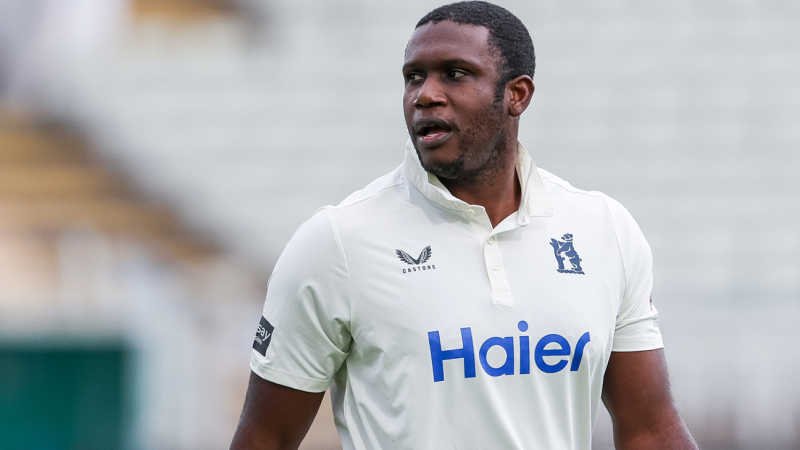
Keith Barker retirement marks the end of a remarkable journey built around versatility, resilience and sustained success in English domestic cricket. The left-arm seamer and left-handed batter has called time on his professional career at the age of 39 after a knee problem restricted him to only two County Championship appearances during his return to Warwickshire in 2026.
Barker’s decision closes a career that began with Warwickshire in 2009, included seven highly productive seasons with Hampshire, and ultimately brought him back to the club where his professional journey started. Across 171 first-class matches, he accumulated 5,554 runs at 28.33 and claimed 544 wickets at 25.00, including 23 five-wicket hauls.
His retirement is therefore more than the conclusion of another county career. Barker leaves behind the record of a genuine domestic allrounder who could influence matches with both bat and ball, while also overcoming injuries, career interruptions and the physical demands of almost two decades of professional cricket.
Why Keith Barker’s retirement matters to English county cricket
Barker’s career is particularly significant because players capable of making a substantial contribution in both disciplines are difficult to replace. His left-arm seam offered captains a different angle of attack, while his batting provided valuable lower-order runs.
That combination made him especially useful in first-class cricket, where the ability to contribute in multiple phases of a match can have an impact far beyond a simple batting or bowling average.
His numbers underline that contribution. Barker scored more than 5,500 first-class runs and took more than 500 wickets. The 544 wickets came at an average of exactly 25.00, while his 23 five-wicket hauls demonstrate that he was not merely a support bowler accumulating wickets over a long career.
He also made meaningful contributions in limited-overs cricket, taking 158 wickets across List A and T20 cricket and scoring more than 1,000 runs in white-ball competitions.
Keith Barker’s return to Warwickshire ends sooner than hoped
The final chapter of Barker’s career had a strong sense of nostalgia. After spending seven seasons with Hampshire, he returned to Warwickshire in 2026 on a 12-month contract, giving him the opportunity to finish his playing days at the club where his professional career had begun.
However, his body ultimately made the decision for him.
A knee injury severely restricted his availability, allowing him to play only two Championship matches during the season. His most recent appearance came in Warwickshire’s draw against Yorkshire at Scarborough in June.
For a cricketer who had spent years competing across long county seasons, the inability to regularly take the field understandably became an important factor in deciding whether continuing was realistic.
Barker acknowledged that tension in his retirement statement. Even at 39, he still wanted to compete and believed he could make a difference, but the accumulated physical toll of a long career and numerous injuries eventually forced him to accept that the time had come to stop.
A first-class record built on consistency
The headline statistics from Barker’s career show remarkable longevity. His 171 first-class appearances produced 5,554 runs and 544 wickets, giving him the profile of a player who contributed consistently rather than relying on a handful of exceptional seasons.
| Category | Keith Barker’s Career Record |
|---|---|
| First-class matches | 171 |
| First-class runs | 5,554 |
| First-class batting average | 28.33 |
| First-class centuries | 6 |
| First-class wickets | 544 |
| First-class bowling average | 25.00 |
| Five-wicket hauls | 23 |
The spells that defined Barker’s career
Some of Barker’s most memorable performances came when Warwickshire were competing for County Championship success. His best innings figures were 7 for 46 against Nottinghamshire in 2021.
He also produced match figures of 11 for 70 against Durham in 2012. Both seasons ultimately ended with Warwickshire winning the County Championship, adding extra significance to two of his standout bowling performances.
Those performances highlight what made Barker valuable. His left-arm pace could create problems for batters, particularly when conditions offered assistance, while his ability to contribute with the bat gave his team additional flexibility.
From football prospect to professional cricketer
Barker’s sporting background was not limited to cricket. Before committing fully to the game, he was a talented footballer and represented England at under-20 level.
His eventual decision to concentrate on cricket proved to be a defining moment. The result was a professional career spanning 17 seasons and two major county environments, with Warwickshire and Hampshire both playing important roles in his development.
His story is also a reminder of how unusual the path to professional cricket can be. Barker was not simply a specialist bowler who occasionally batted. His value came from developing two disciplines to a level that allowed him to remain relevant across different phases of his career.
Seven seasons at Hampshire added another chapter
After his initial spell at Warwickshire, Barker spent seven seasons with Hampshire. That period became an important part of his career and helped establish him as one of the more dependable allrounders in the English domestic game.
Although he eventually returned to Warwickshire, Barker made it clear that his Hampshire years remained hugely important to him. He credited the club with giving him lasting memories, friendships and experiences.
The move back to Warwickshire therefore should not be viewed as a rejection of Hampshire. Instead, it allowed Barker to complete a career journey that began in the same environment where he had first developed as a professional cricketer.
The difficult 2025 suspension
Barker’s career also contained a difficult period away from the field. In 2025, he received a 12-month backdated suspension after testing positive for a prohibited substance during a routine drugs test.
Warwickshire described the incident as an administrative error. Barker had been prescribed a like-for-like alternative for a longstanding medical condition, and the National Anti-Doping Panel found that he had not been seeking a competitive advantage.
The episode became another challenge in an already lengthy career, but Barker continued to receive support from the Professional Cricketers’ Association. In his retirement message, he specifically thanked the PCA for the assistance it provided, particularly during the difficult period surrounding the case.
Why Barker’s allrounder profile was so valuable
The modern county game demands players who can offer tactical flexibility. Barker’s left-arm seam bowling gave captains an option that could change the balance of an attack, while his left-handed batting added variety to the lower order.
His 544 first-class wickets are the clearest evidence of his bowling importance, but the 5,554 runs should not be overlooked. Six first-class centuries further demonstrate that he was capable of producing substantial contributions rather than merely surviving at the crease.
This is where Barker’s career offers an important lesson for younger county cricketers: versatility can extend a player’s value over a long period. When injuries or changes in team composition affect one discipline, the ability to contribute elsewhere can keep a player competitive.
What Barker’s retirement means for Warwickshire
Warwickshire now lose an experienced player who understood the club’s culture and had spent much of his cricketing life within its system. His departure creates both a playing vacancy and an experience gap.
Replacing 544 first-class wickets is obviously difficult, but replacing the combination of left-arm bowling, lower-order batting and extensive county experience may be even harder.
For Warwickshire, Barker’s retirement could therefore create an opportunity for younger players to take on greater responsibility. At the same time, the club will have to consider how best to replace the balance that a genuine allrounder provided.
A career shaped by resilience
The strongest theme running through Barker’s career is arguably resilience. He dealt with injuries, a career interruption and the physical demands of playing professional cricket into his late thirties.
Even after returning to Warwickshire in 2026, he was still prepared to compete despite his body increasingly limiting his opportunities. His decision to retire was therefore not about a lack of desire. Quite the opposite: his own words suggest that the desire to play remained strong.
That makes his retirement especially poignant. Professional athletes rarely leave because they suddenly stop loving their sport. Often, the hardest decision comes when the mind still wants to continue but the body can no longer meet the demands of the game.
Why finishing at Warwickshire carries special meaning
Barker described Warwickshire as a place where he grew not only as a cricketer but also as a person. He first came to the club in 2008 and made his debut in 2009.
Returning to the club for the final season of his career created a rare opportunity to close the circle. Rather than ending his playing days far from where his professional journey began, Barker was able to finish in the city and environment that had shaped much of his early life in cricket.
That sense of belonging is an important part of County Cricket‘s identity. Unlike franchise competitions, county clubs often build relationships with players that stretch across generations. Barker’s return is a strong example of that connection.
The legacy Keith Barker leaves behind
Barker will not be remembered simply for one spell, one season or one statistic. His legacy is built on the breadth of his contribution and his longevity.
More than 5,500 first-class runs, 544 wickets, 23 five-wicket hauls and six centuries represent a substantial body of work. His white-ball record adds another layer to a career that successfully crossed formats and eras.
Perhaps most importantly, Barker leaves professional cricket with the respect that comes from having repeatedly found ways to contribute. His career demonstrates that elite domestic cricket is not only about international selection or headline-making performances. It is also about reliability, adaptability and doing the difficult work required across long seasons.
What comes next for Keith Barker?
Barker has not indicated a detailed post-retirement career plan, so it would be premature to assume what his next professional step will be. However, his experience across two major county environments gives him a wealth of knowledge that could eventually prove valuable in coaching, player development or another cricket-related role.
His understanding of left-arm seam bowling, lower-order batting and the demands of county cricket could be particularly useful to younger players. Whether he chooses to remain closely involved in the sport or takes a different path, his experience will remain a valuable asset.
Conclusion
Keith Barker’s retirement brings an impressive 17-season professional career to a close. From his early days at Warwickshire to seven seasons with Hampshire and his emotional return to the Bears, Barker built a career defined by versatility and persistence.
His 171 first-class matches, 5,554 runs and 544 wickets tell the statistical story, while his battles with injury and his determination to continue competing provide the human story behind those numbers.
Retirement may have arrived sooner than Barker wanted, but finishing his career at Warwickshire gives the story a fitting ending. The player may now leave the field, but his contribution to English county cricket will remain part of the record for years to come.
For breaking news and live news updates, like us on Facebook or follow us on Twitter and Instagram. Read more on Latest Cricket on thefoxdaily.com.






COMMENTS 0