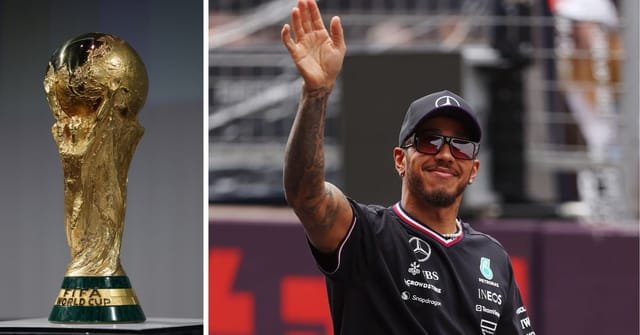
Introduction: The World’s Greatest Motorsport Driver Picks His Football Teams
Lewis Hamilton has spent his entire career transcending boundaries between racing disciplines, between cultures, between the narrow world of Formula One and the broader landscape of global sport and social consciousness. It should surprise nobody, then, that when it comes to international football’s biggest tournament, he refuses to choose just one team. The seven-time Formula One World Drivers’ Champion has declared that he will be supporting both Brazil and England at the 2026 FIFA World Cup a tournament that kicks off on June 12 across three host nations: the United States, Mexico, and Canada.
Speaking to reporters ahead of the Monaco Grand Prix, Hamilton opened up about a connection to Brazilian football that stretches back to his childhood in England and has deepened across decades into something that transcends a casual sports fan’s rooting interest. His words were simple, direct, and genuinely felt the kind of thing you say not to generate a headline but because it is true.
Who is saying this? Lewis Hamilton Ferrari racer, seven-time world champion, honorary Brazilian citizen, and arguably the most globally recognizable figure in Formula One history. What is he saying? That Brazil is tied with England as his team for the 2026 World Cup. When did he say it? Speaking to reporters ahead of the Monaco Grand Prix in 2026. Where does this tournament take place? The United States, Mexico, and Canada, beginning June 12. Why does his loyalty to Brazil run so deep? The answer to that question tells a story that is worth exploring in full.
The Brazil Connection: More Than Football, More Than Sport
Hamilton’s admiration for Brazil did not begin with football, though football is where it most publicly expresses itself. The deeper root is motorsport specifically, his profound reverence for Ayrton Senna, the late Brazilian racing legend and three-time Formula One World Champion whose career, personality, and tragic death at the 1994 San Marino Grand Prix left an imprint on the sport that has never faded.
Senna is, by most accounts, the single most influential figure in Lewis Hamilton’s racing life. The way Senna drove with absolute commitment, with a spiritual intensity that seemed to exist beyond the ordinary boundaries of competitive sport, with a willingness to place himself entirely in the hands of his talent and faith shaped Hamilton’s own approach to his craft. Hamilton has spoken about Senna’s influence across his entire career, and the emotional weight of that connection carries over into his relationship with Brazil as a country, as a culture, and as a sporting identity.
That connection became formally official in November 2022, when Hamilton was made an honorary Brazilian citizen a distinction that recognizes his affinity for the country and its people. It is not a common honor, and it is not one given lightly. For Hamilton, it formalized something that had already been true emotionally for years.
Speaking ahead of Monaco, Hamilton explained his football allegiance in terms that locate Brazil’s appeal not in trophies or tactics but in something fundamentally human:
“Growing up in England I used to love watching Brazil play. Honestly, Brazil’s always been my favourite team. They were so cool. For me, it’s [Brazil] tied with England. I just appreciate where they come from, many of the players come from the streets where they play with no shoes. There’s something quite special about Brazilian culture.”
Lewis Hamilton
That final observation “many of the players come from the streets where they play with no shoes” is the key to understanding the depth of Hamilton’s Brazilian identification. He is not simply admiring a football team’s style of play, though Brazil’s football history is replete with stylistic brilliance. He is speaking about social origins, about what it means to develop talent from circumstances of genuine hardship, about the journey from favela pitches to the global stage. As someone who grew up in Stevenage and navigated the predominantly white, economically exclusionary world of motorsport as a Black British driver, Hamilton understands something about what it means to come from somewhere the establishment did not expect you to come from and reach somewhere it did not expect you to go.
Hamilton’s England: The Native Country That Shares the Spotlight
Hamilton’s English identity is no less genuine for the attention his Brazilian affinity receives. Born and raised in Stevenage, Hertfordshire, he carries the Three Lions with him as his primary national allegiance the country that shaped him, the culture he grew up in, and the football team whose fortunes he has followed his entire life. England at a World Cup occupies a specific emotional space for every English person of Hamilton’s generation: the combination of genuine hope, learned caution, and the particular anguish of a nation that invented the game and has won it precisely once.
England in 2026 arrive at the tournament under the management of Thomas Tuchel, with a squad that has already generated considerable debate and not all of it favorable. The selection decisions made by Tuchel have raised eyebrows, with several high-profile names absent from the 26-man squad in ways that have prompted commentary from former players and current pundits alike.
England find themselves in Group L alongside Croatia, Ghana, and Panama a draw that presents both manageable opposition and the kind of organized, physically competitive tests that England historically find less comfortable than their talent levels might suggest.
| Team | Group | Group Stage Opponents | World Cup Titles |
|---|---|---|---|
| Brazil | Group C | Scotland, Morocco, Haiti | 5 (1958, 1962, 1970, 1994, 2002) |
| England | Group L | Croatia, Ghana, Panama | 1 (1966) |
Brazil at the 2026 World Cup: The Five-Time Champions Chasing History
For Hamilton’s first team even if only tied with England Brazil arrive at the 2026 World Cup carrying the weight of a nation’s impossible expectations and the memory of considerable recent heartbreak. The five-time champions, whose 1958, 1962, 1970, 1994, and 2002 titles span six decades of football history, have not lifted the trophy since their legendary 2002 triumph. For a country that considers international football success a near-birthright, the wait has been long and at times excruciating.
Brazil are placed in Group C alongside Scotland, Morocco, and Haiti a draw that gives them a clear path to the knockout stage while providing at least one test of genuine quality in the Moroccan side that has been one of Africa’s most impressive teams in recent years. Scotland and Haiti represent different challenges but neither should threaten Brazil’s progression on current form.
The Brazilian football identity that Hamilton identified in his comments the streets, the culture, the journey from nothing to everything runs through the current squad as it has through every Brazilian generation. The stylistic evolution of Brazilian football over the decades has moved it closer to European technical and tactical norms, but the foundational cultural identity remains: a country that produces footballers with an instinctive joy in the game that is shaped by those early years of improvised play in environments where no coach, no coaching manual, and no infrastructure existed.
The Cole Palmer Question: England’s Selection Controversy
While Hamilton’s football loyalties make for warm and culturally rich reading, the harder-edged conversation around England’s World Cup prospects has centered on selection specifically, who Thomas Tuchel left out of his 26-man squad and whether those decisions leave England weaker than they need to be.
Among the notable absentees are Phil Foden, Trent Alexander-Arnold, and Harry Maguire names that generate varying levels of controversy depending on the perspective of the commentator. But the absence that has attracted the most pointed analysis from former professionals is that of Cole Palmer.
Former Manchester United and Tottenham Hotspur striker Teddy Sheringham made his position clear, arguing that the 23-year-old Chelsea player should have been included in Tuchel’s squad:
“I probably would have chucked Cole Palmer into the squad as well just to say to him go on and give us that bit of trickery that we need, when we need it. He’s the kind of player that can open some doors no other players can. He’s been a big player in big games for Chelsea too.”
Teddy Sheringham
Sheringham elaborated on the specific tactical utility he sees in Palmer not necessarily as a guaranteed starter but as the kind of impact option whose particular skill set changes the game in ways that more conventional players cannot:
“He comes and he goes with his little flashes and that could have been the icing on the cake for England in certain games. In my view, Morgan Rogers is the only No. 10 in the England squad for what I’m looking for from a player in that position. Maybe that’s why you’d take Cole Palmer just to change it up when needed because they’re very different players.”
For players and fans alike, the 2026 edition will feel different from its predecessors bigger in every literal dimension, with more teams, more matches, and more stories competing for the world’s attention across the six weeks of competition. Lewis Hamilton, watching from wherever the Formula One calendar places him during those weeks, will be tracking two stories simultaneously: the five-time champions from the country that made him an honorary citizen, and the nation that shaped him from birth.
Conclusion: A Fan With Two Hearts, A Tournament With Room for Both
Lewis Hamilton’s World Cup allegiances are a window into a life lived across cultures, across sporting worlds, and across the kind of experiences that create loyalties too layered to be reduced to a single flag. His love for Brazil is about Senna and streets and the particular beauty of talent that emerges from hardship without losing its joy. His love for England is about home about Stevenage, about growing up watching the World Cup and feeling that particular English combination of hope and dread.
Both are genuine. Both are earned. And both will be tested beginning June 12, when the biggest tournament in world football opens across three nations and the world remembers, every four years, why the sport matters so much.
England need goals and coherence from a squad missing some of its most creative players. Brazil need to end a 24-year wait and remind the world why their football culture produced more champions than any other nation on earth. Hamilton will be watching both, feeling the pull of divided loyalty with the ease of someone who long ago decided that allegiances are not diminished by being shared.
The World Cup begins on June 12. Lewis Hamilton has two teams. The only question now is whether either of them gives him something to celebrate come July.</
For breaking news and live news updates, like us on Facebook or follow us on Twitter and Instagram. Read more on Latest Sports on thefoxdaily.com.






COMMENTS 0