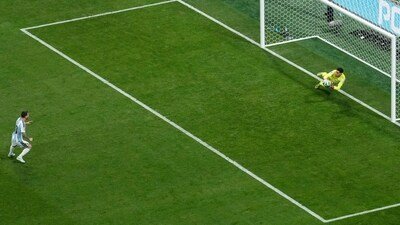
Few players in football history have achieved what Lionel Messi has accomplished. From record-breaking goal tallies and Ballon d’Or triumphs to World Cup glory and countless club trophies, the Argentine captain has built a legacy that may never be matched. Yet even the greatest athletes possess weaknesses, and during the 2026 FIFA World Cup, one particular aspect of Messi’s game has become impossible to ignore: penalties.
Following Argentina’s dramatic Round of 16 victory over Egypt, attention shifted away from Messi’s goal and assist and toward another missed penalty. The miss was not an isolated incident. Earlier in the tournament, Messi also failed to convert from the spot against Austria. The result is a remarkable and unexpected statistic: the greatest goalscorer in World Cup history now holds an unwanted record for penalty misses in a single tournament.
The discussion is no longer about one missed opportunity. It is about whether Argentina’s pursuit of another World Cup title could be jeopardized by continuing to rely on Messi as their primary penalty taker when alternative options may offer a higher conversion rate.
Why Messi’s Penalty Misses Have Become a Major Talking Point
Penalty kicks are among football’s most decisive moments. While they may appear straightforward, they often determine championships, knockout matches, and sporting legacies.
At the World Cup level, margins between success and failure are incredibly small. A missed penalty can instantly change the direction of a tournament.
Messi’s latest miss against Egypt gained attention because it followed a similar pattern to his earlier failure against Austria. In both situations, goalkeepers remained patient, resisted committing early, and forced Messi into making the first move.
Although Argentina ultimately won both matches, the misses have raised concerns about what might happen in a quarter-final, semi-final, or final where opportunities are scarce and mistakes become costly.
Messi’s Historic World Cup Legacy Remains Untouched
Before examining the penalty debate, it is important to understand the broader context.
Messi remains one of the most influential players in World Cup history. His goals, assists, leadership, and ability to perform under pressure have repeatedly carried Argentina through difficult moments.
In the 2026 tournament alone, he responded to both penalty misses by making decisive contributions in open play. Against Austria, he scored twice after missing from the spot. Against Egypt, he created a goal and scored another as Argentina recovered from a two-goal deficit.
This ability to recover from setbacks separates elite players from ordinary ones.
However, while Messi’s overall impact remains extraordinary, the penalty issue deserves attention because international tournaments are often decided by the smallest details.
Breaking Down Messi’s World Cup Penalty Record
Statistics can reveal trends that emotions often overlook.
Across six World Cup appearances, Messi has taken eight penalties during regular play.
| Category | Total |
|---|---|
| World Cup Penalties Taken | 8 |
| Scored | 4 |
| Missed | 4 |
| Conversion Rate | 50% |
A 50 percent conversion rate is surprisingly low for a player of Messi’s caliber.
For comparison, elite penalty specialists typically maintain success rates above 80 percent, while the very best often exceed 85 percent over long periods.
The numbers become even more significant when viewed through the lens of tournament football, where every missed opportunity can dramatically alter outcomes.
The Evolution of Penalty Taking in Modern Football
Penalty taking has changed dramatically over the last two decades.
In previous eras, success often depended on power and accuracy. Today, advanced analytics, video scouting, goalkeeper databases, and sports psychology have transformed the process.
Every major international team now studies opponents in extraordinary detail.
Goalkeepers review:
- Preferred shooting corners
- Run-up patterns
- Body positioning
- Shot placement tendencies
- Reaction under pressure
As a result, predictable habits become increasingly dangerous.
The challenge for penalty takers is no longer simply beating the goalkeeper. It is staying one step ahead of opponents who have spent hours analyzing every previous attempt.
Has Messi’s Unpredictability Become Predictable?
One of the most fascinating aspects of the current debate involves Messi’s famous penalty technique.
For years, Messi’s stop-start approach has been praised for keeping goalkeepers guessing. He frequently pauses during his run-up, attempting to force the goalkeeper into moving first.
When executed perfectly, the technique can be highly effective.
However, modern goalkeepers appear increasingly prepared.
Rather than diving early, opponents are beginning to remain patient and wait for Messi’s decision.
This tactical adjustment changes the entire equation.
If goalkeepers refuse to react first, Messi loses one of the primary advantages built into his routine. The contest becomes less about deception and more about shot placement.
That shift may explain why several recent penalty attempts have looked strikingly similar despite being taken against different opponents.
The Data Behind the Debate
Advanced football analytics reveal an interesting pattern.
While Messi frequently changes his run-up speed, body language, and striking technique, many of his penalties ultimately end up in similar areas of the goal.
This creates a paradox.
His preparation appears unpredictable, but the final destination of the ball may be more predictable than many realize.
For goalkeepers armed with extensive video analysis, identifying these tendencies becomes significantly easier.
At the highest level of football, even small patterns can become valuable information.
A goalkeeper who correctly anticipates a preferred zone gains a substantial advantage before the shot is even taken.
How Elite Penalty Specialists Approach the Situation Differently
Several modern players have developed exceptionally reliable methods from the penalty spot.
Rather than constantly changing their target area, many focus on consistency.
The philosophy is simple: place the ball accurately enough, and the goalkeeper cannot stop it regardless of whether they know where it is going.
This approach emphasizes:
- Repeatable mechanics
- Confidence under pressure
- Power and placement
- Mental composure
- Clear decision-making
The best penalty takers often remove uncertainty from their own process. Instead of reacting to the goalkeeper, they trust a rehearsed routine developed through thousands of repetitions.
This consistency is one reason why some specialists maintain remarkably high conversion rates throughout their careers.
Why Argentina Faces a Difficult Decision
The challenge for Argentina is not purely statistical.
If football decisions were based solely on numbers, selecting a penalty taker would be straightforward.
Instead, the issue involves leadership, psychology, team dynamics, and trust.
Messi is not merely another player in the squad. He is the captain, the emotional leader, and the focal point of Argentina’s attack.
Removing penalty responsibilities from such a figure could create unintended consequences.
At the same time, tournament football demands ruthless efficiency.
If another penalty arrives in a World Cup semi-final or final, Argentina must decide whether sentiment or probability offers the better path toward victory.
Julian Alvarez Emerging as a Strong Alternative
One player increasingly mentioned in discussions is Julian Alvarez.
The Argentine forward has developed a reputation as a calm and reliable finisher from the penalty spot.
His conversion numbers compare favorably with many elite strikers across world football.
| Player | Career Penalties | Scored | Success Rate |
|---|---|---|---|
| Julian Alvarez | 19 | 17 | 89%+ |
| Lionel Messi | 150 | 116 | 77%+ |
While sample sizes differ significantly, Alvarez’s record suggests he possesses the technical and psychological qualities necessary to handle pressure situations.
The question is whether Argentina’s coaching staff would trust him with the responsibility when the stakes are highest.
The Psychological Side of Penalty Taking
Penalty kicks are often described as mental battles disguised as technical exercises.
The pressure is enormous.
Millions of viewers watch. Entire nations hold their breath. One moment can define careers.
Elite players succeed because they can manage this pressure more effectively than others.
Messi has demonstrated remarkable mental strength throughout his career. Yet even the most experienced athletes are vulnerable to confidence fluctuations.
Repeated misses can subtly influence future decision-making, timing, and execution.
That does not necessarily mean Messi lacks confidence. However, opponents may enter future penalty situations believing they have identified a vulnerability.
In elite sport, perception alone can alter outcomes.
Could Argentina Use a Situational Approach?
One potential solution is flexibility.
Rather than permanently removing Messi from penalty duties, Argentina could adopt a situational strategy.
For example:
- Messi remains first choice during open matches.
- Alvarez handles penalties when statistical matchups favor him.
- Specific opponents trigger different selections.
- Penalty shootout responsibilities remain separate from in-game penalties.
Such an approach would allow Argentina to maximize strengths while minimizing risk.
Modern football increasingly embraces data-driven decision-making, making this type of tactical flexibility more realistic than ever before.
What Opponents Are Learning From Messi’s Misses
Every match provides new information.
Opposing coaches, analysts, and goalkeepers will undoubtedly study Messi’s recent penalties in detail.
The lessons are clear.
Patience can be effective. Remaining stationary longer may force Messi into committing first. Understanding preferred shooting zones can increase the likelihood of a save.
Whether these observations lead to future success remains uncertain, but one reality is undeniable: every missed penalty adds valuable data for future opponents.
Why This Debate Matters Beyond One Tournament
The discussion surrounding Messi’s penalties extends beyond the 2026 World Cup.
It highlights a broader truth about elite sport.
Greatness does not eliminate weaknesses. In fact, the higher an athlete climbs, the more closely every weakness is examined.
Messi’s extraordinary achievements have raised expectations to unprecedented levels. Consequently, even relatively minor flaws become global talking points.
Few players in history have faced such intense scrutiny while maintaining such exceptional performance standards.
Conclusion
Lionel Messi remains the heartbeat of Argentina’s World Cup campaign. His creativity, leadership, vision, and goals continue to make the difference when his nation needs him most. Yet the numbers surrounding his recent penalty performances cannot be ignored.
Two missed penalties in the same tournament have reignited an important debate about risk management, strategy, and decision-making at football’s highest level. While Messi has repeatedly rescued Argentina after those misses, knockout football rarely offers unlimited second chances.
As Argentina advances deeper into the World Cup, coach Lionel Scaloni faces a fascinating dilemma. Continue trusting one of the greatest footballers in history from 12 yards, or consider alternative options with stronger recent conversion records.
The answer could become one of the defining tactical decisions of the tournament. And if Argentina eventually lifts another World Cup trophy, how they handle future penalties may prove just as important as any goal scored from open play.
For breaking news and live news updates, like us on Facebook or follow us on Twitter and Instagram. Read more on Latest Sports on thefoxdaily.com.






COMMENTS 0