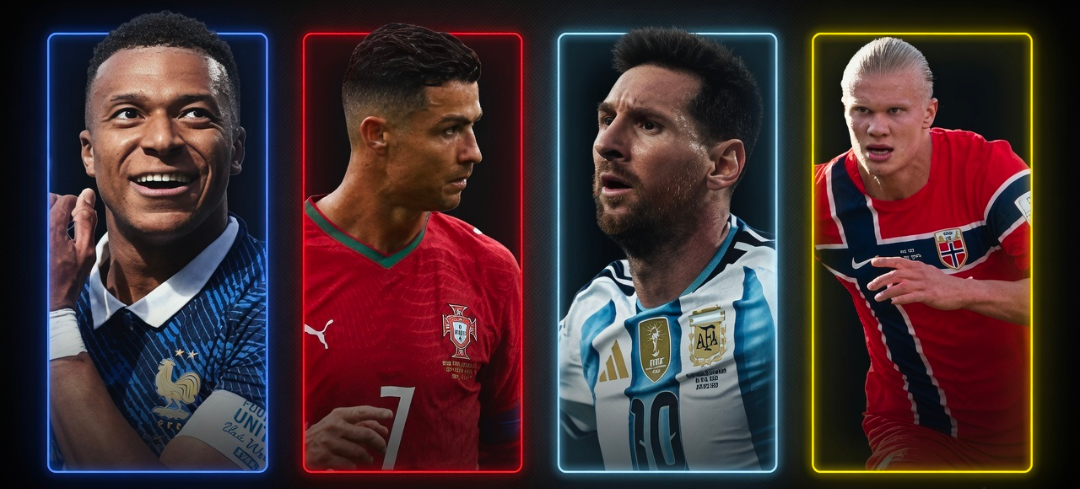
The opening week of the 2026 FIFA World Cup has already offered a fascinating glimpse into Football‘s evolving hierarchy. Four global superstars arrived at the tournament carrying vastly different expectations, yet all were united by one question: who will define this World Cup?
Lionel Messi and cristiano Ronaldo entered unprecedented territory by appearing in their sixth FIFA World Cup. Kylian Mbappe arrived as the game’s most feared tournament performer, while Erling haaland finally stepped onto football’s grandest stage after Norway’s long absence from the competition.
Their opening matches produced four distinct narratives that could shape the rest of the tournament. Messi reminded the world that greatness can age gracefully. Mbappe reinforced his reputation as football’s ultimate World Cup weapon. Haaland translated his club dominance onto the international stage. Ronaldo, meanwhile, faced difficult questions about whether his influence now extends beyond statistics and symbolism.
The Numbers Behind the Opening Performances
Statistics rarely tell the complete story in football, but they often provide the first clues about a player’s impact.
| Player | Opponent | Result | Goals | Assists | Key Narrative |
|---|---|---|---|---|---|
| Lionel Messi | Algeria | Argentina 3-0 Algeria | 3 | 0 | First World Cup hat-trick and historic milestone |
| Kylian Mbappe | Senegal | France 3-1 Senegal | 2 | 0 | Delivered decisive goals under pressure |
| Erling Haaland | Iraq | Norway 4-1 Iraq | 2 | 0 | Dominant World Cup debut performance |
| Cristiano Ronaldo | DR Congo | Portugal 1-1 DR Congo | 0 | 0 | Historic appearance overshadowed by missed chances |
While the numbers favor Messi, context reveals why each performance carried a different level of significance.
Lionel Messi: Legacy and Performance Converge
Argentina’s 3-0 victory over Algeria belonged entirely to Messi.
On his 200th appearance for Argentina, the 39-year-old delivered his first World Cup hat-trick, moving level with the men’s all-time World Cup scoring record. More importantly, he controlled the tempo, dictated attacking patterns, and demonstrated that his influence extends far beyond finishing chances.
For years, critics have questioned whether age would eventually limit Messi’s ability to dominate entire matches. against Algeria, he provided a definitive answer.
This was not a case of a veteran player producing isolated moments of brilliance. Messi was the driving force behind everything Argentina created in attack.
The performance also highlighted an important tactical evolution. Rather than relying on explosive acceleration, Messi now dominates through positioning, anticipation, and decision-making. His understanding of space remains unmatched, allowing him to impact games in ways younger players often cannot.
In a tournament where momentum can define champions, Messi has already placed himself at the center of the early narrative.
Kylian Mbappe: The World Cup Specialist
Every generation produces players who seem uniquely suited to football’s biggest stage. For this era, that player is Mbappe.
France’s 3-1 victory over Senegal was more competitive than the final score suggests. When Senegal reduced the deficit and threatened a comeback, Mbappe responded with the decisive goal that effectively ended the contest.
That ability to deliver in high-pressure moments separates great players from elite tournament performers.
Mbappe combines explosive pace, intelligent movement, and ruthless finishing with an unusual comfort under pressure. While many players feel the burden of World Cup expectations, Mbappe appears energized by them.
At an age when most forwards are still developing consistency, he is already building one of the greatest World Cup résumés in modern football.
If France are to defend their title ambitions deep into the knockout rounds, Mbappe will almost certainly remain their most important player.
Erling Haaland: A Debut Worth Waiting For
For years, football fans wondered how Haaland’s extraordinary club form would translate to international football’s biggest stage.
Against Iraq, the Norwegian striker answered that question emphatically.
His two first-half goals in Norway’s 4-1 victory showcased everything that makes him one of the world’s most feared forwards: physical dominance, intelligent positioning, and clinical finishing.
Unlike Messi and Ronaldo, Haaland arrived at this World Cup without the weight of previous tournament expectations. His challenge was different.
Could he replicate his club-level efficiency while carrying the hopes of an entire nation?
The answer was immediate and convincing.
Perhaps the most impressive aspect of Haaland’s performance was its simplicity. He did not attempt to overcomplicate his role or force spectacular moments. Instead, he focused on what elite strikers do best: creating space, finding opportunities, and converting chances.
For Norway, his goals could mark the beginning of a memorable campaign.
Cristiano Ronaldo: History Meets Present Reality
Ronaldo’s opening match against DR Congo was historic before the first whistle even blew.
At 41, he became one of the few players to appear in six FIFA World Cups, extending a legacy that has already reshaped modern football.
Yet football has always been a sport that prioritizes current performance over past achievements.
Portugal’s 1-1 draw exposed a difficult reality. Ronaldo’s influence remains significant, but his role has evolved dramatically.
He no longer dictates matches through constant movement or sustained involvement in build-up play. Instead, his value depends heavily on efficiency inside the penalty area.
Against DR Congo, that efficiency was missing.
He failed to score, did not register an assist, and missed presentable opportunities. Portugal managed just one shot on target throughout the match, raising questions about whether the team remains overly dependent on Ronaldo’s presence.
The challenge for Portugal is not whether Ronaldo should play. It is how the team can maximize his strengths while minimizing the physical limitations that naturally accompany age.
His experience, leadership, and mentality remain invaluable. However, tournament football often demands more than reputation alone.
What These Performances Reveal About Football’s Changing Era
The opening week of the 2026 FIFA World Cup highlighted a fascinating transition between generations.
Messi and Ronaldo continue to command global attention, but their journeys are heading in different directions. Messi appears to have adapted his game seamlessly to the realities of aging, while Ronaldo faces increasing scrutiny over his ability to influence matches consistently.
Meanwhile, Mbappe and Haaland represent the future.
They are entering their prime years with the potential to dominate international football for the next decade.
What makes this tournament particularly compelling is that it offers a rare overlap between two iconic eras.
Fans are witnessing the final chapters of Messi and Ronaldo’s extraordinary rivalry while simultaneously watching Mbappe and Haaland establish their own legacies.
Who Made the Biggest Statement?
Based purely on opening-match impact, the ranking is difficult to dispute.
- 1. Lionel Messi: A hat-trick, a historic milestone, and complete control of Argentina’s victory.
- 2. Kylian Mbappe: Two crucial goals that demonstrated his ability to deliver under pressure.
- 3. Erling Haaland: A commanding World Cup debut that confirmed his elite status.
- 4. Cristiano Ronaldo: A historic appearance overshadowed by an underwhelming performance.
However, World Cups are not won in the opening week.
Momentum can shift quickly, narratives can change overnight, and players who struggle early often recover to define tournaments.
Looking Ahead: What Comes Next?
Messi has reignited belief that Argentina can challenge for another title. Mbappe has reinforced France’s status among the tournament favorites. Haaland has given Norway genuine hope of advancing deep into the competition.
For Ronaldo and Portugal, the path forward may prove more complicated.
The coming matches will determine whether the opening draw was a temporary setback or an early warning sign.
One thing is already certain: the 2026 FIFA World Cup is not simply a battle between nations. It is also a contest between generations, legacies, and contrasting styles of greatness.
And after just one round of matches, the race to define this World Cup has only just begun.
For breaking news and live news updates, like us on Facebook or follow us on Twitter and Instagram. Read more on Latest Sports on thefoxdaily.com.



COMMENTS 0