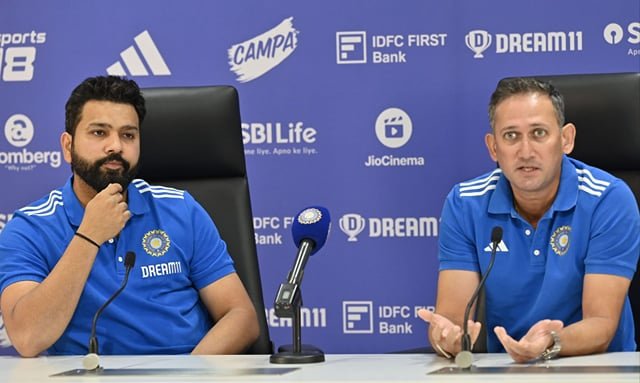
India are preparing to host the West Indies for a three-match ODI series, but the build-up to the contest has also brought renewed discussion around the major decisions that shaped the Indian white-ball setup. Former India batter and IPL winner Mohammad Kaif has offered his assessment of one of the biggest calls of the recent transition: Rohit Sharma’s removal as ODI captain.
Kaif argued that ending Rohit’s tenure as India’s ODI captain after the veteran batter had led the team to the 2025 Champions Trophy title was arguably the toughest decision made during Ajit Agarkar’s tenure as chief selector. His comments came while discussing the wider changes in India’s leadership and selection structure.
Mohammad Kaif Says Rohit Sharma’s Removal Was a Particularly Difficult Call
Rohit Sharma’s ODI captaincy came under the spotlight after India’s successful 2025 Champions Trophy campaign. The veteran opener had already established a significant record as India’s white-ball leader, and his captaincy was closely associated with the team’s aggressive approach in limited-overs cricket.
According to Kaif, the timing of the decision made Rohit’s removal especially difficult. India had just achieved success in a major ICC tournament, meaning the selectors had to consider the balance between the immediate results delivered by an experienced captain and the need to prepare the team for the next phase.
Kaif compared the situation with Gautam Gambhir’s recent comments about Sanju Samson. While Gambhir had described Samson’s omission as one of the toughest calls, Kaif felt the decision involving Rohit carried an even greater weight because of what had happened immediately beforehand.
Speaking on his YouTube channel, Kaif said:
“I think the most difficult call was dropping Rohit as captain after he won the Champions Trophy, not dropping Samson, as Gambhir said. If you ask him, maybe Agarkar will say this was the toughest call.”
Kaif also mentioned Suryakumar Yadav, pointing out that his position was another difficult decision after India’s T20 World Cup success. The former batter therefore identified the treatment of Rohit and the transition involving Suryakumar as two particularly significant calls during Agarkar’s tenure.
Rohit Sharma’s Captaincy Record Remains a Major Part of the Debate
The discussion around Rohit is not simply about one selection decision. It is also connected to the broader question of how India manages transitions after successful tournament campaigns.
Rohit became India’s white-ball captain during a period when the team was looking for greater consistency in leadership. His tenure included several major ICC campaigns and eventually culminated in Champions Trophy success. That achievement strengthened the argument that his leadership still had value in the short term.
At the same time, international teams have to plan beyond individual tournaments. Selectors must consider age profiles, future competitions, leadership succession and the development of players who could carry the team forward.
That makes a captaincy transition more complicated than simply judging a player on the basis of the previous tournament. Kaif’s argument focuses specifically on the difficulty of making such a call immediately after a major trophy win.
Ajit Agarkar’s Future Adds Another Layer to the Discussion
Kaif’s comments also come at a time when there is uncertainty surrounding the future of India’s senior men’s selection committee. According to the report, current chief selector Ajit Agarkar is expected to complete his tenure on October 4 and is reportedly not seeking an extension.
The BCCI has not yet announced Agarkar’s successor. That means the next selection committee could inherit a team that is already in the middle of a significant leadership and personnel transition.
Whoever takes over the role will have to deal with several long-term questions. These include the succession of established players, the emergence of younger talent, the balance between experience and potential, and the construction of India’s white-ball squads for upcoming international assignments.
Kaif, however, believes the next selector could benefit from the depth available in Indian cricket. In his view, the strength of the domestic system means the incoming decision-makers will have a large pool of players to choose from.
Kaif Credits the IPL for Strengthening India’s Player Pool
One of the strongest points in Kaif’s assessment was his praise for the Indian Premier League and the wider domestic cricket structure.
He argued that the IPL has changed the pathway through which Indian players gain exposure to high-pressure cricket. Players now regularly share dressing rooms with international stars and face some of the world’s most established bowlers before making the jump to international cricket.
Kaif believes that experience has reduced the psychological gap that once existed between domestic cricket and international cricket.
He explained that when Indian batters succeed against elite overseas bowlers in the IPL, they can carry that confidence into international matches. In his view, facing prominent international names in a familiar competitive environment makes the eventual transition to India duty less intimidating.
Kaif described the IPL as a “bridge” between domestic and international cricket, highlighting how the tournament has changed the development pathway for Indian players.
Why the IPL Has Become an Important Part of India’s Cricket Pipeline
The Indian Premier League was inaugurated in 2008 and has developed into one of the most prominent T20 franchise competitions in the world. Its importance to Indian cricket extends beyond entertainment and franchise results.
For emerging Indian players, the tournament provides an opportunity to play alongside and against established international cricketers. It also exposes them to different tactical approaches, coaching systems and high-pressure match situations.
This has created a much wider pool of players capable of stepping into international cricket.
That depth can be particularly valuable for selectors. When injuries, workload management or changes in form affect established players, the national team has more alternatives available than it did in previous generations.
Kaif’s comments therefore point toward a broader transformation in Indian cricket: the national team is increasingly supported by a large competitive ecosystem rather than depending exclusively on a small group of established names.
India’s White-Ball Depth Could Make Selection More Complicated
Greater depth is an advantage for Indian cricket, but it can also make selection decisions more difficult.
When several players are performing well, selectors have to make choices involving players with strong domestic or franchise records. A player can be performing consistently in one format while still finding himself outside the international XI because another player fits the team’s tactical requirements.
This is especially relevant in ODI cricket, where teams need a combination of batting depth, bowling options, fielding ability and players capable of handling different phases of a 50-over innings.
Rohit’s situation illustrates another side of the same problem. A successful established captain can remain highly valuable while selectors simultaneously begin planning for the next generation of leadership.
That transition requires difficult calls, particularly when recent results do not provide an obvious reason to make immediate changes.
India vs West Indies: Three-Match ODI Series Schedule
The discussion surrounding Rohit comes just before India begin their three-match ODI series against the West Indies. The series is scheduled to take place between September 27 and October 3.
| Match | Date | Venue |
|---|---|---|
| 1st ODI | September 27, 2026 | Thiruvananthapuram |
| 2nd ODI | September 30, 2026 | India |
| 3rd ODI | October 3, 2026 | India |
The opening match is scheduled for September 27 in Thiruvananthapuram, with the second ODI following on September 30 and the final game on October 3.
For India, the series represents another opportunity to build continuity in the ODI setup. With leadership and selection decisions continuing to attract attention, performances from established players and emerging contenders could influence future squad combinations.
Rohit Sharma’s Legacy Remains Part of India’s ODI Transition
Regardless of how the captaincy transition is viewed, Rohit Sharma’s contribution to Indian white-ball cricket remains an important part of the conversation.
His leadership period featured an aggressive batting philosophy and a team structure designed to attack opposition bowling early. His captaincy also overlapped with a period in which India regularly entered major international tournaments among the teams expected to compete for trophies.
The Champions Trophy victory added a significant achievement to that period. That is precisely why Kaif considers the subsequent decision to move away from Rohit as captain particularly difficult.
Transitions are often easier to explain when a team is struggling or when results have clearly declined. They can be considerably more complicated when a captain has recently delivered silverware.
What Kaif’s Comments Say About India’s Next Phase
Kaif’s wider argument is that the Indian cricket system has reached a stage where the national team can continue producing strong options even when major personnel changes take place.
He suggested that the strength of the player pool gives future selectors, coaches and captains a strong foundation. His assessment was particularly focused on white-ball cricket, where the IPL has provided players with regular exposure to pressure and international competition.
However, having a deep pool of talent does not eliminate the difficulty of selection. Instead, it can increase competition for places and make decisions involving senior players more closely scrutinized.
The Rohit Sharma captaincy transition is an example of that challenge. The selectors had to balance the value of an experienced leader against the longer-term requirements of Indian ODI cricket.
Final Verdict
Mohammad Kaif’s comments place Rohit Sharma’s ODI captaincy exit within the larger story of India’s transition from one generation of leadership to another. His argument is that moving away from a captain immediately after a Champions Trophy triumph represented an especially difficult decision.
The discussion also highlights how dramatically India’s cricket ecosystem has changed since the IPL began in 2008. With a deeper pool of players gaining high-pressure experience, selectors have more options than ever before, even though choosing between those options can become increasingly complicated.
As India begin their three-match ODI series against the West Indies, the focus will now shift from past selection decisions to the team’s current direction. The performances during the series could provide another indication of how the next phase of Indian ODI cricket is taking shape.
For breaking news and live news updates, like us on Facebook or follow us on Twitter and Instagram. Read more on Latest Cricket on thefoxdaily.com.






COMMENTS 0